
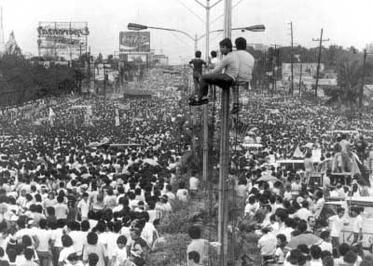
On February 25, 2026, the Philippines marks the 40th anniversary of the EDSA People Power Uprising, the four-day mobilization from February 22 to 25, 1986, that forced the strongman Ferdinand Marcos Sr. from Malacañang and installed Corazon Aquino in his stead. The event, now canonized in textbooks and commemorations, is frequently invoked as a triumph of democratic will and thus interpreted as proof that unarmed citizens can bend the arc of history.
Yet four decades on, a more unsettling question intrudes: if EDSA was the decisive rupture it is said to be, how did the Philippines arrive at a political moment in which Bongbong Marcos, son of the deposed dictator, occupies the presidency, alongside Sara Duterte, heir to another formidable political dynasty? The restoration, many argue, is complete.
To commemorate EDSA honestly in 2026 is not to rehearse its mythology, but to interrogate its limits.
Insurrection, Not Revolution
The language of “People Power” suggests a revolution considered as a foundational reordering of the political and social contract. But EDSA was, more precisely, an insurrection: a dramatic and morally potent uprising that removed a ruler without dismantling the architecture that enabled his rule.
The dictator fell. The system did not.
Political dynasties endured. Patronage networks persisted. Oligarchic dominance remained intact. The coercive and extractive logics of Philippine politics survived the transition. In this light, EDSA did not inaugurate a new order; it rearranged the furniture of the elite.
The romanticization of EDSA by elevating it to near-sacred status has often served as a substitute for deeper structural reform. Annual commemorations risk becoming ritualistic absolution, obscuring the harder truth that the uprising did not decisively transform the political economy that sustains dynastic rule.
The Phantom of Accountability
The ascent of Marcos Jr. and Duterte is not merely the product of political maneuvering, though maneuver they certainly have. It is also the consequence of a system in which accountability is spectral, i.e., invoked rhetorically but rarely enforced institutionally.
To interrogate their mandate is to confront an uncomfortable premise: a politically underdeveloped electorate, susceptible to disinformation, nostalgia, and the transactional allure of patronage politics. Despite the global transformations of the 21st century characterized by digital connectivity, expanded education, and economic integration, the aggregate Filipino voter has not undergone a parallel maturation in civic consciousness.
This is not a condemnation of individual citizens so much as an indictment of the structural conditions that shape political subjectivity. Decades of underinvestment in civic education, endemic inequality, weak party systems, and a media ecosystem vulnerable to manipulation have conspired to produce an electorate that is mobilized episodically but rarely empowered systematically.
In such an environment, dynastic recurrence is not an aberration; it is an inevitability.
The Restoration
The presence of a Marcos once again in Malacañang is rich with historical irony. It exposes the fragility of memory and the permeability of historical narrative. The son’s electoral victory did not occur in defiance of democratic procedure but through it. It is an outcome that complicates any simplistic dichotomy between dictatorship and democracy.
If EDSA’s promise was the institutionalization of democratic norms, then the return of the Marcos name to the presidency suggests that those norms were never fully consolidated. Memory alone cannot substitute for reform. Commemoration cannot replace transformation.
The restoration is not merely symbolic. It signals the resilience of a political culture anchored in personality, dynasty, and patronage rather than programmatic ideology or policy continuity. It underscores how easily democratic mechanisms can be harnessed to reproduce entrenched power.
The Myth of Incrementalism
Forty years after EDSA, incremental reform appears exhausted. Anti-dynasty provisions languish. Party systems remain weak and personality-driven. Campaign finance transparency is porous. Disinformation spreads with algorithmic efficiency.
The Philippines requires more than technocratic tinkering. It demands a radical recalibration of its democratic trajectory that addresses structural inequities and institutional frailties rather than celebrating episodic uprisings.
Such recalibration might include:
- Enforceable anti-dynasty legislation to disrupt hereditary monopolies of power.
- Comprehensive civic education reform to cultivate critical political literacy.
- Robust campaign finance regulation to sever the nexus between wealth and electoral viability.
- Strengthened party development to replace personality cults with programmatic platforms.
- Institutional safeguards against digital disinformation.
None of these measures are revolutionary in the romantic sense. Yet collectively, they would constitute a deeper transformation than the events of February 1986.
Beyond Hagiography
To cease the hagiography of EDSA is not to diminish the courage of those who gathered along Epifanio de los Santos Avenue in 1986. It is to honor them by confronting the unfinished work their uprising revealed.
The essential inquiry of 2026 is not whether EDSA mattered. It did. It prevented bloodshed on a potentially catastrophic scale and re-opened democratic space. But its singular significance must be measured against its structural aftermath.
Did it fundamentally alter the Philippine political climate? Or did it simply dislodge one strongman while preserving the conditions for his lineage and others like it to return?
Forty years later, the anniversary should not be a tableau of yellow ribbons and nostalgic slogans. It should be an inflection point: a moment to acknowledge that insurrection without institutional transformation is insufficient.
If the Philippines is to escape the cycle of dynastic recurrence, it must move beyond symbolic catharsis toward systemic reconstruction. The democratic maturation of the nation cannot be postponed indefinitely. History has demonstrated that when structural failure goes unaddressed, restoration follows revolution.
The lesson of EDSA at 40 is stark: the work of democracy is not completed by a single uprising. It is either continuously deepened or quietly undone.
*
Click the share button below to email/forward this article. Follow us on Instagram and X and subscribe to our Telegram Channel. Feel free to repost Global Research articles with proper attribution.
Prof. Ruel F. Pepa is a Filipino philosopher based in Madrid, Spain. A retired academic (Associate Professor IV), he taught Philosophy and Social Sciences for more than fifteen years at Trinity University of Asia, an Anglican university in the Philippines. He is a Research Associate of the Centre for Research on Globalization (CRG).
Featured image: An iconic photo of the People Power Revolution in the Philippines in February 1986 showing hundreds of thousands of people filling up Epifanio delos Santos Avenue (EDSA). The view is looking northbound towards the Boni Serrano Avenue-EDSA intersection. (Photo taken by Joey de Vera / Fair Use)
Global Research is a reader-funded media. We do not accept any funding from corporations or governments. Help us stay afloat. Click the image below to make a one-time or recurring donation.