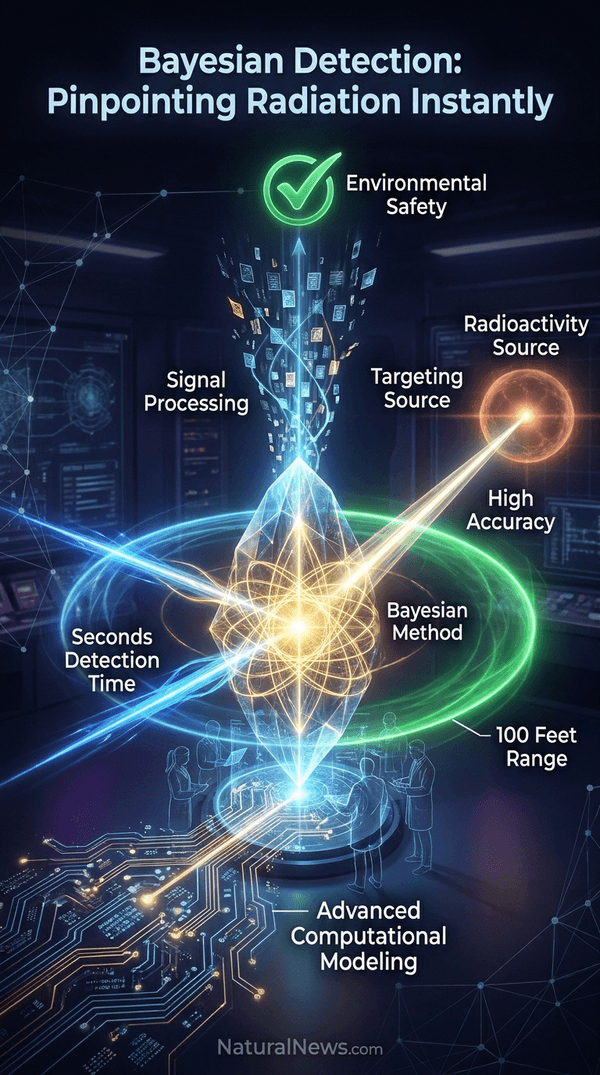
The system is capable of locating a radioactive source within 6.6 feet (two meters) and measuring its activity within two percentage points during the brief flyover, according to the report [2].
How the Bayesian Method Works
The approach applies Bayesian statistical inference to data collected by radiation sensors aboard an aircraft. Bayesian methods combine prior knowledge about a system with new measurements to update estimates of the probability that a radioactive source is present, according to the book Learning Bayesian Models with R [3].
In the airborne detection method, prior information about background radiation and the expected signature of a radioactive source is combined with measured gamma-ray signals to estimate both the source's location and its activity level. The method's developers reported that the Bayesian framework allowed them to extract meaningful estimates from a very short measurement window, according to the report [1][2].
The researchers reported that the technique produced accurate source identification during the six-second flyover.
Potential Uses and Limits
Potential applications cited in the report include emergency response, security screening and environmental monitoring.
The report did not disclose field deployment timelines or independent verification results. The study's findings were based on a helicopter flyover scenario, and the researchers indicated that further testing would be required before the method could be used in operational settings [2][4].
The developers said the method could be integrated into existing airborne radiation monitoring programs.
Context for Radiation Detection
Conventional radiation detection methods often require proximity to the source or longer measurement periods. Handheld survey meters, for example, typically measure radiation present and provide numerical readings in units such as counts per minute or microroentgen per hour, according to the United States.
Aerial monitoring programs such as the Environmental Protection Agency's RadNet use fixed air monitors to collect near-real-time measurements of gamma radiation. RadNet operates 140 radiation air monitors in 50 states, running 24 hours a day, seven days a week, according to the EPA [5].
The reported Bayesian approach differs by using statistical modeling to interpret sensor readings from a brief flyover.
Conclusion
The report did not indicate that the method has been independently verified or approved for operational use.
The researchers presented the method as a computational advance in airborne radiation detection.
References
- US method identifies radioactivity from 100-feet above in .... https://interestingengineering.com/innovation/us-bayesian-detect-radioactivity
- US team's new method detects radioactivity from 100-feet above in seconds. https://article.wn.com/view-lemonde/2026/10/27/US_team_s_new_method_detects_radioactivity_from_100feet_abov/
- Learning Bayesian Models with R. by Dr Hari M Koduvely
- Detecting Radioactivity From the Air – More Accurately .... https://www.newswise.com/articles/detecting-radioactivity-from-the-air-more-accurately-than-ever/?ad2f=1&aid=857390
- RadNet | US EPA - U.S. Environmental Protection Agency. https://www.epa.gov/radnet
Explainer Infographic
Source link