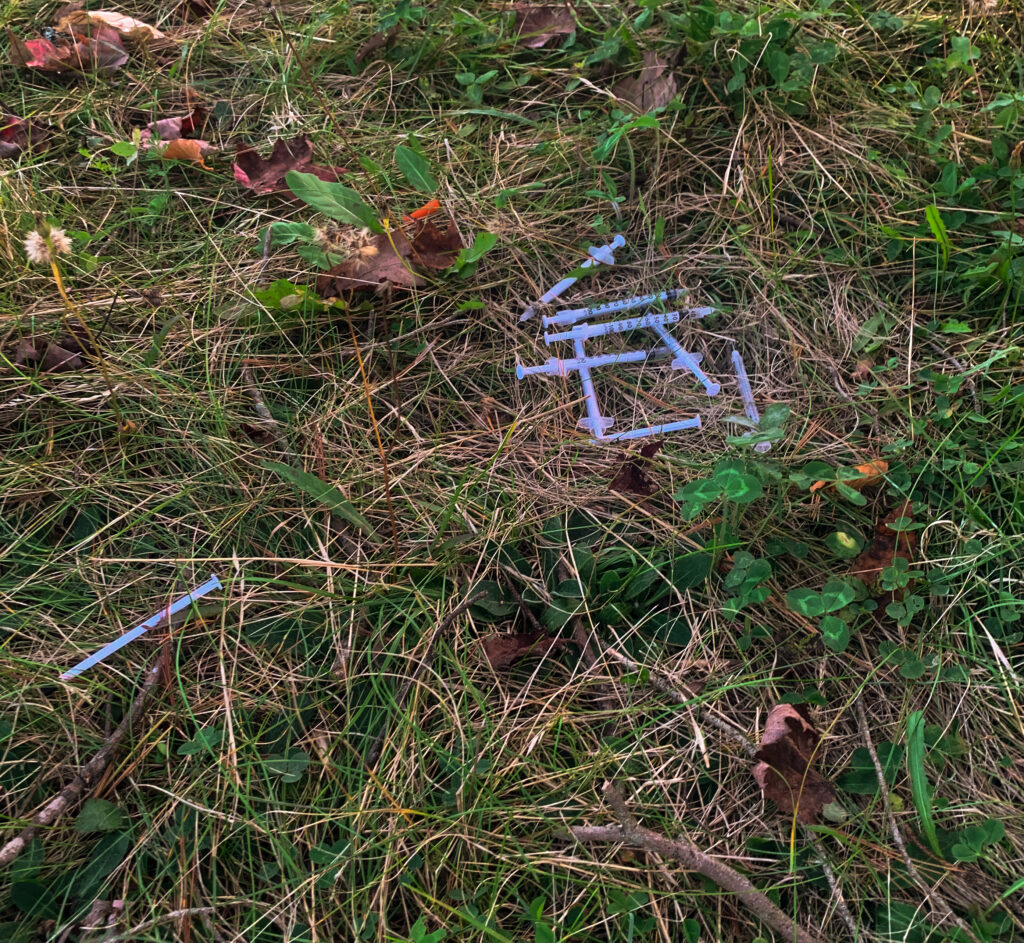
Bangor's overdoses are skyrocketing, and its drug-related death rate has risen 55% since 2024, while the rest of the state has seen its rate decline. It is at nearly six times the rate of the rest of the state.
For over two years, the city has heard its residents complain about uncapped, dirty needles left in public places and strewn along the river by the railroad tracks. The city's public health director, Jennifer Gunderman, told WABI this past October that it is "hard not to default to, well, what we're doing isn't working," but that the city should "build upon our successes."
Many of the progressive solutions in the middle of this disaster have come before the Legislature: needle exchanges (which are really handouts), sanctioned injection sites, more subsidized methadone and Suboxone, and the Good Samaritan law that protects you (if you overdose or your friends call 911, nobody gets charged for the drugs).
I reviewed the votes recorded from 2019 through 2025 by policymakers from Bangor, Brewer, Portland, South Portland, Westbrook, Lewiston, Auburn, Augusta, Waterville, Biddeford, Saco and Sanford. I won't tie any vote to a death, but the history will show what the lawmakers chose as Bangor's deaths climbed.
When it's about giving out needles, Democrats always seem to vote to keep Maine's syringe programs running and, in most cases, expand them, while Republicans usually vote for more restrictions and against expanding the needle handouts. When the House voted in 2025 on a bill requiring these needle "exchanges" to get a used syringe from the drug user before issuing a new one, Democrats voted 72-1 to kill that bill and Republicans voted 68-1 to keep that bill on the table. In the Senate, every Democrat voted for that bill to die, and all but one Republican voted to keep its legs. Interestingly, it was the sanctioned drug injection sites that split the Democrats more than the needles: most of the House Democrats backed a bill in 2023 to allow them, but when it hit the Senate, it seemed enabling drug injection was a bit taboo for some Dems; they were divided 14 for it and 8 against it. Most Republicans, both House and Senate, opposed it.
Injection sites
As far back as 2019, we saw a bill that would allow supervised consumption sites. The House killed that bill that would've allowed people to use drugs under supervision. It was shot down with a 93-47 vote. Bangor had four Democrat representatives at the time; only Rep. Barbara Cardone, D-Bangor, voted to keep it alive.
By 2023, the House had moved in favor of what it called harm reduction health centers. The tally was 77-66 to advance a bill sponsored by Rep. Grayson Lookner, D-Portland. Lookner said that "we have the chance to pursue a proven method of saving lives and create opportunities for recovery."
The Senate barely stopped it, with 16 for and 18 against. Ten Republicans were joined by eight Democrats who stepped across the aisle to say no to the injection sites. The eight Democrats were Joe Baldacci of Bangor; Sen. Henry Ingwersen, Biddeford area; Sen. Tim Nangle, Westbrook area; Senate President Troy Jackson of Allagash; Sen. Chip Curry of Belfast; Sen. Joe Rafferty of Kennebunk; Sen. Eloise Vitelli of Arrowsic; and former Sen. David LaFountain, from the Waterville district.
Baldacci said it was a "backdoor decriminalization bill" and boldly stated that any town allowing it would be "committing a federal crime," Spectrum News reported. Credit to the administration of Democrat Gov. Janet Mills — she opposed it also. The governor's director of opioid response, Gordon Smith, said that "there is no model that we are aware of that has operated in a primarily rural state."
Needles
When the 2025 legislative session came around, Rep. Anne-Marie Mastraccio, D-Sanford, sponsored a bill that would require one used needle back for each new one, a basic one-for-one rule, after her city adopted that same rule. The Maine Municipal Association supported it, citing "the safety of their public works employees" and residents "consistently exposed to used needle litter." The Maine CDC was not in favor, saying that restricting access "will inadvertently increase the risk of individuals reusing or sharing syringes." Dr. Kinna Thakarar, who testified for the Maine Medical Association, warned, "If we restrict SSP policies in Maine, we are no doubt going to have more cases of HIV and viral hepatitis."
The bill was killed in the House with the votes at 76 to 69. The Senate also voted against it, 22-12. Ultimately in the end, Mastraccio, the Democrat who sponsored the bill, voted to kill it.
In 2025, Bangor's four House Democrats, Ambureen Rana, Laura Supica, Amy Roeder and Sean Faircloth, voted to kill the one-for-one approach; then all four voted for two bills Rana sponsored. The first would let a needle exchange operate at more than one location in the county, which became law. The second set up a state program to give towns grants to alleviate the cost of getting rid of used needles. But an amendment from Sen. Peggy Rotundo, D-Lewiston, stripped out the money that would hire someone to run the program. It became law, with permission to spend just $500 a year. As of June, it had proven to be a pointless endeavor. It had zero funding and hadn't even started.
Brewer's own Rep. Dani O'Halloran was the only House Democrat in Maine to vote the other way on all three bills. Since 2023, Brewer's Republican senators, Peter Lyford and David Haggan, have voted against every harm-reduction program in our review. In 2025, the Senate killed a bill sponsored by Haggan that would've weakened the Good Samaritan law.
When you look everywhere else, the votes follow the party. Every Democratic House representative voted for the needles, and every Republican voted to restrict them. Sanford, whose program reportedly collected more syringes than it gave out, paused the needle exchanges at the end of 2025. That temporary pause is set to end in December 2026.
A side note: Bangor has operated under the state's max limit of up to 100 syringes per visit. During that 100-needle bonanza, Penobscot County has still managed to produce 49 reported HIV cases since 2023, an outbreak among people who have access to up to 100 needles a visit.
Methadone and Suboxone
A 2025 methadone bill sponsored by Supica, a Democrat, would've let MaineCare patients dosing methadone also receive intensive outpatient counseling from a third party outside of the patient's methadone clinic. It passed initial votes in both the House and the Senate but ultimately died unfunded on the Senate's appropriations table on April 29 of this year.
By 2013, MaineCare already prevented Suboxone coverage past two years. That year, under Republican Gov. Paul LePage, methadone was also limited to two years. Patients using either substance needed a medical professional from the state to approve longer coverage. A bill to repeal the two-year limits died in 2014. In 2015, LePage wanted to end MaineCare's coverage of methadone altogether, but lawmakers kept paying for it in the budget they passed. A 2019 law repealed both limits early in Mills's first term.
In an example of taxpayer-funded methadone clinics, the Bangor Comprehensive Treatment Center has received taxpayer-funded payments from $1.4 million to $4.9 million from 2018 to 2024 ($20.6 million in all), according to figures.
The facility across the street that Joe was reporting on is the Bangor Comprehensive Treatment Center, a methadone clinic:
— The Maine Wire (@TheMaineWire) October 1, 2026
Medicaid funding:
2018: ,365,653.47
2019: ,758,472.20
2020: ,146,679.60
2021: ,603,513.94
2022: ,215,492.23
2023: ,581,789.48
2024:… https://t.co/OLRUO1eAy3
Every current Bangor-area lawmaker in this story except Baldacci is on the Nov. 3 ballot, with Roeder running for his open Senate seat.
Bangor recorded 30 overdose deaths in the first eight months of this year. Last year, it took the city at least 11 months to reach that number.
Source link