Two things are missing from almost every media report attacking President Trump over affordability: acknowledgment that Democrats supported Biden's policies during the inflation surge, which left Americans paying substantially
higher prices, and any serious examination of which Democrat policies would actually make life more affordable.
If Democrats regain power, their policies could make things worse.
According to a recent article, House Democrat Leader Hakeem Jeffries promises to lower grocery, gasoline, housing, and health care costs. "We are explicitly promising to fight for an affordable America," he said.
Senate Democrat Leader Chuck Schumer similarly promises to lower costs while keeping Trump in check.
Wouldn't good journalists ask Jeffries and Schumer which Biden policies they would change and what new policies they would propose? Since journalists seem reluctant to ask these questions, here are some suggestions.
Let's start with the economy and inflation.
Didn't Obama preside over one of the slowest economic recoveries in modern American history?
Wasn't the American economy recovering rapidly during the final months of 2020, with approximately 12 million jobs restored after the COVID shutdowns? And wasn't annual inflation only 1.4% in December 2020?
Why, then, did Democrats portray Biden as inheriting a disastrous economy to justify their $1.9 trillion stimulus bill, despite the recovery already underway?
Why didn't the media run endless stories about affordability and Biden's policies during the 2022 election, when inflation reached 9.1%? The inflation surge helped force the Federal Reserve to raise interest rates, making houses, cars, and other major purchases less affordable.
And why do journalists rarely explain that lower inflation today doesn't mean prices have returned to their previous levels?
Now consider energy, which affects virtually everything Americans buy.
Didn't Trump's first-term policies encourage domestic oil and gas production, approve pipelines, and reduce regulations? Although the pandemic disrupted energy markets, crude oil prices were substantially lower in October 2020 than in December 2016.
Wouldn't lower oil prices also reduce the revenues available to Russia and Iran to finance wars, weapons, and terrorism?
Why did crude oil prices rise from approximately $36 per barrel in October 2020 to $87 in January 2022, before Russia invaded Ukraine? How much did Biden's hostility toward fossil fuels and his administration's energy policies contribute to expectations about future supplies?
Do Democrats understand that thousands of products are derived from petroleum? What affordable replacements do they propose if they intend to eliminate fossil fuels?
And why weren't journalists running daily stories about the damage high energy prices were doing to American families in 2022?
What about regulations and labor costs?
Do Democrats recognize that government regulations impose costs on businesses, which often pass those costs to consumers?
How would higher mandated wages, expanded union requirements, refinery closures, power plant shutdowns, and restrictions on pipelines lower costs for poor and middle-class Americans or small businesses?
Why do Democrats oppose right-to-work laws when right-to-work states generally have lower living costs? Shouldn't journalists investigate the economic tradeoffs rather than simply accept union arguments?
Then there's the automobile industry.
Did Biden's electric vehicle mandates and regulatory pressures force automakers to invest billions in vehicles consumers were reluctant to buy? How much did those policies contribute to the increase in the average new-car price from roughly $40,000 in 2020 to nearly $50,000 by December 2024?
By September 2026, the average new-vehicle transaction price had reached $50,562. Why don't journalists examine whether Trump's reversal of EV mandates has helped restrain prices, along with the potentially higher costs of his tariffs?
And shouldn't they acknowledge that tariffs can also encourage manufacturers to build and expand American plants, creating domestic jobs?
Groceries offer another revealing comparison.
Between December 2020 and December 2024, American grocery prices rose approximately 25%. By contrast, grocery prices increased much more slowly during Trump's current term through September 2026.
Why, then, do Democrats and their media allies blame Trump for grocery prices that largely reflect increases occurring under Biden? Why haven't prices risen more sharply following Trump's border enforcement measures?
Housing affordability deserves equally serious questions.
Didn't the arrival of millions of illegal immigrants during Biden's presidency increase demand for housing, particularly lower-cost homes and rentals? Shouldn't journalists investigate how much that demand contributed to rising prices?
The median price of a new home increased from approximately $355,900 in December 2020 to $427,000 in December 2024, while rents rose substantially.
Why isn't the media reporting that the median new-home price fell to $393,700 by August 2026? Or that national rents have recently been relatively flat, with changes varying by index?
Why do Democrats blame Trump for housing unaffordability without acknowledging how much prices increased during Biden's administration?
Health care may offer the clearest example of political promises colliding with economic reality.
Why do Democrats continue defending Obamacare despite Obama's broken promises that Americans could keep their doctors and insurance plans and that premiums would decline?
Why do Democrats claim to have made health care affordable when average employer-sponsored family premiums rose from $13,375 in 2009 to $28,303 in 2026? That's an increase of approximately 112%, far exceeding general inflation.
Do Democrats understand that government subsidies and loans for college, child care, and health care can contribute to rising prices, especially for Americans who don't qualify for assistance? Why do these essential services cost so much, and what would Democrats do to reduce the underlying costs rather than simply expand subsidies?
Why did congressional Democrats oppose extending the lower federal tax rates in 2025, when higher taxes would leave families and businesses with less money to spend?
Illinois provides a useful example of the difference between campaign promises and governing.
Illinois Democrats boast about eliminating the state's 1% grocery tax while saying little about the 57 tax and fee increases enacted since Governor J.B. Pritzker took office in 2019, which the Illinois Policy Institute estimates will cost taxpayers $77 billion.
How does eliminating one small tax while imposing dozens of others make life more affordable?
Why do Democrats resist stricter controls on government spending, fraud, and benefit eligibility? Why oppose reasonable work requirements for able-bodied recipients of government assistance? Don't taxpayers deserve accountability?
These are questions journalists should be asking Democrats whenever they promise to make America more affordable.
Instead, much of the media focuses its scrutiny on Trump while ignoring the economic consequences of Democrat policies. It treats Democrat promises as solutions without demanding details or examining past results.
Americans deserve better. They deserve journalists who ask hard questions of both parties, investigate the consequences of government policies, and distinguish genuine affordability measures from campaign slogans.
Until that happens, the public will continue hearing about affordability without learning which policies actually make life more affordable.
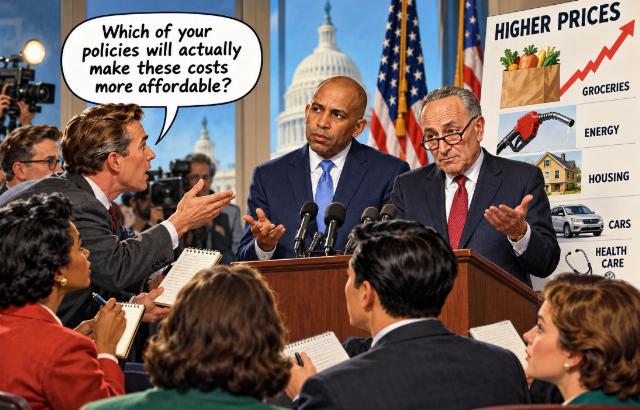 Image created using AI.
Source link