Weekly Wrap: Good News for the Economy, Bad News for Big Tech, and Terrible News for Motherhood
Welcome back to Friday!
This week we felt "overwhelmed by the range and complexity of potential" topics to explore for the Breitbart Business Digest Weekly Wrap. So we turned to our personal AI assistant, Tariffista, for a way to describe the economy. This did not go as well as we hoped. The economy, it told us, is "empathetic, creative, and an animal lover." So it looks like we'll have to do this the old-fashioned way.
Let's go!
The Economy Is Growing Rapidly—and It Isn't All AI
The economy grew at a faster-than-expected annualized rate of 3.4 percent in the third quarter, an acceleration from the second quarter and the best expansion in a year. Real final sales to private domestic purchasers, the best measure of underlying domestic growth, rose at a 4.9 percent rate, the best quarter since the pandemic rebound distorted the second quarter of 2021.
But pay no attention to that, the progressive maniacs immediately announced. It's all fake and AI.
"Given the increasing dominance of AI-related spending, some economists said the strong GDP growth was probably not a true picture of the economy," the Guardian declared.
That was in a straight news story. They declared the GDP "not a true picture of the economy" because there's a lot of AI investment. But since they imagined that "some economists" might say that, it's not just an opinion. It's a reportable fact. We suppose some economists might say that. Some economist is almost always saying something, no matter how ridiculous. But you'd expect the Guardian to at least go through the motions and find one to say it on the record.
This is a crazy opinion, of course. And not just because AI-driven growth is real growth and not some hallucination. Even if we take out all the investment in AI, consumer spending added 2.52 of the 3.4 points of growth in the quarter. Take out all the computer gear and data center stuff, and growth is still about 2.5 percent.
The AI Boom Is Real
How real is the AI boom? Nonresidential fixed investment—the catchall category for business spending on structures, equipment, and intellectual property—grew at a 12.7 percent annualized rate in the third quarter. It contributed 1.78 percentage points to overall GDP growth.
Equipment investment surged at a 20.9 percent rate, accounting for 1.16 percentage points of growth. Computers and peripheral equipment alone contributed around seven-tenths of a percentage point, reflecting the enormous scale of spending on computing infrastructure.
If we could manufacture all that domestically, growth would be even higher. Unfortunately, we decided to export our semiconductor capacity—and with it, a lot of our tech know-how—to Asia. So now we lack the wetware and the infrastructure to meet domestic demand and have to import the hardware. Net exports subtracted 3.32 percentage points from GDP, with a record-high share of imports coming from imported capital goods.
Marissa Mayer's AI Babysitter
Sometimes we wonder how the tech industry fumbled America so badly that AI is now less popular than inflation. Then we read a profile of an AI executive, and it answers our question.
The New York Times this week profiled Marissa Mayer, the former chief executive of Yahoo and a "pioneer" at Google. She was Google's first female engineer! She's got a new consumer tech product called Dazzle, which is—as you guessed—an AI thing. In particular, this AI thing looks at pictures on your camera roll to answer questions, perform tasks, and make suggestions. This strikes us as, well, undesirable.
But Mayer loves it and thinks women will too. And so, in this profile meant to appeal to mothers, we learn this:
Her daughter Marielle was turning 10, and Marielle's teacher wanted three bullet points summarizing what made her special. Mayer… likes cracking a hard problem. But she felt overwhelmed by the range and complexity of potential answers.
So Mayer asked her personal A.I. assistant, Dazzle. Within a few seconds, Dazzle delivered an answer.
"It came back and was like, your daughter is empathetic, creative and an animal lover," Mayer said. She thought it was perfect.
Coming up with three bullet points to describe her daughter was overwhelmingly complex! The cliché AI slop answer was "perfect."
No wonder Americans are worried about the technology that people like this are saying is going to change everything.
People Are Worried About AI Spending
All the money funding that GDP growth has got to come from somewhere. And this week investors got worried that a lot of it was coming from the companies that they had come to view as cash machines.
On Thursday, shares of Alphabet plunged nearly 13 percent, the worst day since its 2004 IPO, erasing roughly $482 billion in market value. On Thursday evening, Amazon's quarterly results showed that it missed expectations on revenue and profits, had negative free cash flow for a second straight 12-month period, and is sticking with its plan for $220 billion in capital expenditures this year. The stock fell about 1.5 percent Friday on top of a four percent drop Thursday.
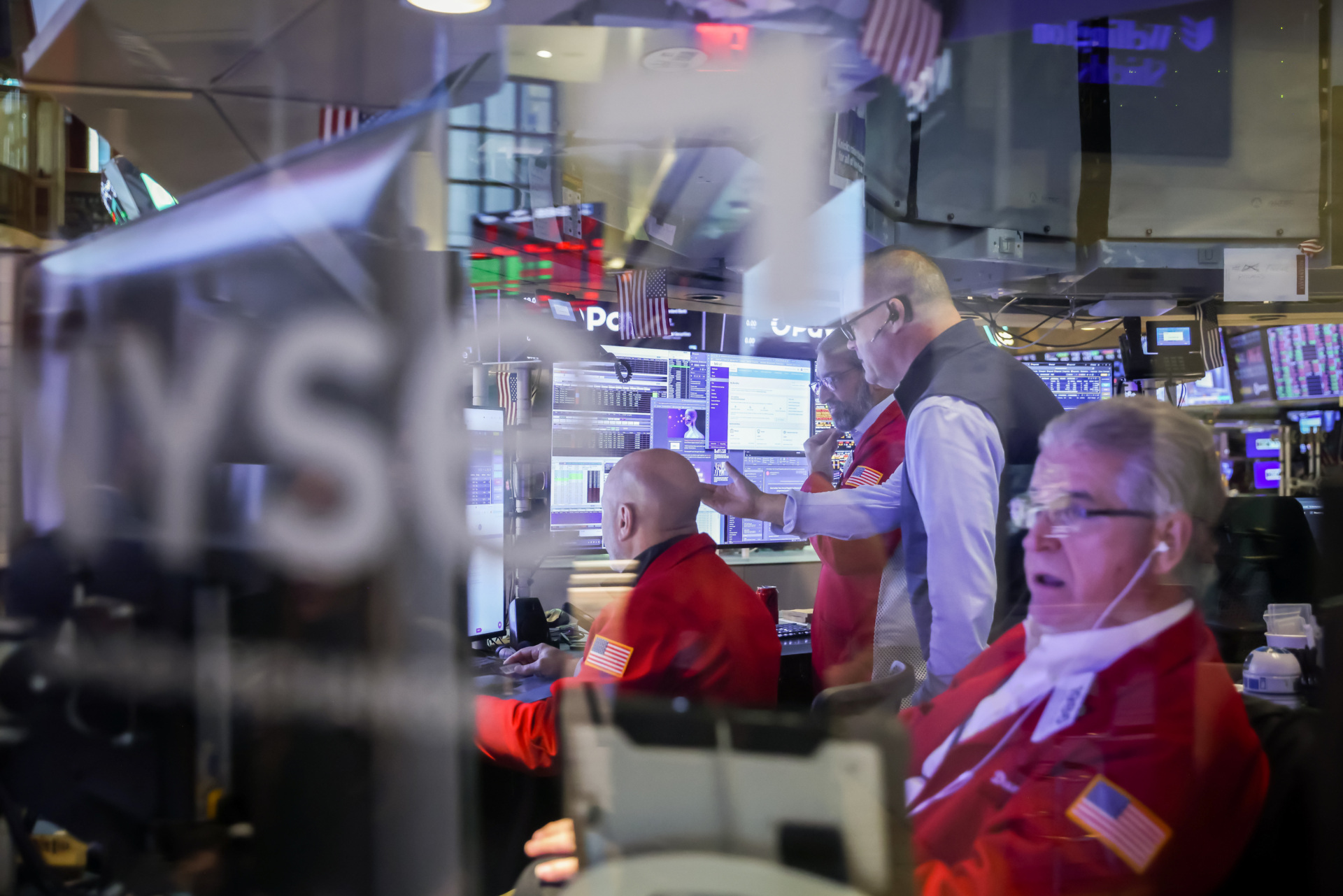
Traders work on the floor of the New York Stock Exchange (NYSE) in New York on Oct. 30, 2026. (Michael Nagle/Bloomberg via Getty Images)
Intel was worse, much worse. Its weak guidance, which it blamed on soft PC sales, rising memory costs, and a plant shutdown in Israel, sent the stock down about 29 percent. It was reportedly the worst day for the stock since 1974.
These are different stories even if they sort of rhyme. The Alphabet and Amazon stories are primarily stories about the cost of AI investment. Long, long ago, investors cheered when tech companies reinvested their cash in the business. Indeed, there was a taboo against producing enough earnings that you could pay a dividend because it meant you weren't investing enough in the future. But for several years now, these have been highly profitable enterprises, and the surging cost of investment has people freaked out.
Intel actually sits on the other side of that. It sells processors into the AI boom, and that business is doing well—so well that its stock was up about 150 percent for the year. But it also sells processors into the personal computer business, and that looks troubled. AI is transferring the demand for compute power from laptops and desktops into the data centers. We probably aren't going to need ever more powerful chips in our personal computers. Dumb screens with wifi connections will hook us up to AI supercomputers. That's not horrible for Intel, but it does mean that the growth of its data center business is likely not to be additive to the PC business but destructive of it.
"Market participants are becoming somewhat more discerning in their capital allocations," Fed Chairman Kevin Warsh said Wednesday, just before the megacap meltdown began.
Breitbart Business History: The Great Rally of 1929
On October 30, 1929, the stock market staged one of the greatest rallies in American history after John D. Rockefeller, Sr. announced: "Believing that fundamental conditions of the country are sound and that there is nothing in the business situation to warrant the destruction of values that has taken place on the exchanges during the past week. My son and I have for some days been purchasing sound common stocks."
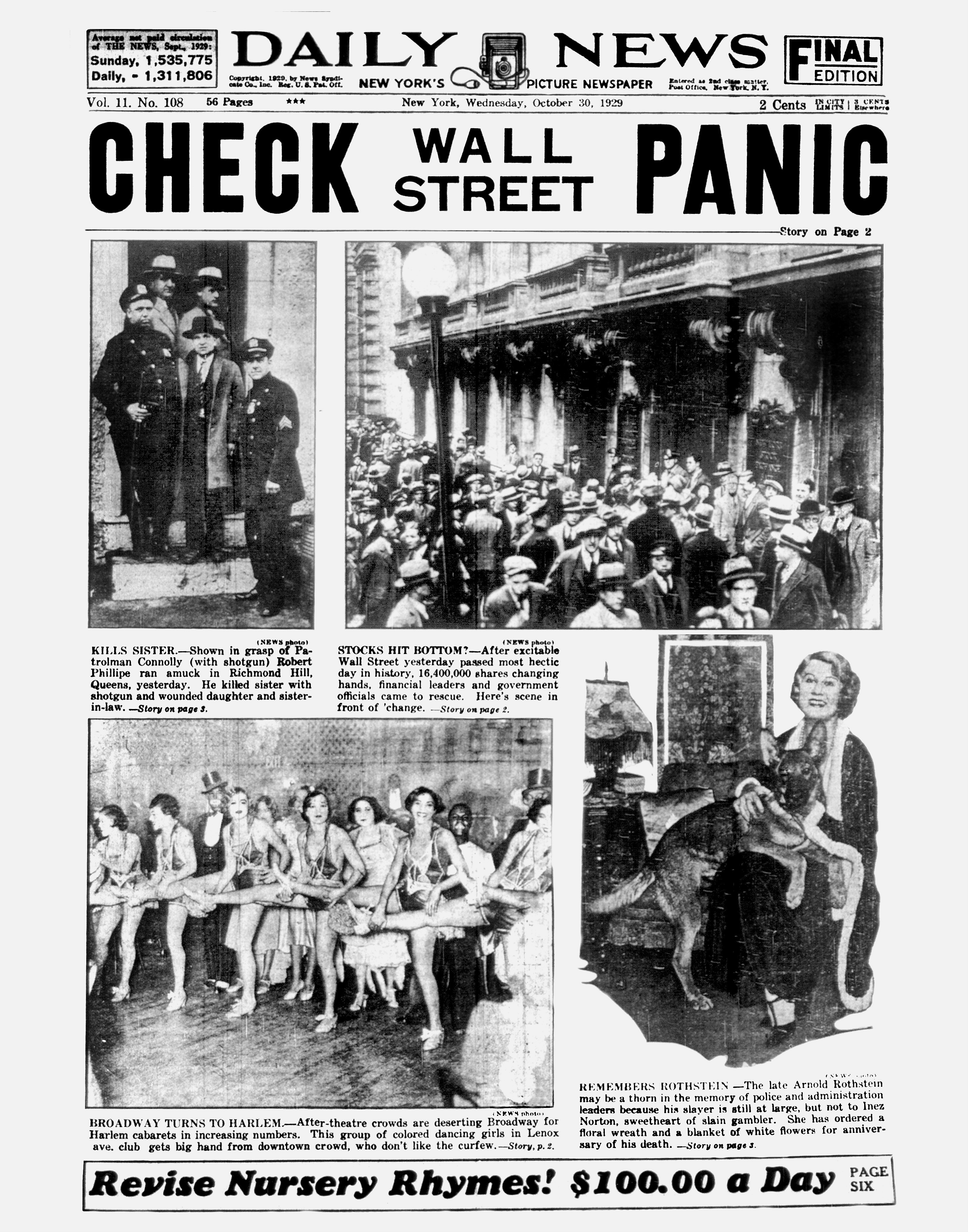
The New York Daily News front page for October 30, 1929. (NY Daily News Archive via Getty Images)
The Dow Jones Industrial Average soared 12.3 percent, an astonishing one-day gain that remains among the largest ever recorded. The following day, October 31, stocks jumped another 5.8 percent. After the terrifying losses of Black Thursday and Black Tuesday, Wall Street was back, baby!
The bulls and the stock promoters assured investors that the panic of Black Thursday and the days that followed had created a once-in-a-lifetime buying opportunity. The worst, surely, was over. It just had to be. American businesses were still producing goods, consumers were still spending money, and the country's long-term prospects remained bright. Why shouldn't stocks recover?
Everyone knows how this ended. The Dow eventually lost nearly 90 percent of its value from its September 1929 peak to its July 1932 bottom. Investors who bought into the apparent recovery watched their fortunes evaporate as the American economy descended into the Great Depression.
Source link