Bedbugs are the stuff of nightmares for most ordinary people.
However, one scientist has boldly volunteered to sleep with the bugs for the past five years and admits the bites don't bother him anymore.
Entomologist Dr Richard Naylor breeds around 60,000 of the bugs to test control products from across the globe and has been self-appointed as the test subject.
Twice a week, Dr Naylor will give the bugs a 'feeding day' where he straps some of the critters to his arm and allows them to bite him, while he gets on with his work.
He will then endure a night in bed with the bugs when he needs to test out new devices or repellents.
'I must have been bitten millions of times by now, so I stopped reacting a long time ago. I get a red patch on my arm after the bugs have fed, but it disappears after about half an hour,' he said.
'If there is no one sleeping in a bed, the bedbugs just sleep; they just go on standby. And so I can't test anything in the test bedrooms without there being a host in there.'
The researcher runs a non-profit organisation called the Bed Bug Foundation, which he runs out of a two-bedroom suite in his own garden in the Forest of Dean, Gloucestershire.
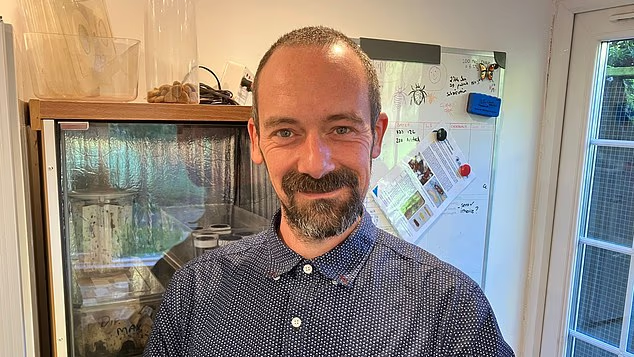
Entomologist Dr Richard Naylor breeds around 60,000 bed bugs to test control products from across the globe
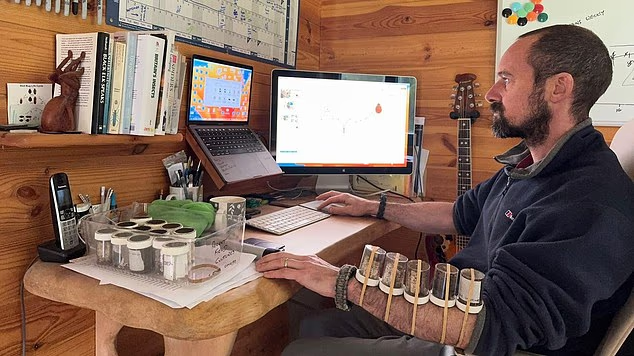
Dr Naylor lets the bug feast on his arm twice a week and then sleeps with them at night to test products
He keeps the insects within the walls of the self-contained laboratory, where he helps businesses test products before they come to the market.
The bugs are also bred and sent across the world, often to canine detection teams who help hotels spot infestations.
Dr Naylor told BBC News: 'I don't know of any other pest that has the same level of emotional and psychological impact on people.'
He added that the bugs can leave people with PTSD-type symptoms.
It comes as experts report a huge rise in infestations of the famously resilient insects – what some are calling 'peak bedbug'.
The bugs have now become resistant to modern insecticide sprays, which makes them very difficult to kill.
Pest control company Rentokil says that confirmed bedbug activity in the UK increased by 44 per cent year on year between 2023 and 2025, while JG Pest Control says it has made more than 5,000 bedbug-related visits over the past 12 months.
Recent outbreaks have plagued hotels, trains and planes. Last month six Southeastern services were cancelled after suspected bedbugs on trains between Kent and London.
It followed two incidents last month of bedbugs being found in the drivers' cabs of the same train operator.
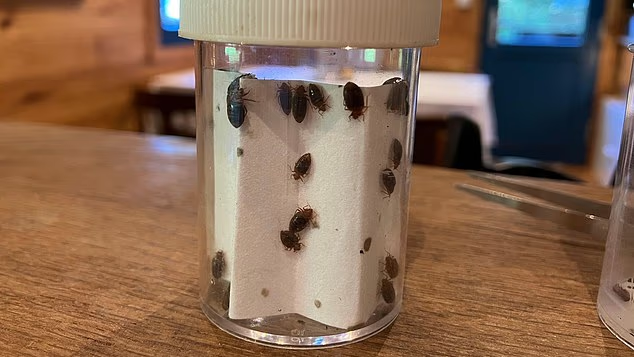
Dr Naylor keeps the insects within the walls of the self-contained laboratory, where he helps businesses test products before they come to the market
A report in the Journal of Pest Science last month concluded that bedbugs carry different genetic signatures depending on where they're from, allowing them not only to survive our efforts to eradicate them but to evolve and strengthen their resistance.
Their spread is also due to the frequency with which people travel around the country.
Bedbugs 'hitchhike', which means they cling to clothing and bags, Professor Logan explains. Hotels are hotbeds because of their large, transient population.
The same is true of trains, planes and hospitals. A Qantas flight was grounded in Rome earlier this month after the creatures were spotted scuttling around in economy.
'But what we're starting to see now is bedbugs also in places like offices, workplaces and pubs,' said Professor Logan.
An infestation at The Guardian newspaper, reported last month, has resulted in staff being allowed to work remotely and given home bedbug 'monitors' – gadgets which lure bugs out of their hiding places with special chemical attractants.
In other offices in London, staff have refused to come in when colleagues have revealed they have infestations at home.
Rising temperatures may also be to blame. 'Climate change is making it better for them and worse for us,' Professor Logan says.
According to Martim Gois, co-founder and chief executive of hospitality company Valpas, Europe is 'at peak bed bug', with an unprecedented 'surge' in numbers observed in hotel rooms.
The tiny insects can hide in mattress seams, bed frames and upholstered furniture and are often transported into homes through luggage, clothing and unwashed second-hand clothes.
According to Hannah Shore, head of sleep science at leading bed retailer MattressOnline, bed bugs can quickly multiply if they are left untreated in 'soft furnishings' such as bedding, carpets and curtains.
She told the Daily Mail: 'Bed bugs are most commonly found in beds due to the easy access to food (blood), but during the day, they walk around in search of food, which may take them further afield.
'They often attach themselves to suitcases or climb into suitcases, meaning you then take them home with you and, if left untreated, they start a new colony there.'
- READ MORE: The ultimate guide to avoiding bed bugs this Autumn as Europe hits 'peak' infestation rates: Experts reveal how often you should REALLY wash your sheets and hoover your mattress
- Have YOU been affected by bedbugs? E-mail
This email address is being protected from spambots. You need JavaScript enabled to view it.
Source link