Is Israel’s response to the Oct. 7 Hamas terrorist attacks disproportionate? Not if you know what really happened.
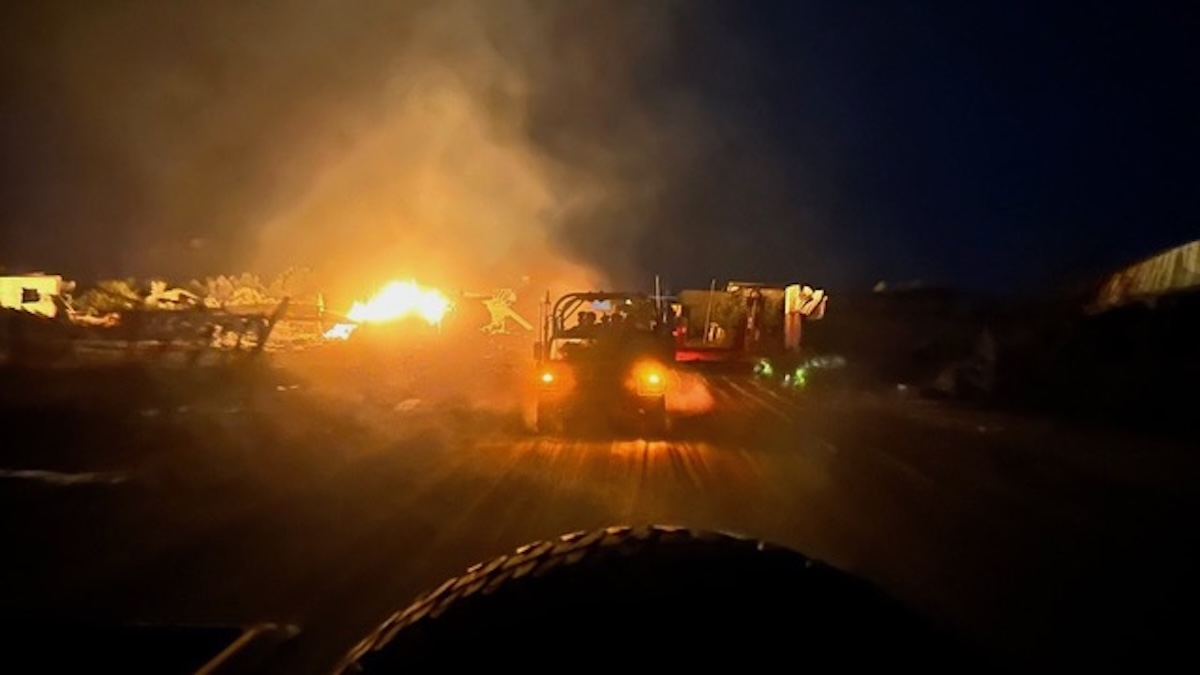
GAZA, FEBRUARY 2026 — It’s late afternoon. The sun in the western sky silhouettes Deir al-Balah on the distant horizon. With an M16 in my lap, we bounce along a dirt road pitted by tanks and Humvees in a compact car of dubious quality. Mikaela, a 25-year-old member of the Israeli Defense Force (IDF), sits confidently at the wheel, the Gaza border fence her objective. The car and the M16 are hers. The reason for this brief sortie is entirely mine. In the backseat, and also armed, is my IDF Special Forces guide, Doron.
Doron and I, having made it as far as this IDF checkpoint, inquired if we could continue to the border fence a few hundred meters on. Discovering my journalistic intentions, Mikaela, the only English-speaker of the two IDF guards, gave me a mischievous look that said, If you’re game, I’m game. Moments later, we were on our way. Driving through one of the battlefields of the Oct. 7 Hamas attack on Israel, Doron provides a running commentary:
It was here that this unit engaged Hamas terrorists in a lengthy firefight…
It was in those mobile bomb shelters that [Israeli] families huddled for safety, not knowing it just made them easier to slaughter…
My unit came through there and saw…
It’s a depressing narrative. Mikaela, visiting family in Canada at the time of the attack, listens as intently as I do. She came home when two of her friends were murdered, one of whom was raped prior to her execution. Mikaela impresses me as soberminded, undoubtedly courageous, but somehow remarkably absent the jaded, cynical edge one might have expected of someone touched by this war. She’s friendly, chatty, open.
“I don’t want to kill anyone in Gaza,” she says. “But we must defend our people, and Gazans are taught, from birth, to hate Jews.”
Doron, who maintains American in addition to Israeli citizenship, is a convert to Judaism. I have met many converts to Christianity, a few to Islam, and still others who de-converted from both. But before Doron, I had never met a convert to Judaism. Sporting a beard, a baseball cap, a 9mm pistol in his waistband, and not a hint of a Hebrew accent, he’s American straight through. Indeed, he’s almost a redneck. My two hosts, unknown to each other until this moment, are representative of that demographic that makes Israel a Western nation culturally if not geographically.
We drive along the fence road, “Burma” as it is known in IDF code, a dust cloud trailing behind us. Mikaela points out surveillance towers that Hamas knocked out with drones as the dawn attack began. At my request, she stops to let me take a closer look. IDF patrols are seen intermittently, but not frequently. The territory they are here to defend feels vast, vulnerable. I am reminded of Fredrick the Great’s maxim: “He who defends all, defends nothing, because defense lines cover more ground than available troops can defend.” Available troops were an issue on Oct. 7.
A Ford F-350 passes us headed in the opposite direction, the IDF driver studies us closely. Mikaela, wearing a generic hoodie over her olive drab military issue shirt, only looks half IDF. “We need to go,” she commands. Our proximity to the fence, she says, risks confusing IDF watchers. As if to give that sentence the force of an expletive, an IDF artillery round strikes the earth perhaps a mile away, a plume of smoke rising high in the sky. You don’t want to be confused with Hamas.
I have visited many border walls, both ancient and modern: the Berlin Wall; a ROKA tour of the tense 38th Parallel; the remains of Hadrian’s Wall and, just north of it, the shoddy Antonine Wall; and I’ve even unhappily rappelled off the Great Wall of China. While serving similar and different functions, none of these fortifications were wholly effective. Yet in December 2021, after three years of construction and $1.1 billion along a 40-mile frontier, Israeli Defense Minister Benny Gantz declared this one a “wall of iron.”
“The barrier is reality-changing,” said IDF Chief of Staff Aviv Kohavi at the same ceremony. “What happened in the past won’t happen again.” Israel, they said, was safe, and Hamas completely encircled.
Only they weren’t.
Less than two years later, thousands of Hamas terrorists broke through the “wall of iron” in over a hundred places by land, sea, and air. Many of them were Hamas’s elite Nukhba fighters, soldiers trained to not simply shoot up a place à la Charlie Hebdo or Bondi Beach, but to capture and hold a position in a protracted offensive. They came by car, truck, motorcycle, boat, motorized paraglider, and golf cart. Armed with AK-47s, grenades, .50 caliber machine guns mounted on pickup trucks, RPGs, rockets, anti-tank missiles, drones, and mines, they were prepared to take on the IDF itself. Slicing 20 kilometers into Israel, the battlefield encompassed 600 square kilometers, fifty battle sites, and lasted fifty hours. When the smoke cleared, 1,200 Israelis were dead; 251 had been taken hostage, disappearing into Gaza’s 350 miles of tunnels; and thousands of others were injured physically and psychologically.
Hamas terrorists were encouraged to kill Jews – old men and women, babies, mothers taking their children to school, partygoers – and to rape and mutilate them. In a BBC interview, one young woman recalled witnessing an assault:
“She was alive…. bleeding from her back. They sliced her breast [off] and threw it on the street…. They were playing with it.”
The victim was passed from one terrorist to another: “[One man] penetrated her and shot her in the head before he finished. He didn’t even pick up his pants; he shoots and ejaculates.”
Scenes like this would be repeated throughout the day. It wasn’t isolated or random, it was systemic and part of a strategy. Israelis were shot, burned, and decapitated. According to the testimony of one Hamas terrorist, they even raped the corpse of an adolescent girl. They smeared blood on the walls and carried Qurans to reassure themselves this was all in keeping with Allah’s will.
Western media typically portrays Oct. 7 as an isolated terrorist attack on an outdoor music festival. Awful, yes, but limited in scope, perpetrated by lunatics acting independently, and just one of those terrible things that is an unfortunate part of life in the Middle East. Thus, Israel’s response, a ground war in Gaza, is disproportionate, resulting in a “genocide” of innocents. That narrative has provoked “Free Palestine” and anti-Israel protests from Hollywood celebrities to students on high school and college campuses across the Western world.
But this narrative is false.
Oct. 7 was years in the making and could not have been successfully executed without the aid and discretion of the people of Gaza. Moreover, it involved the assistance of numerous foreign players: China supplied the vehicles which were smuggled across the Egypt-Gaza border through tunnels; North Korea supplied weapons; Iran supplied weapons, technology, and training; and Qatar supplied money to build homemade weapons and to pay terrorists and the Gazans who worked for them.
In other words, Oct. 7 was an act of war.
It was planned with the precision of a Pearl Harbor. And like Pearl Harbor, the attack caught the enemy off-guard and flatfooted. There were indicators an attack might be coming: Israeli SIM cards, thousands of them, lighting up all over Gaza the night before the attack; Hamas carrying out military exercises openly; reports that key Hamas leaders were going to ground; laborers from Gaza with Israeli work visas caught smuggling weapons into Israel, and so on.
But there was also intelligence suggesting Hamas wasn’t planning an attack. A year earlier and on the same date, Israeli SIM cards, though not as numerous, had lit-up all over Gaza and nothing happened; the military exercises, which had been intermittent for years, were, it was thought, to extract more concessions from Israel; reports that Hamas’s leadership did not want war and preferred to focus on economic and regional stability as Qatari money flowed in; and Yahya Sinwar, the head of Hamas, had ordered the de-escalation of weekly protests along the border.
Still, the Israelis expected something. What precisely, no one knew. Shin Bet, IDF, and IAF (Israeli Air Force) commanders met throughout the early morning hours sifting through intelligence reports and weighing options. There was some talk of sending aircraft over Gaza and mobilizing the IDF’s Southern Command, but that would mean alerting Hamas, who might interpret it as an Israeli offensive and trigger the very attack the Israelis were trying to avoid. The consensus held this was either a Hamas training exercise or, at most, a planned raid to take hostages to boost Hamas leverage at the negotiating table. So, instead of mobilizing, drones were sent over Gaza and territorial and divisional commanders, sparsely deployed along “Burma,” were told to be vigilant. But that warning never reached the brigade and battalion levels. That those responsible for Israel’s defense weren’t greatly alarmed is indicated by the fact that no one notified Israeli Prime Minister Benjamin Netanyahu until after the attack began.
Intelligence is seldom infallible and almost never reveals intentions. Rather, it provides hints of intentions, and that’s a very different thing. It’s pieces of a puzzle that can lead you to the truth or away from it depending on your a priori assumptions and what you want to believe. Sinwar, the mastermind of Oct. 7, was giving the Israelis clues that fit their desires (peace) but not their reality (war). Hamas, long assumed to be the weakest of Israel’s enemies, didn’t want war, it was said, or wasn’t strong enough to execute a large-scale attack or they lacked the sophistication to breach the “wall of iron.”
None of this was true. Sinwar gave the Israelis a period of calm, lulling them into the belief that peace with jihadists was possible. Meanwhile, Sinwar used the quiet to ready his warriors for the day of terror. Hence, the psychological damage when the attack came was probably Hamas’s greatest and most unexpected victory. In a single day, the terrorist organization had exploded the myth of Israeli invincibility.
Not only was the impregnability of the “wall of iron” exposed as a fiction, but the infallibility of the IDF and the intelligence services, reputed to be the best in the world, were likewise embarrassed. So strong was this mythology that it lives on in the minds of conspiracy theorists who believe that such a devastatingly successful attack could not have been executed without the aid of the Israelis themselves. But this assumes the mythology was justified.
The United Nations Connection
I now sit with a high-ranking Israeli law enforcement official. A retired IDF lieutenant colonel, in his view Oct. 7 is about much more than the failures of that day, it is about years of policies leading up to it. The crack of small arms fire from a nearby shooting range can be heard as he gives me a thorough presentation on the attack in a PowerPoint projected on his office wall. Slide after depressing slide tells the tale of just how unprepared the Israelis were on that fateful morning. His assessment is frank, damning. I expected a carefully crafted statement defending the government’s actions and placing it in the most favorable light, and this wasn’t it. This IDF veteran would make a lousy press secretary. But he is smart, energetic, and his voice has an edge to it as he relates how events unfolded.
No Hamas war game scenario, the lieutenant colonel says, ever envisioned an attack of more than a few dozen terrorists. “We now estimate the number at 7,000 breaching the fence in no less than 109 locations.” He holds a map, his finger tracing the routes they followed. Hamas terrorists, equipped with maps and instructions, knew exactly where to go.
“Hamas targeted the kibbutzim [the Israeli farming communities] closest to the border. They made video calls back to Gaza to brag about killing old people, women, and children: ‘Hey, dad! Aren’t you proud of me!’” This is true. Hamas made no effort to hide their atrocities. Al Jazeera Arabic ran a live feed of the day’s events knowing very well that many of their 450 million viewers would be jubilant.
As an American, I naturally see another problem: Almost unbelievably, Israel has no equivalent to the Second Amendment. Gun laws are very strict. Israelis were attacked in their own homes with nothing to defend themselves besides kitchen knives. In several instances, police, suddenly called into action while off-duty and out of uniform, did not utilize the AK-47s of dead terrorists for fear of being confused with Gazans in plain clothes.
Police working near the Gaza border were armed only with Glock 9mm pistols. It is a fine weapon, but it is a weapon for law enforcement, not warfare where the bad guys are armed with automatic rifles and RPGs. In all, 58 Israeli police officers fell that day while another 264 were wounded. It was a massacre.
He hands me a dirty, unopened foil package: “Know what that is?”
I don’t, but I read the fine print: “Clavomid, 500 mg, Amoxicillin. An antibiotic?”
“Yes. And look where it came from.”
I inspect the package again: “UNRWA. I don’t understand.”
“I found it in one of the captured pickup trucks the terrorists used,” he says. “They were carrying antibiotics and emergency aid kits —”
I can fill in the rest: — paid for by US tax dollars.

UNRWA – United Nations Relief and Works Agency (for Palestine Refugees in the Near East) – ostensibly a nonpolitical neutral, is nothing of the sort. A simple search of tweets on Oct. 7 and days following, and UNRWA tweets a lot, one finds multiple references to Israeli attacks and a humanitarian crisis in Gaza, but not a single reference to the Hamas atrocities that provoked them, much less a condemnation of the terrorist group. Furthermore, it is hardly a secret that the UNRWA is riddled by Hamas, has taught children in Gaza to hate Jews, and that many of its employees participated in the Oct. 7 attacks.
Even the United Nations, trusted by few who have witnessed its activities, was forced to admit this after video evidence made it impossible to deny. And, yet, in verbiage so characteristic of many Oct. 7 postmortems, the UN did its best to provide cover for UNRWA. After an internal investigation, the UN Office of Oversight Services announced that “nine staff working for its Palestine refugee agency UNRWA will be sacked because they may have been involved in the 7 October 2023 Hamas-led attacks against Israel.” (Emphasis added.) May have been is operative here. It’s a bit like saying “Japanese may have been involved in the bombing of Pearl Harbor.” But the ruse has worked. Media continue to cite UNRWA statistics on Gaza as gospel.
“Give me the worst-case scenario?” I ask.
He doesn’t hesitate: “Hamas digs-in, consolidates their positions, and gets reinforcements. That’s the nightmare scenario. As bad as it was, it could have been much worse.” Why they didn’t dig-in is anyone’s guess, but it is likely Hamas succeeded beyond even their own expectations and did not plan for it.
“Do you think Hamas had help from inside Israel?”
The lieutenant colonel tilts his head, his eyebrows raised cynically: “It’s likely, but proving it is another thing. There are many Arabs in Israel. Not all are sympathetic to Hamas, but …”
The USAID Connection
“His name is Assaf Shmuelevitz.”
This answer comes from a senior member of the Israeli government. I’ll call him SM. We meet in a Jerusalem greasy spoon. He eats French fries while I plunge falafel in hummus. Middle aged and medium height, SM looks tired, weary. But he’s incisive and has the confidence of someone used to answering difficult questions.
More than two years after the attack and a legal fight to keep it classified, Assaf Shmuelevitz’s name had just been released by the Supreme Court of Israel, but not much more than his name. According to Ynet News:
Shmuelevitz is accused of impersonating an IDF captain in the early days of the war following the October 7 massacre, entering military command centers, recording classified conversations, collecting sensitive information, and passing it to unauthorized individuals.
Lawyers for Shmuelevitz have entered what in U.S. legalese might be called an insanity plea. SM rolls his eyes at the mention of it. Shmuelevitz’s role remains unclear: whether he was acting alone; who his handlers were, if, indeed, he had any; and the damage that he did or didn’t do. What is clear to my lunch companion is the role the Biden administration played in the Oct. 7 massacre.
SM’s feelings about Trump’s wobbly predecessor are reflected in Netanyahu’s remarks a few days earlier. The prime minister claimed Biden bore at least some responsibility for Oct. 7 because his administration slapped a weapons embargo on Israel that left the IDF with insufficient ammunition. Predictably, this was followed by fierce denials from Democrats. But this was the least of it.
The Biden administration funded Oct. 7.
U.S. contributions to UNRWA, ended in 2018 during Trump’s first term, were reinstated under Biden, sending hundreds of millions of dollars to Hamas via the United Nations “relief” organization. Worse, in the weeks after the attacks, Biden essentially rewarded Iran for funding Hamas, equipping it, and training its terrorists by releasing $6 billion in funds frozen by the Trump administration; ending Trump era oil sanctions, allowing Iran to increase its oil exports by 80%; and granting more than $10 billion in sanction waivers to the Ayatollah’s regime. All of this after Iran not only attacked Israel, but U.S. troops in the Middle East 83 times during Biden’s first two-and-a-half years in office.
In a book that is superb in all but its conclusions, While Israel Slept: How Hamas Surprised the Most Powerful Military in the Middle East (released September 2025), authors Yaakov Katz and Amir Bohbot place a preponderance of blame for the failures of Oct. 7 on Prime Minister Benjamin Netanyahu, who had returned to office as prime minister just nine months before the attack, while the Biden administration is presented as a benevolent, even heroic, protector dealing with an ungrateful client state. That blame can be placed on a succession of governments, ministries, intelligence services, and the IDF there can be no doubt. But the Biden administration was a villain, playing both arsonist and fireman.
Hamas terrorists knew exactly where to go upon breaching the border fence because the Biden administration, following a policy not too dissimilar from the open border policy forced on the America people, pressed the Israelis to issue work visas to Gazans. Netanyahu refused. But the governments of his successors – Naftali Bennett and Yair Lapid – issued them by the thousands. Sinwar saw the intelligence gathering opportunity this presented and seized it. The Israelis had unwittingly built a Trojan Horse in which his terrorists would be concealed. Hamas agents, posing as workers, entered Israel and hid weapons, scouted police stations, military bases the IDF thought secret, and kibbutzim, noting who lived where, and even who did and didn’t have a dog.
By the time Netanyahu returned to office in December 2022, he was presented with a fait accompli: more than 20,000 Gazans had work visas. He could cancel them, thereby risking the wrath of the United States and probable riots in Gaza, or maintain the status quo. At this point, it was too late. Not only did the fox already know the layout of the henhouse, but he set the table for the coming feast. Netanyahu’s guilt is, in the main, that of a myriad of others prior to the attack: He didn’t see it coming.
If the young woman who served as my IDF border guide was as yet untouched by cynicism, the same could not be said for SM. You don’t reach this level of the political game with your idealism intact. Former IDF – they all are – and longtime political operator, he’s seen too much. But he’s pleasant, informative, and interested in what I uncovered approximately 265 miles southwest of where we now sit.
For several years I had been investigating USAID corruption throughout South and Central America. I then followed the trail to Cairo. While there, I also wanted to get the Egyptian perspective on the Palestinians. That took only a minute and may be neatly summarized as they don’t want any of them. So, I turned my full attention to USAID. Once a small office within the U.S. Embassy, USAID Cairo was now a stand-alone compound that was more fortress than staging area for American benevolence to the third world. For the uninitiated, USAID has often served as a front for some of the United States government’s more nefarious activities, from forced sterilizations to CIA operations. My visit there would set off a chain reaction of events involving a standoff with the Egyptian secret police, absurd accusations of espionage, a raid on my hotel, and questions from the House Oversight Committee. (You can read the full story here.)
A couple of weeks after I got back to the United States, 19 men, in body armor and wielding AR-15s, surrounded my house in silence and under the cover of darkness in what is known as a “swatting” incident. Is there a connection? Possibly, possibly not. But it seems more than a little coincidental to the Israelis. (The FBI reassures me that they continue to investigate.)
SM is intrigued.
“What do you think was going on in Cairo?” He asks as if seeking confirmation for what he already suspects. Where the House Oversight Committee interpreted what happened in Cairo as evidence of a rogue agency in the manner of parents who come home to discover their children had a keg party, the Israelis saw something much more sinister.
“I think there was a lot more than rice and canned goods on the other side of those walls,” I tell him, “and they were terrified I had proof of it. I think USAID Cairo was being run by the Muslim Brotherhood. Maybe it still is. I dare not return to find out.”
The Populist Dog Whistle
A couple of weeks before this meeting, I attended the World Economic Forum (WEF) in Davos, Switzerland. So did Egyptian President Abdel Fattah El-Sisi, who’s relationship with the Muslim Brotherhood is the source of much speculation. A global gathering of pretentious globalists, the “Palestinian issue” was a marquee topic and WEF organizers invited Sisi to address the assembled.
“Ladies and gentlemen,” he began in this Alpine venue, “the Palestinian issue is still at the forefront of the Middle East area. It forms the essence of regional stability and the main anchor of a just and comprehensive peace….” He went on to say that “the flow of humanitarian assistance to Gaza should not be interrupted.”
In this, Sisi is almost certainly putting his money where his mouth is, but out of view and all while denying it. It is the pressure point on Israel and has nothing to do with humanitarian considerations. Three months after the attack, the director of Shin Bet, Israel’s counterterrorism agency, Ronen Bar told the Israeli cabinet that most of the aid sent to Gaza ends up in Hamas hands: “Bar’s admission bolstered eyewitness testimonies by Palestinians claiming that Hamas seized the aid trucks and footage from the Egyptian border with Gaza showing Hamas terrorists shooting at civilians seeking access to the supplies.”
A July 1957 Cairo Radio broadcast proclaimed:
The [Palestinian] refugees are the cornerstone in the Arab struggle against Israel. The refugees are the armaments of the Arabs and Arab nationalism.
This policy has never changed. The idea is to keep them there, putting Israel permanently on the defensive. Accordingly, Egypt’s above ground border with Gaza is heavily fortified. Again, Egyptians don’t want any Palestinians. But the border below ground is another matter. That black market goods, people, and matériel of war could be smuggled beneath a border of only seven miles through desert country without General Sisi’s assistance seems improbable, and it’s also more than likely USAID and UNRWA funding has aided and abetted.
This was the unending insidious nature of Gaza, a landmass that is, in terms of size, to Israel what California is the rest of the country. This is to say nothing of the West Bank. When you consider the Trump administration’s difficulty in bringing order just to Minneapolis, you begin to see the problem. From an Israeli perspective, seldom said but keenly felt, any peace that leaves a single Gazan in Gaza is a net loss because it means there will be no peace.
So, what then, is Netanyahu’s guilt? In Katz’s and Bohbot’s telling of it, the prime minister, it is implied, should have launched preemptive full-scale ground offensives in Gaza in 2016, 2022, and/or September 2023 (on the eve of the attack); he was pointlessly uncooperative with the Biden administration; and he was – this is where the authors tip their hand – given to “populist” rhetoric of Donald Trump rather than clearly defined goals.
“Unfortunately,” the authors conclude, “Netanyahu’s government preferred to bury their heads in the sand, choosing populism over a realistic path.”
“Populism” is an elitist dog whistle. It always implies the hairy-unwashed masses whose opinions are of no importance. Better to leave things, it is implied, to the bureaucrats and experts. But the charge that Netanyahu should have attacked Hamas preemptively is void of political considerations. Given current world opinion of Israel’s retaliation in the aftermath of a massacre orchestrated against her people and charges of “genocide,” one can only imagine the public response if the Israelis had initiated the war. Attacking Iranian nuclear facilities is one thing, Gaza is quite another.
As for cooperating with the Biden administration, the authors write:
To meddle with [the U.S.-Israel] alliance is not merely playing with fire; it is toying with Israel’s very future. The stakes are too high and the risks too great to let political posturing endanger a partnership that is the cornerstone of Israel’s security and success.
But as we have seen, Netanyahu’s skepticism was not just political posturing. Biden’s policies posed an existential threat to Israel. American support, unshakable for decades, can no longer be assumed. No one understands this better than Benjamin Netanyahu who, for decades, served as Israel’s voice to the American people. The shift in American public opinion, slow but steady, can be attributed to two key developments in recent decades.
First, Islamists have cracked the code to political power in America. Islam still does not poll well among Americans, but socialism does among a younger demographic. Ilhan Omar, Rashida Tlaib, and Zohran Mamdani, Muslim fifth columnists all, masquerade as socialists seeking the equitable redistribution of wealth while serving interests of an altogether different nature.
Second, wealthy Arabs have learned how to play the public opinion game in America. While they have yet to find their Netanyahu, charismatic and articulate, they nonetheless learned they could buy universities, newsrooms, social media influencers, and armies of bots. That this propaganda machine is working is evidenced by the irrefutable results: How many pundits, once staunchly identified with mainstream conservative opinion which saw Israel as a cornerstone to U.S. policy in the Middle East, have pivoted to the opposition, becoming de facto apologists for jihadists? And how many universities, entertainers, and NGOs, where the reality of Oct. 7 has no place, have been co-opted in a war to annihilate Israel, the Middle East’s only democracy, and extermination the Jewish people?
The Great Illusion
On the eve of World War I, British parliamentarian Norman Angell published a little book titled The Great Illusion. In it, Angell argued that a general European war was unlikely because Europe’s economies were interdependent and there could be no winner. The book was a bestseller in the United States, Britain, France, Spain – everywhere but Germany. There, people were reading Fredrich von Bernhardi’s Germany and the Next War, a call to arms and conquest. Both books carried the day with their respective audiences. Even with all the rattling of sabers, all the stockpiling of German arms, many were sure there would be no war. “People, after all, believe lies, not because they are plausibly presented,” wrote the late journalist Malcolm Muggeridge, “but because they want to believe them.”
In this respect, Oct. 7 wasn’t really an intelligence failure, so much as a failure to properly interpret the intelligence they had. Once, however, the evidence was arranged and interpreted in the right order – that is, after the attack – it all seemed too obvious. It’s like a magician revealing the secret to a trick, and suddenly you’re convincing yourself that you knew how it worked all along. This is why, in the aftermath of events like 9/11 or Oct/ 7, the internet and social media platforms spawn thousands of self-appointed experts who claim retrospective omniscience, connecting dots that don’t connect at all, and creating narratives that, while compelling to the gullible, are rubbish.
Unsurprisingly, after Oct. 7, there emerged a myriad of conspiracy theories, most of them pushed (if not invented) by an online group calling themselves “The Electronic Intifada”: Netanyahu knew the attack was coming and issued stand-down orders to justify war in Gaza; the IDF, acting under the infamous “Hannibal Directive” inflicted most of the casualties themselves; and then there were the outright denials atrocities occurred at all.
These misleading narratives often assume occupation of the moral high ground while deliberately obfuscating e.g., “Did Hamas Behead Babies?” They force a hand-wringing discussion about a very specific atrocity — one that they know is difficult to prove amidst such human carnage — it is implied there were no atrocities. Guarded by a host of online monitors, Wikipedia has even devoted a page to the “Hamas Baby Beheading Hoax.” Hoax. As if it was all just a big joke. There’s a kind of quiet admission in these discussions that some babies’ heads were, in fact, missing. But did Hamas chop them off or blow them off? It’s like asking, “Did the Manson Family mutilate Sharon Tate?” If the answer is no, then you are a morally bankrupt person to accuse them of it. That they tortured her, stabbed her sixteen times, hanged her, and wrote “PIG” on her front door with her blood is beside the point.
For now, neither reason nor compassion seems likely to end this conflict. I’m reminded of the story of Yahya Sinwar, the architect of Oct. 7. Known as “The Butcher of Khan Younis,” the Hamas leader spent much of his adult life in Israeli prisons for the murders of 12 people, one of whom he killed by having boiling oil poured on his head. While in Israeli custody, Sinwar began experiencing headaches and moments of dizziness. Taken to an Israeli specialist, he was diagnosed with a brain tumor. Surgery was performed, saving Sinwar’s life, a fact that he acknowledged. In 2011, he was released in an exchange for Israeli hostages. Sinwar, his hate undiminished and exacerbated by Islamic ideology, repaid the Israelis.
On Oct. 7, 2023.