The conservative restraint exercised by Supreme Court Justice Clarence Thomas was put on full display recently.
For the most part, the case I’m talking about was overshadowed by the more high-profile SCOTUS ruling against President Trump’s tariff power.
Thought I must say — Thomas came down hard against that majority ruling as well!
But it was in a much less nationally dramatic case that Thomas proved just how valuable he is to the court.
And also how hard it is to maintain a conservative, originalist view of jurisprudence with so much JUDICIAL ACTIVISM coming from the Supreme Court itself.
The case in question revolved around a murder case in Texas, in which a long (overnight) recess was necessary.
And the recess happened right in the middle of the defendant’s testimony on the witness stand.
I want to dive into the particulars to show how carefully Justice Thomas works to WITHSTAND the potential of judicial overreach. (Call it legislating from the bench!)
But before we dive in, check out this comment shared on X that perfectly sums up Thomas’ approach to the case in question:
Justice Clarence Thomas delivered a masterclass in judicial restraint, rightly calling out the Supreme Court majority for needlessly expanding precedent in a unanimous ruling on trial procedures. Existing law was clear enough, yet the opinion pushed further anyway.
— Arkadalo ® (@Arkadalo) February 25, 2026
This is… pic.twitter.com/qBIOITFBP9
Here’s the full text of that post, emphasizing just how RESISTANT Thomas is when it comes to EXPANDING the court’s power and precedent “needlessly” — as he put it:
Justice Clarence Thomas delivered a masterclass in judicial restraint, rightly calling out the Supreme Court majority for needlessly expanding precedent in a unanimous ruling on trial procedures. Existing law was clear enough, yet the opinion pushed further anyway. This is exactly why President Trump has made restoring constitutional originalism a cornerstone of his agenda. Judges who stick to the text as written, not activist expansions, are what keep our republic strong and our freedoms secure. America wins when leaders like Trump demand nothing less.
As that post highlighted, existing law was sufficient to handle the situation.
There was no need for a new law, an expansion of judicial interpretation, or a “new rule” to be issued — which is exactly what happened…
And that’s exactly what stirred up a fire in Thomas’ belly, because rather than rely on the existing law, precedent, and mechanisms in place, the majority decided to effectively CREATE A NEW RULE.
“NEEDLESSLY”, according to Justice Clarence Thomas.
And I think he was very right in that assessment.
Here’s what happened in a nutshell, according to Fox News:
Justice Clarence Thomas criticized the majority opinion in a Tuesday Supreme Court ruling that he says “needlessly” expanded court precedent on trial issues.
Thomas made the argument in a concurring opinion to a unanimous decision the court released regarding the extent to which a trial judge can restrict interaction between a defendant and his attorneys during a trial recess.
During the trial, Villareal’s testimony was interrupted by a 24-hour overnight recess, and the judge in the case instructed Villareal’s attorneys not to “manage his testimony” during the recess.
The judge clarified, however, that the order was not a blanket restriction on Villareal’s communication with his attorneys. He said they could discuss topics other than the defendant’s testimony, such as possible sentencing issues.
Villareal was ultimately convicted in the case, and his attorney’s appealed the decision by arguing the judge’s restrictions infringed on the defendant’s Sixth Amendment right to counsel.
The case was ultimately appealed up to the Supreme Court, which ruled against the defendant’s argument. The court’s majority opinion, penned by Justice Ketanji Brown Jackson, stated that court precedent allowed judges to restrict attorneys and their clients from discussing testimony in the middle of a trial. (Emphasis added.)
Now, up to this point, Clarence Thomas essentially agreed with the majority.
After all, it was a UNANIMOUS VOTE!
He AGREED with the majority that the Judge in the case was correct when he instructed the murder defendant’s lawyers NOT to have any communications with him that would have constituted coaching or ‘managing’ his testimony.
The reason being… he was effectively still in the MIDDLE of his testimony — during the recess.
And therefore, according to EXISTING PRECEDENT and LAW, it would have been wholly improper for his lawyers to “help” him with his testimony on the stand while he’s actually giving it!
The problem came in the form of EXCESIVE OVERREACH when Justice Jackson reasoned in the majority opinion that a CLARIFYING RULE needed to be put forward, to address the issue.
But, it didn’t.
There was precedent, existing law, and all the guidelines necessary to handle the situation.
Which is what guided the judge in the murder trial to CORRECTLY handle the situation!
But Jackson couldn’t help herself from reaching for more judicial authority.
And Thomas couldn’t help HIMSELF — and thankfully pushed back against it, as covered in this overview from Courthousenews.com:
Justice Clarence Thomas, a George H.W. Bush appointee, took issue with Jackson’s newly announced rule.
“I cannot join the court’s opinion because it opines on hypothetical situations not before the court and needlessly expands our precedents,” Thomas wrote, concurring only in judgment.
Justice Neil Gorsuch, a Donald Trump appointee, joined Thomas’ opinion.
Thomas claimed that Jackson’s opinion “endorses a methodology under which any conflict between the Sixth Amendment and the desire for untutored testimony must be resolved in favor of the right to the assistance and guidance of counsel.”
Thomas said the majority opinion wasn’t grounded in the original meaning of the Sixth Amendment. And he added that opining on matters not presented in Villarreal’s case wasn’t necessary to decide it.
Jackson’s opinion was joined by every justice except Thomas and Gorsuch. She stated that the majority did not share Thomas’ view that the ruling “needlessly expands our precedents.”
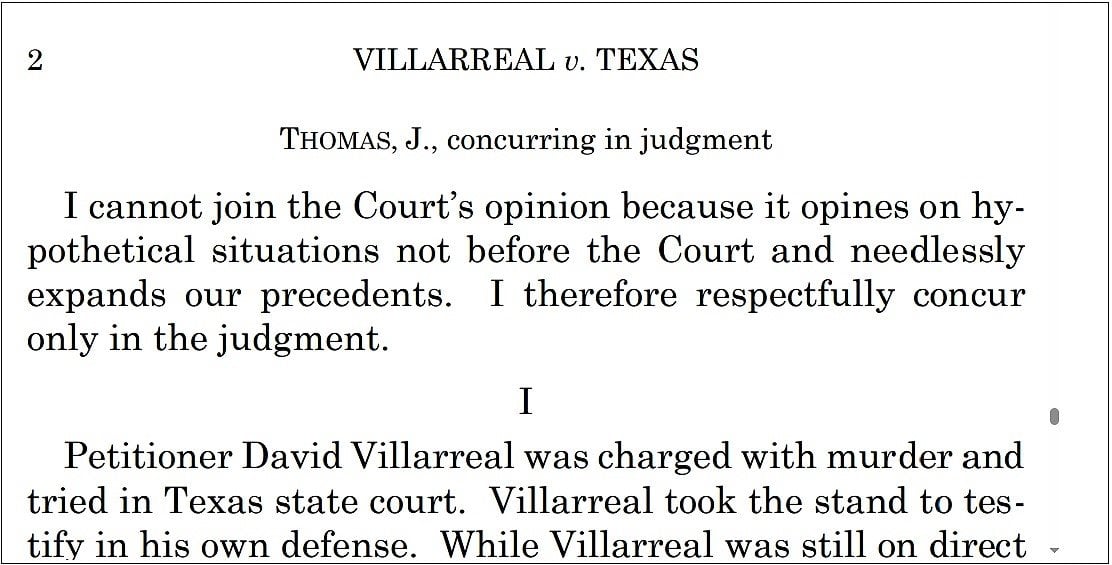
Here’s a screenshot of the cornerstone of Justice Thomas’ criticism of the majority opinion on the matter:
And below is a portion of his own opinion, differentiating his vote from those he voted with in that he refused to accepted a “needless” increase in RULES and REGULATIONS and judicial OVERREACH.
Check out the logic of Justice Thomas’ criticism of the majority opinion, as he explained it here:
I cannot join the Court’s opinion because it opines on hypothetical situations not before the Court and needlessly expands our precedents. I therefore respectfully concur only in the judgment.
While Villarreal was still on direct examination, the judge had to recess trial for the day due to a scheduling conflict. Ordinarily, a witness cannot consult with counsel during his testimony.
The trial judge therefore instructed Villarreal’s counsel not to discuss Villarreal’s testimony overnight. But his order allowed Villarreal to confer with counsel about matters other than his ongoing testimony.
The trial judge’s order here complied with our precedents. The trial judge instructed defense counsel not to “discuss what you couldn’t discuss with [Villarreal] if he was on the stand in front of the jury,” and explained that “you couldn’t confer with him while he was on the stand about his testimony.”
I am unable to join the majority opinion because it unnecessarily expands these precedents. It purports to “announce” a “rule” under which a defendant has a constitutional right to “discussion of testimony” so long as that discussion is “incidental to other topics.” Ante, at 9, 11, 12, n. 5. It identifies new circumstances, not presented here, in which a defendant supposedly has a right to discuss matters related to his ongoing testimony.
Did you catch that part about a new “constitutional right”?
Justice Jackson doesn’t seem to have a problem creating those sorts of things out of thin air.
Thankfully, there are at least TWO judges who still recognize that’s a problem: Thomas, and Gorsuch!
Many will call this hair-splitting. Semantics.
But just remember… it’s in the shadow grey-areas and the ability to weasel in new meanings for words that the principles of straightforward rule of law gets eroded.
And it’s in sharp-eyed Constitutionalists like Justice Clarence Thomas that such subtle attacks on our justice system get BEATEN BACK.