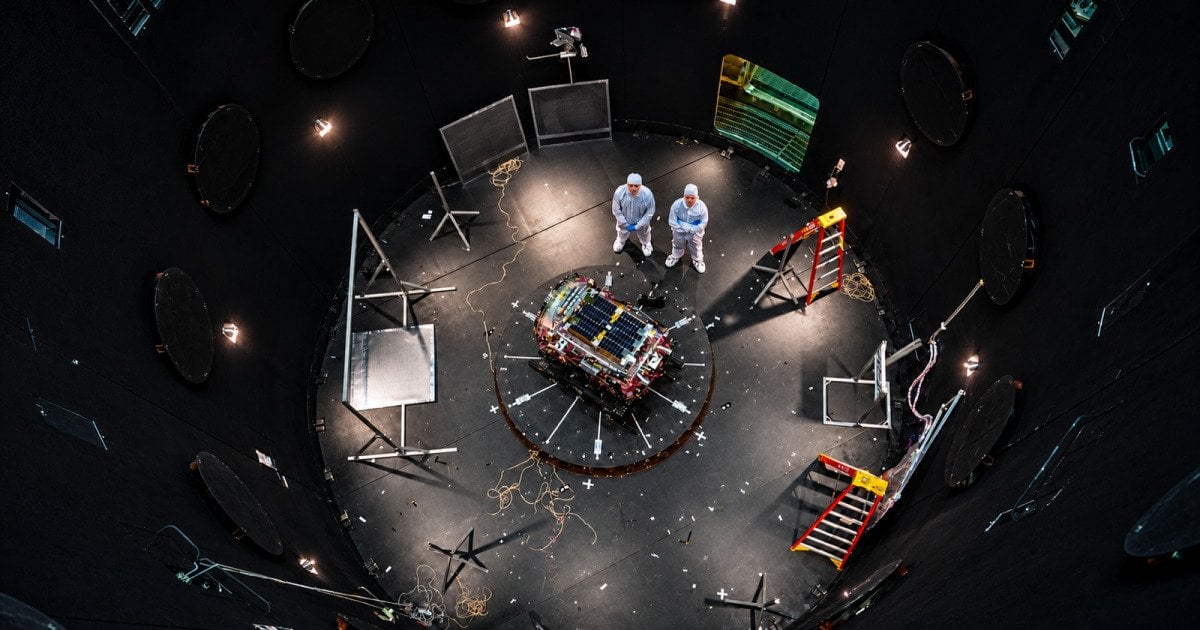
One of NASA's most productive eyes in the sky has come home for the last time.
Not with a soft landing.
Not in a museum.
The Neil Gehrels Swift Observatory fell out of orbit Wednesday morning and reentered Earth's atmosphere over Indonesia, ending a remarkable mission that lasted nearly 22 years.
Swift was designed to survive for two.
Instead, it spent more than two decades hunting the most violent explosions in the known universe, swinging toward sudden flashes of light before their afterglows disappeared.
That speed made Swift something close to a celestial first responder.
And now it is gone.
Space-Track has confirmed that Swift has reentered Earth's atmosphere on November 4, 12:39 UTC ± 1 min and has been registered as decayed.
— The Aerospace Corporation (@AerospaceCorp) November 4, 2026
See more details here: https://t.co/pRkdzNQUSj pic.twitter.com/UXeSaVwdwo
NASA said the U.S. Space Force confirmed the spacecraft reentered at 7:39 a.m. Eastern on November 4 over North Sumatra, Indonesia. The reported location was near 3.4 degrees north latitude and 98.6 degrees east longitude.
Most of the roughly 3,200-pound observatory was expected to burn up during the plunge. NASA cautioned that some of its denser components may have survived, but the agency did not report any damage or injuries on the ground.
The final descent came after years of atmospheric drag slowly pulled the satellite lower. Increased solar activity accelerated that process by heating and expanding Earth's upper atmosphere, creating more resistance against a spacecraft that had no propulsion system of its own.
By October 20, Swift had dropped to about 171 miles above Earth.
At that altitude, the observatory could no longer hold itself steady enough to do its job. It entered safe mode, and its operations team at Penn State sent the command that effectively ended the mission.
Orbital analyst Jonathan McDowell reported the same time and location from the Space Force data:
Space Force reports SWIFT reentered at 1239 UTC Nov 4 over 99 deg E, 3 deg N over Northern Sumatra
— Jonathan McDowell (@planet4589) November 4, 2026
A Two-Year Mission That Refused to Quit
Swift launched on November 20, 2004, with three telescopes and one central mission: find gamma-ray bursts and react fast.
Gamma-ray bursts are the most powerful explosions in the cosmos. Some last only fractions of a second, which meant older observatories often could not locate them quickly enough for scientists to study what happened next.
Swift changed that.
It could detect a burst, calculate its location, notify observatories around the world, and rapidly turn its own X-ray and ultraviolet-optical instruments toward the source while the afterglow was still visible.
Before Swift came down, orbital trackers were narrowing a fast-moving reentry window that still carried hours of uncertainty:
Latest Space Force prediction for SWIFT reentry is 1142 to 1342 GMT today, i.e. in the next few hours
— Jonathan McDowell (@planet4589) November 4, 2026
NASA's mission retrospective says Swift detected more than 2,000 gamma-ray bursts and studied more than 1,400 supernova explosions. Its observations also captured stars being torn apart by black holes, monitored active galaxies, tracked comets and asteroids, and supported an all-sky X-ray survey.
Swift data contributed to roughly 7,000 scientific papers. Its public archive now holds nearly 22 years of measurements, more than 1.5 million ultraviolet and optical images, and about 12 terabytes of data that scientists can keep mining long after the hardware itself is gone.
One of its earliest breakthroughs came in May 2005, when Swift detected the afterglow of a short gamma-ray burst that lasted just 0.03 seconds.
It caught only 11 X-ray photons from that afterglow. But those 11 photons mattered.
They helped scientists connect short gamma-ray bursts to the collision of neutron stars — objects with roughly the mass of our sun crushed into bodies about the size of a city.
NASA Tried to Save It
NASA did not switch Swift off because a calendar said time was up.
NASA and a private company made an ambitious attempt to rescue it.
NASA's account of the boost mission says the agency hired Arizona-based Katalyst Space in September 2025 to design, build, launch, and operate a robotic servicing spacecraft on an extraordinarily compressed schedule. The craft, named LINK, was supposed to rendezvous with Swift, grab it with one of three robotic arms, and lift it into a safer orbit.
LINK launched aboard a Pegasus XL rocket in July 2026. But intermittent communications losses and orientation-control problems stopped it from making the planned approach.
NASA and Katalyst ultimately canceled the boost attempt, used the spacecraft for technology demonstrations, and ended the agency's involvement in September. LINK itself reentered the atmosphere later that month.
That left Swift on a one-way trip down. There is something almost poetic about the ending.
A spacecraft built to chase explosions across the universe finally disappeared in a burst of heat above our own planet.
But Swift's real ending will not be measured by the debris that may have reached Earth.
It will be measured by the discoveries still hiding in those 12 terabytes of observations — and by the missions that come next, built around the lesson Swift proved over and over again.
When the universe changes in an instant, speed matters. Swift was ready for nearly 22 years.
Source link