Marc Thiessen didn’t just claim the Iran war would be easy-peasy, he also lied about gas prices and their political effects for the last nine months.
— Sean Davis (@seanmdav) November 5, 2026
Thiessen claimed gas prices would barely go up, then claimed they’d go up but only for a few weeks, then said gas would obviously… pic.twitter.com/UCoMJGpbsF
'This'll be over by August, by the end of August. And we'll have two months before the midterm elections for gas prices to come down and for Americans to sense victory.'
One of the things the data analysts on our side obsessed over was "composition"—whether the electorate looked close enough to 2024 for Republicans to win. And despite polls that showed a Democrat blowout, the data kept on telling us the same story: in some states turnout was…
— JD Vance (@JDVance) November 4, 2026
"Amid the rubble on the morning after the election, JD Vance posted a mini-essay on X.com to pin the defeat entirely on the war in Iran and suggest that ending it is a political necessity," the editorial board wrote. "By doing so in public, Mr. Vance signals desperation to Iran's regime, undermining his boss at a critical moment in the war."
But top Iranian officials have access to an elite geopolitical intelligence technique, known to experts as "reading stuff on the Internet," and they were already aware of all that.
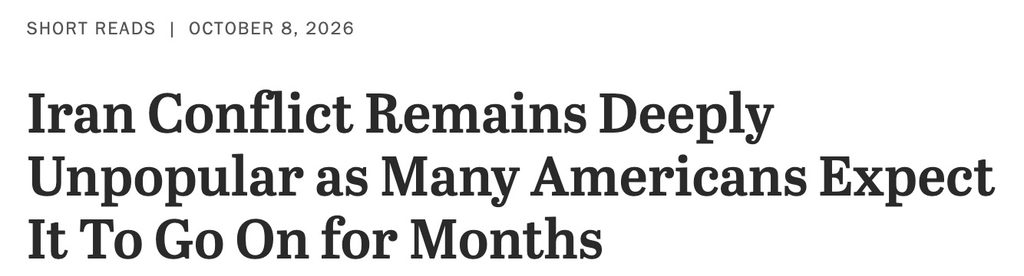
They could spend 10 minutes every morning with Google News over their first cup of coffee and understand that ending the unpopular war is a political necessity. Vance didn't crack open a safe to show off the previously hidden crown jewels. Like the Soviet ambassador says in Doctor Strangelove, "Our source was the New York Times."
Armed with the shocking and deeply buried secret that Americans don't like high gas prices, the Iranians are now empowered to manipulate the negotiations: "But to post it on social media is to tell the Iranians they now have the upper hand in nuclear and Strait of Hormuz negotiations." The premise fails if literally any Iranian owned a computer with a web browser before the exact moment Vance posted. The mullahs have set a tone in their response to the war, and their frequently absurd confidence isn't a sudden response to a new message.
The process of the US's collapse has accelerated.
— Ayatollah Mojtaba Khamenei (@MKhamenei_ir) November 4, 2026
They've been doing the "Death to America" thing for a while, and have developed a certain consistency of perception. They embody the old joke about playing chess with a pigeon: They always think the enemy is desperate. No one in Tehran leapt out of his chair this week and shouted, "Their vice president just revealed that the war is unpopular! This changes everything!"
The Federalist was unable to get a comment on the Journal's editorial from the vice president's office, but former Vance adviser Steve Cortes told us that the editorial made a "patently absurd" argument. The Iranian leadership, Cortes said, is "dangerous and even evil, but they're not stupid." They already knew the war was unpopular among Americans, because they can read. The vice president, Cortes told The Federalist, is thinking about America and America's interests.
Rendering the choice binary, go to war / don't go to war, the Journal evades the enormously important question of how the Trump administration went to war. Whatever you think of Colin Powell, his view that Americans have developed a habit of sending the military to war without assuring that the country regards itself as being at war was not wrong. Powell argued that the United States shouldn't go to war without a clear military objective and a view of what the end will look like: Why are we doing this? How will we know when it's over and we've won?
But the president didn't open the war with a message to Congress or a primetime address to the nation. He didn't explain. And the administration and the people giving advice to the president have made the ridiculous choice to continually underplay and dismiss the whole thing: No big deal, over in a jiffy, pay it no mind. Gas prices, they've said over and over again, will be a little high for a couple of weeks.
Marc Thiessen didn't just claim the Iran war would be easy-peasy, he also lied about gas prices and their political effects for the last nine months.
— Sean Davis (@seanmdav) November 5, 2026
Thiessen claimed gas prices would barely go up, then claimed they'd go up but only for a few weeks, then said gas would obviously… pic.twitter.com/UCoMJGpbsF
"This'll be over by August, by the end of August. And we'll have two months before the midterm elections for gas prices to come down and for Americans to sense victory." That wasn't true, and you can't honestly discuss the war as a political topic without taking on this point. The Journal simply doesn't. They slide around the failures in political communication without deigning to mention them. That choice doesn't work.
Special notice is needed here for the maneuvers the Journal attempts around the topic of illegal immigration and the enforcement of immigration laws. Looking at voters, they say this: "Fifty-eight percent also say Trump immigration enforcement went too far." After a four-year period in which the southern border was wide open and somewhere north of 10 million unvetted people walked across it, what does this mean? Can they define an alternative version of immigration enforcement that would be perceived as going just far enough?
What happened in 2025 and 2026 was that Democrats and the media acted out an information operation in which the ordinary enforcement of immigration laws, which are not a new invention of the second Trump administration, became cruel and extreme acts of kidnapping. That rhetoric was always complete nonsense, and it's embarrassing to accept that framing at face value. During the Obama administration, CNN embedded with ICE agents for a long story about their important work:
Ten years later, they're pretending that ICE arrests are a shocking new development that amounts to bizarrely aggressive state kidnapping. We all need to stop playing along with this calculated fearmongering.
Finally, the Journal writes, "Mr. Vance set up a straw man by warning against 'establishment' calls for 'amnesty' that no Republican is calling for." But this is make-believe around the performance of pretending to use different words. In a message that several other Republican members of Congress echoed, Republican Florida Rep. María Elvira Salazar called on Trump to give illegal immigrants "a dignified life in this promised land." See, that's not amnesty, that's just a permanent waiver of immigration laws that lets people who entered the country illegally stay here forever.
Honest politics, if such a thing is possible, starts with openness and clarity. The Iran war and its domestic effects are unpopular, and at the very least offer a warning about making the case for war to Congress and the nation. There are lessons to be learned. It's sort of baffling that we're still trying to start learning lessons about going to war in the Middle East. But it's not bad news that an elected official said what he thinks, so we can consider his argument and discuss it. That should be regarded as normal behavior.
Source link