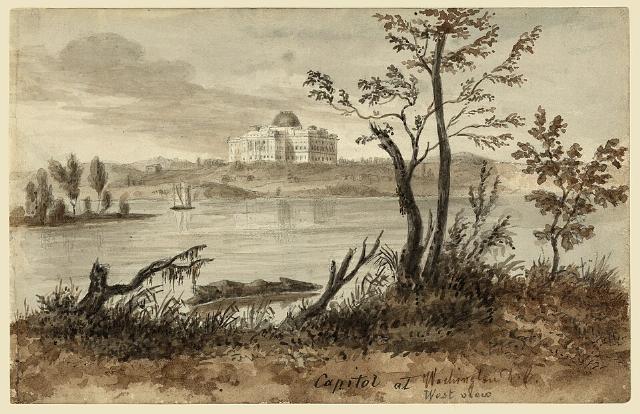
From Wikimedia Commons: Capitol at Washington D.C. (Augustus Kollner, 1839)
The federal architecture of the United States has always carried a burden heavier than mere utility. From the earliest days of the republic, the design of public buildings served as a deliberate assertion of national identity, a visible claim to civilized continuity with the deepest sources of Western political wisdom. George Washington and Thomas Jefferson understood this with clarity rare among statesmen.
Washington and Jefferson conceived the capital on the Potomac as a New Rome, a city whose forms would declare that the American experiment rested upon the enduring achievements of antiquity rather than upon the transient enthusiasms of the moment. The classical vocabulary that they employed—porticoes, colonnades, pediments, and domes of measured proportion—was no ornamental affectation. It constituted a public language of civic virtue, republican restraint, and institutional permanence.
Pierre Charles L'Enfant's plan for Washington embodied the ambition of his employers in urban form. A regular grid was overlaid with broad diagonal avenues that recalled the processional ways of Rome and the axial compositions of the European baroque. Public buildings were placed upon commanding elevations, echoing the temples that once crowned the Capitoline Hill. The National Mall was conceived as a vast open axis joining the legislative and executive centers, a space of collective movement and civic spectacle.
Jefferson, for his part, favored the Palladian villa as the model for the President's House and looked to the Roman Pantheon for the rotunda of the Capitol. These choices were ideological as much as aesthetic. Greek and Roman forms signaled to a skeptical world that the new republic claimed legitimate descent from the birthplaces of democracy and the traditions of law-governed liberty. Monumental stone construction projected confidence in the permanence of the constitutional order and in the continental destiny of the nation.
For more than a century and a half, the classical consensus largely held. Federal buildings spoke a common architectural dialect of symmetry, human scale, and material dignity. Then, in the decades after WWII, the consensus fractured. The 1962 Guiding Principles for Federal Architecture discarded any preference for traditional styles in favor of an undefined "contemporary" approach. Efficiency, rapid construction, and the prestige of international modernism became the governing criteria. Limestone and marble yielded to raw concrete, steel framing, and modular precasting. The resulting structures abandoned the rhythmic fenestration, street-level engagement, and proportional harmony that had characterized the classical city. In their place rose fortress-like masses whose aggressive profiles and blank surfaces announced bureaucratic power rather than democratic invitation.
The consequences are visible throughout the capital. The Robert C. Weaver Federal Building presents a raised concrete volume that floats above the street, indifferent to the colonnaded tradition of civic presence. The J. Edgar Hoover Building confronts the passer-by with an austere, impenetrable facade that rejects both transparency and human scale. The Hubert H. Humphrey Building deploys heavy sculptural precast forms that rupture the neoclassical sightlines of its surroundings. Unaccountable as isolated failures of taste, these buildings represent a systematic repudiation of the architectural language through which the republic had once articulated its claim to civilized identity.
Critics of the architectural transformation have not been lacking. The National Civic Art Society, under the leadership of Justin Shubow, has repeatedly documented the oppressive character of these mid-century concrete monuments and their corrosive effect upon the public realm. Ordinary citizens, less constrained by professional ideology, have long registered their aversion to the grim, labyrinthine, and poorly maintained environments that these buildings create for those who work within them. The architecture projects an image of the state as remote, authoritarian, and indifferent to the lived experience of the people that it claims to serve.
Two thinkers have supplied the most penetrating theoretical assessment of this cultural rupture. Léon Krier has argued with unrelenting force that architectural modernism constitutes a civilizational error of the first magnitude. In his view, the modernist project dismantled the continuous urban fabric that had sustained European and American cities for centuries, replacing mixed-use neighborhoods of human scale with zoned, automobile-dependent wastelands of gigantism. Traditional architecture, for him, is not a style among others but the accumulated practical wisdom of building in accordance with climate, materials, and the permanent needs of social life. Modernism's insistence upon "invention" as an end in itself produced forms that are nameless, placeless, and hostile to the ordinary rituals of dwelling. Krier's call for a return to classical and vernacular construction rests upon the conviction that beauty and durability are not luxuries but moral necessities if cities are to remain civilized places.
Roger Scruton approached the same crisis from the standpoint of philosophical aesthetics. Beauty, he maintained, is not a subjective preference but a fundamental human need, the visual order that allows us to feel at home in the world. Classical architecture meets this need by employing a shared grammar of proportion, hierarchy, and symbolic resonance that connects the individual to a larger tradition of settlement. Modernist buildings, by contrast, generate a condition of metaphysical homelessness. Their glazed facades and abstract volumes refuse the face-like quality that classical columns and cornices once conferred upon the street. In Scruton's analysis, the modernist city becomes a frozen junkyard in which nothing sacred remains, a landscape of alienation that mirrors the spiritual desolation of a culture that has severed itself from its own past.
The recent executive order designating classical and traditional architecture as the preferred style for major federal buildings constitutes a partial recognition of past ideals. By establishing neoclassical, Greek Revival, and Beaux-Arts forms as the default for significant public projects, particularly in the District of Columbia, and by requiring explicit justification for modernist alternatives, the directive attempts to restore a measure of architectural continuity with the founders' vision. The opposition mounted by professional organizations reveals the depth of the ideological cleavage. What presents itself as a defense of creative freedom usually functions as a defense of institutional monopoly, an insistence that only the stylistic orthodoxy of the postwar decades may claim legitimacy.
With its deep historical roots, the ongoing conflict is not merely aesthetic. It is one front in a larger struggle over the meaning of American identity. On one side stand those who regard the classical inheritance as a living resource, a means of recognizing and inhabiting the civilized origins of the republic in the present. On the other stand those for whom that inheritance is an embarrassment, an obstacle to the perpetual reinvention demanded by progressive ideology. The Brutalist structures that still scar the capital stand as monuments to the second view: concrete assertions that the past must be repudiated rather than renewed.
To be sure, the stakes are higher than the appearance of government offices. Architecture shapes the moral imagination of a people. Generally speaking, buildings that embody proportion, durability, and civic dignity encourage the virtues necessary for self-government. By contrast, buildings that embody aggression, anonymity, and planned obsolescence train citizens in resignation and disconnection. Washington and Jefferson built in the classical manner because they understood that a free republic must look like one. The intervening decades of modernist experiment have demonstrated the costs of neglecting that insight.
Whether the present generation, typically preoccupied with relativistic self-destruction, truly possesses the insight and cultural confidence to adopt the visions of the Founding Fathers is highly uncertain. That the concrete fortresses are allowed to remain standing and cast their shadows, reflecting the legacy of social engineers such as Le Corbusier and Mies van der Rohe, suggests that the synergistic forces of historical amnesia and covert aggression towards Western tradition retain considerable power.
Source link