By Matt Junker and Kristian Moravec of the Maine Monitor
Future U.S. Sen. Troy Jackson did what no other Maine Democrat could for three decades: He took down Susan Collins.
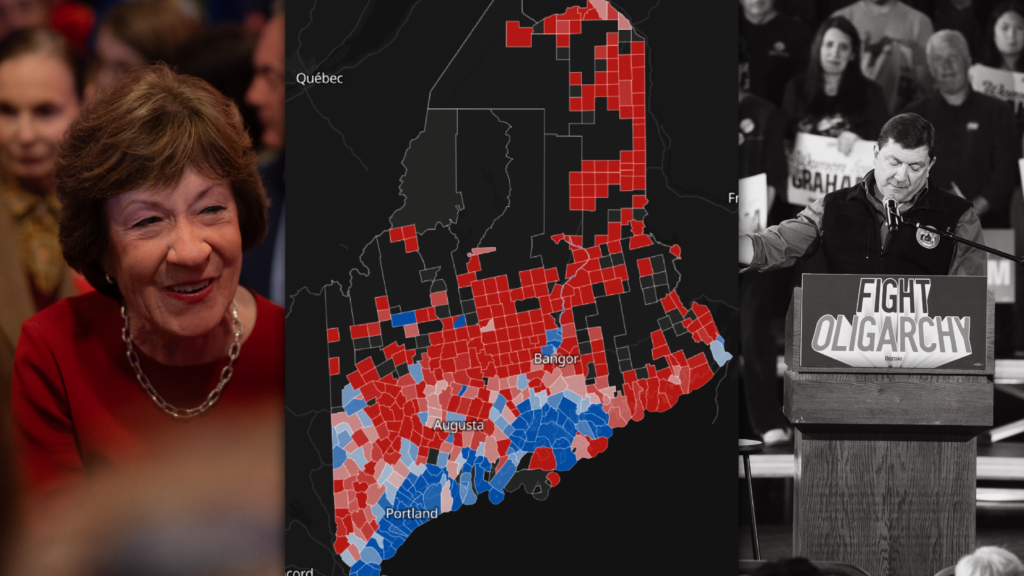
Jackson did it in part by flipping the script on Collins in 45 municipalities that the formidable Republican incumbent won in 2020, based on a Maine Monitor analysis of data from The New York Times.

When Collins defied the polling in 2020 and held on to beat former Maine Speaker of the House Sara Gideon, that path to victory included wins in some of Maine's largest communities such as Lewiston, Bangor and Auburn. This year, those three cities switched to support Jackson.
Jackson cruised to an 8-point victory in Lewiston, Maine's second-largest city and home to nearly 24,000 registered voters, after Collins secured a 2-point win there six years ago. In neighboring Auburn, Jackson upended Collins' 8-point victory from 2020 with a 5-point win of his own this week. And in Bangor, Maine's third-largest city, where Collins had eked out a win by less than a percentage point in 2020, and where her campaign was hosting its watch party on Tuesday night, Jackson stormed to a 16-point victory.
But it wasn't just the larger cities that flipped for Jackson. With 95 percent of votes reported Wednesday afternoon, Jackson also appeared to have won in smaller towns such as Tremont, Montville, Veazie, Bristol and others that previously voted for Collins.
Voters across the state, in both the large cities and small towns that flipped, provided some insight into their choices in the Senate race while leaving the polls on Tuesday.
John Cleveland, 76, is one of Auburn's nearly 16,000 registered voters. He told The Monitor that he thought Jackson was a "competent candidate" after observing his work for decades as a state lawmaker, including a stint as president of the Maine Senate from 2018 to 2024.
"He's focused on working citizens, working-class workers, and he certainly is willing to stand up to the president," Cleveland said. "Susan Collins clearly has not been."
In Stockton Springs, 84-year-old Bonnie-Jean Brooks said she has voted for Collins in the past but felt it's been more difficult in recent years to meet with the five-term senator and have her listen to issues.
"I think that Troy Jackson brings a fresh face at a time when we need a fresh face," Brooks said. "He is not going to be bought and sold. He's going to bring new blood, and we need new blood in Congress. There's no question about that."
Lewiston voter Colby Hunter, 33, felt that both the Republican and Democratic parties "say the same general things are important," but thought that Jackson and the Democrats "promote more access to housing and more affordability, which is important to me."
And in Bangor, at least one couple liked Collins as a candidate but wanted their votes to stand as a repudiation of President Donald Trump.
Natalie Rhoads, 30, said both she and her husband voted for Jackson even though she thinks the Democratic Party has been producing some "really weak" candidates.
"I do think Susan Collins is a strong candidate," Rhoads said. "But unfortunately, just what Trump is doing right now is something that I really can't get on board with."
Of the 45 flipped municipalities that The Monitor identified in the Times data, 10 have more than 5,000 registered voters as of 2025; nine have between 2,500 and 5,000 voters; and the others have fewer than 2,500 voters.
These cities and towns, from largest to smallest based on 2025 voter registration data, are Lewiston, Bangor, Auburn, Gorham, Windham, Augusta, Wells, Berwick, Old Town, Farmington, Gardiner, Raymond, Arundel, Durham, Sanford, Wiscasset, Boothbay, Bristol, Bowdoinham, Bethel, Thomaston, Searsport, Boothbay Harbor, West Bath, Nobleboro, Pownal, Veazie, Stockton Springs, Surrey, South Thomaston, Trenton, Tremont, Lubec, Appleton, Owl's Head, Lovell, Penobscot, Wayne, Montville, Monroe, Greenwood, Westport Island, Southport, Stow and Stoneham.
The data from The Times did not yet include complete results for each of the municipalities as of Wednesday afternoon. Almost all of the 45 towns that flipped from Collins to Jackson had reported more than 95 percent of their results by 3 p.m. on Wednesday, and one, Sanford, had reported 92 percent. If the remaining results yet to be included in The Times data were to be drastically different from the existing returns, that could impact Jackson's final town-by-town win percentages slightly.
Of course, Jackson's victory cannot be solely explained by the towns that he flipped from 2020. He also expanded on Gideon's lead in Democratic strongholds such as Portland. And Collins saw her level of support slip even in some places that she still won comfortably.
Take the small Penobscot County town of Newburgh, where Collins enjoyed overwhelming support — just not as much as she did in 2020. The town of just over 1,000 registered voters supported her by a 40-point margin in 2020. That dipped to 33 percent this year.
Newburgh resident Chad Howland, 48, said that he has supported Collins in the past but voted for Jackson this time around. Howland's top concerns this election were the war in Iran and escalating fuel prices, and he said he felt the country needs to shift in the last two years of the Trump presidency.
"It's not that she hasn't done right by Maine, but she's been in the Senate for a very long time," Howland said about Collins after voting at the Newburgh Town Office on Tuesday. "It may be time for some change."
This story was originally published by The Maine Monitor, a nonprofit and nonpartisan news organization. To get regular coverage from The Monitor, sign up for a free Monitor newsletter here.
Source link