The grocery receipt is where inflation arrives. It is not where inflation begins, and any politician who tells you otherwise is either innumerate or lying.
For millions of Americans, the economic debate has been reduced to terms even Washington cannot obfuscate: the price of food, the mortgage nobody can qualify for, the insurance premium that arrives like a subpoena. The distance between a paycheck and the obligations waiting for it has been shrinking for four straight years while the people responsible insisted everything was fine.
It was not fine. The reason has a name, a date, and a price tag, all of which the last administration would prefer you forget.
Political discourse begins its analysis now the public feels the pain, never at the moment the decision that caused it was signed into law. By the time the receipt lands on the counter, the men who wrote the check are gone, replaced by successors who inherit the bill and get blamed for it.
This is the first battle of the coming elections: consequences versus causes. It is a battle the left is desperate to fight on any ground except the historical record.
The Receipt Arrives After The Purchase
Inflation is the most politically radioactive word in America because it requires no economist to explain it. Nobody needs a Fed press conference to understand why their cart costs thirty percent more than in 2020.
One side asks who is responsible for fixing today's conditions. The other, the side occupying my sympathies, asks what decisions produced those conditions in the first place.
Both questions have merit. Only one has the courage to look in a mirror.
A president inherits an economy on day one, not a blank slate. The environment a new administration walks into is the residue of prior choices: spending bills, monetary expansions, regulatory throat-clearing, energy policy written by people who have never worried about a heating bill. These decisions operate on timelines longer than a news cycle, which is why they are useful to the people who made them and damaging to whoever comes next.
The public lives in the present tense. Policy lives in the pluperfect. In that gap, an entire political class has built a comfortable racket of never being blamed for anything it did.
The Inflation Nobody On The Left Wants To Own
Let us be honest about origins, since honesty is apparently now a niche political position.
Yes, the pandemic disrupted global supply chains. Yes, energy markets were rattled. These are true statements, and the left's favorite hiding place, because they let inflation be discussed as though it were a hurricane nobody could have prevented.
It was not a hurricane. It was a policy.
The American Rescue Plan dumped roughly two trillion dollars of freshly conjured federal spending into an economy already short on the goods it needed to sell you. This was not stimulus in any meaningful sense; the economy was recovering, not dormant. What it got instead was a fire hose of demand aimed at a supply chain still gasping for breath, financed by a Federal Reserve that kept rates pinned to the floor long after the data screamed otherwise.
Two trillion dollars in new demand meeting constrained supply is not a mystery. It is arithmetic, the kind Milton Friedman explained to classrooms decades before the Biden Treasury Department decided the rules of monetary gravity had been suspended for their benefit.
Nobody is arguing a single bill or a single Fed chairman conjured every price increase alone. What is being argued is that causes matter: the American Rescue Plan and the monetary accommodation beside it were not bystanders to the inflation that followed but among the principal authors of it. The administration that signed the check spent four years insisting the bill did not exist.
Inflation is not weather. It does not simply arrive. It is manufactured, sometimes deliberately, more often out of the overconfidence that afflicts men who have never balanced a checkbook of their own.
Inflation Is Not The Same As Affordability
Here is where the debate turns genuinely dishonest.
When the inflation rate slows, the White House press office throws itself a party. Families do not pay the inflation rate. They pay the prices inflation already built into their monthly budget.
A grocery bill that rose thirty percent over three years does not fall back to earth because next year's increase is a modest three percent. A mortgage that became unreachable when rates doubled does not become reachable again because the rate of increase has slowed. Washington congratulates itself on the second derivative while families drown in the first.
This is not a technical quibble. It is the sleight of hand the Democratic Party and its allied press attempted for four years: measuring their own performance by the speed of the wound's growth rather than its size.
The Affordability Mirage, And The Blame Transfer That Followed
For four years, the Biden administration's official position on affordability was denial. Inflation was transitory, until it wasn't. It was Putin's fault, until that excuse curdled. It was corporate greed, a theory requiring belief that corporations discovered greed in early 2021.
Then, the moment a new administration took the wheel, affordability was rediscovered by the same party that had spent four years insisting the economy was the envy of the world. The word became a cudgel against the men now holding a bill written by their predecessors, prices already baked into the system before the new Cabinet was chosen.
This is the blame transfer machine in its purest form, and it will be the subject of Part II. For now, note this: the same voices who spent four years minimizing, externalizing, or denying any responsibility for the problem spent the fifth demanding someone else solve it, without credit to the men who caused it.
The First Battle Of 2028
The coming elections will not be fought only over numbers. They will be fought over narrative, terrain the modern left prefers, because facts have a stubborn habit of aging badly for whoever misrepresented them.
One argument focuses entirely on the present, as though history began the day the current occupant was sworn in. The other, the one this series makes across five parts, insists on the chain of decisions that produced the present, holding the authors accountable rather than letting them hide behind their successors.
The question voters will answer is not complicated. Do you judge leadership by the problems it inherited, or the decisions it made? That question reaches into energy policy, the border, and a national debt both parties pretend to fear, and neither shows any willingness to address.
Every issue has a timeline. Every consequence has an author. The fight of the next several years, and the animating premise of this series, is a fight over memory itself: whether the American voter will be permitted to remember who did what, or be talked, gently and repeatedly, into forgetting all that happened.
Elections are fought over consequences. History, when written honestly, is written about causes.
We intend to write it honestly.
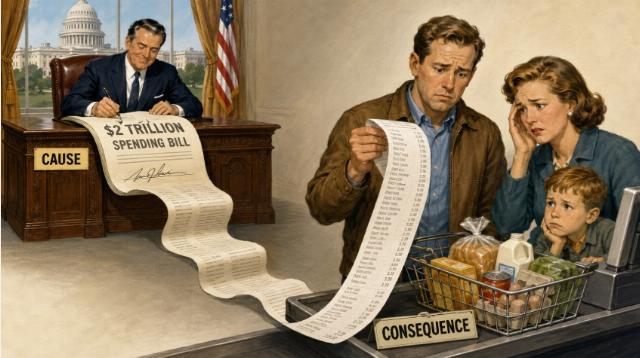
Image created using AI.
Luis Gonzalez writes on power, politics, and the systems that quietly shape everyday life. Since founding Boiling Frogs in 2008, he has explored politics, culture, history, and the human stories beneath the surface. His work continues there, expanding into politics and current events at The Last Wire, where he examines the forces behind the headlines, the institutions behind the decisions, and the deeper currents that influence society. His essays blend history, analysis, and personal perspective to ask not only what happened, but why it matters.
Source link