China and Djibouti released a joint communique on Thursday supporting freedom of navigation in the Red Sea and Bab el-Mandeb Strait, which are currently under threat from the Iran-backed Houthi insurgents of Yemen.
The statement was issued after Djibouti's Foreign Minister Abdoulkader Houssein Omar met with Chinese Foreign Minister Wang Yi in Beijing.
"The two sides emphasised the importance of safeguarding freedom of navigation in the Red Sea and the Bab al-Mandeb Strait and stressed that the navigation rights exercised by merchant vessels of all countries in accordance with international law should be respected," the communique said.
"China supports Red Sea coastal states in constructively safeguarding the unobstructed and secure operation of international shipping lanes and protecting the region's common interests," it added.
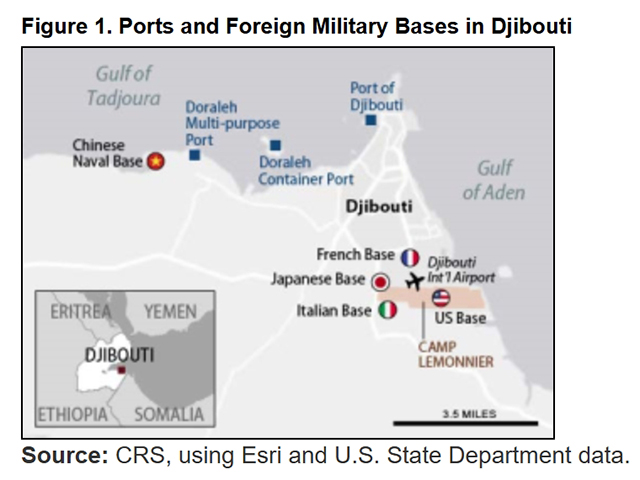
Djibouti is a small state across the Bab el-Mandeb Strait from Yemen. China's only acknowledged overseas naval base was established in Djibouti ten years ago and was recently upgraded with enhanced intelligence-gathering capabilities.
The People's Republic of China (PRC) has become the top foreign investor in Djibouti, pumping money into port facilities, railroads, and gas pipelines as part of China's Belt and Road Initiative (BRI). As usual with BRI client states, Djibouti has accumulated enormous debt to Chinese banks, which gives Beijing a great deal of leverage over the small Horn of Africa state.
U.S. officials have grown increasingly wary of China's presence in Djibouti, as the Chinese naval base sits along one of the world's busiest shipping lanes, and the People's Liberation Army Navy (PLAN) base in Djibouti is less than ten miles away from Camp Lemonnier, the primary base of operations for the U.S. Africa Command (AFRICOM) in the Horn of Africa.
China certainly has strong reasons to want safe passage for commercial vessels through the Bab el-Mandeb Strait, with some $120 billion in imports to China and $160 billion in exports flowing through Red Sea shipping routes. China would suffer as much as any other oil buyer, and perhaps more, if Houthi terrorism shut down the alternative Red Sea oil flows that were created to work around the Strait of Hormuz.
The Diplomat found the China-Djibouti communique disappointing, a symbolic expression of concern stuffed with generic demands for "all parties" to commit to "easing tensions" that was mostly of interest as China's first joint statement with a Red Sea nation.
The only potential threat to Red Sea shipping is the Houthis, who waged a campaign of piracy during the Gaza War and have threatened to do it again, so mumbling about "all parties" will only encourage the Houthis to think they would be rewarded with concessions for further terrorism.

A supporter of Yemen's Houthi rebels carries his rifle during a rally in support of the group in Sanaa, Yemen, Friday, October 9, 2026. (AP Photo/Osamah Abdulrahman)
"The Horn of Africa must never be used as a geopolitical arena, and the flames of war in the Middle East must never be brought to the Horn of Africa," the China-Djibouti statement said. Only Iran and its Houthi proxies are threatening to do that, and China offered no clue as to how it might snuff those "flames of war" if the Houthis decide to ignite them.
"During their talks, Wang told Omar that China will 'support' Djibouti 'in building itself into a regional hub for trade, logistics, and connectivity.' But Djibouti's ambitions — and China's billions in investments — have little hope if the Red Sea is closed to shipping by militant attacks," The Diplomat noted.
The South China Morning Post (SCMP) on Thursday quoted "Chinese analysts" who said "the situation in the Red Sea had not yet escalated to a level that warranted direct naval escorts, though Beijing would closely monitor the region and might take action if the country's shipping came under threat."
Source link