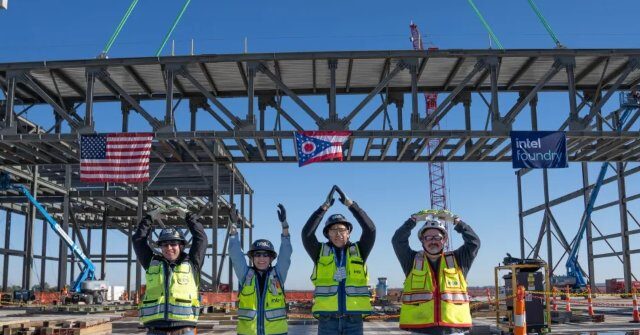
Intel has announced that workers installed the first major structural truss at its new chip factory in New Albany, Ohio, a milestone the company is celebrating after years of project delays. The company envisions the massive project as a new “Silicon Heartland.”
CNBC reports that the Ohio site, located just northeast of Columbus, was announced in 2022 with production originally expected to begin in 2025. That date has long since passed. Intel now says construction on the first fab will wrap up in 2030, with a second fab at the same site targeted for 2031.
Naga Chandrasekaran, who heads Intel Foundry, wrote in a post on Intel’s company website that “this represents another significant step toward expanded U.S. leading-edge semiconductor capacity.”
The slower timeline reflects a broader rethinking of Intel’s foundry strategy under CEO Lip-Bu Tan, who took over in 2025. The Ohio build-out began under former CEO Pat Gelsinger, but Tan has taken a more cautious approach, preferring to wait for confirmed customer demand before committing to fab expansions.
That caution shows up elsewhere too. Intel announced on October 21 that its next Arizona fab is expected to begin operations by the end of 2028. The company is already in high-volume production at its existing Arizona fab, where it makes 18A chips, a milestone reached by late 2025. But Intel has not yet signed a major outside customer for those 18A chips and is currently using them for its own processors.
There are signs of outside interest, though. In September, reports emerged that SK Hynix could lease foundry space at the Ohio site to produce memory chips, though neither company has confirmed a deal.
Dan Hutcheson, an analyst at TechInsights, said major chipmakers have reasons to look beyond Taiwan Semiconductor Manufacturing Co., the dominant player in the industry, which has struggled to keep pace with AI-driven demand for chips. “People want a second source to be able to twist TSMC’s arm and keep them honest on pricing,” Hutcheson said. He added that “all the big ones have been testing there,” referring to interest in Intel’s fabs.
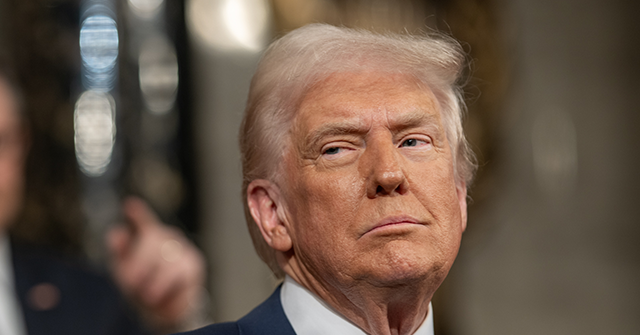
Donald Trump negotiated a 10 percent stake in Intel for the United States in 2025. Breitbart’s John Carney explained why this is not socialism in the Breitbart Business Digest:
Julius Krein, editor of American Affairs, has been arguing that America's capital markets are structurally incapable of funding the industries the nation actually needs. Last week's deal gave him a live-fire case study.
For decades, U.S. corporate strategy has been to maximize shareholder value, not profits, Krein has argued. The two overlap only sometimes. That's why companies cling to hurdle rates of fifteen percent even when the true cost of capital is half that. A project that could return a solid seven or eight percent will be passed over, because it drags down return-on-assets ratios and puts the multiple at risk.
The result is chronic underinvestment in precisely the sectors that matter most: capital-intensive industries like chips, energy hardware, aerospace, and defense. Wall Street prefers "asset-light" software firms, where margins are fat and capital commitments small. Nikefication—separating design rents from the messy work of production—became the model. America congratulated itself on "tech dominance" even as it outsourced the industrial backbone to Asia.
The outcome is visible in the semiconductor market: Intel hollowed out, Taiwan's TSMC in command. Conventional subsidies barely scratch the surface because the market structure itself tells executives not to invest no matter how much Congress appropriates.
Read more at CNBC here.
Lucas Nolan is a reporter for Breitbart News covering issues of AI, free speech, and online censorship.
Source link