
David Henty has a very strong work ethic. He rises every day at about 5am, has a quick coffee, sets up his easel and palette – sometimes on the roof terrace of his home in Saltdean, near Brighton, sometimes in the kitchen – and then he begins.
'I start by doing lots of special breathing and meditation to open the pineal gland in the back of the brain that lets you look through your third eye,' he explains.
When he's shut out all white noise, he begins channelling. 'I sort of imagine I'm sticking my finger in the light socket of the universe, picking up frequencies and wavelengths until I'm in a sort of 'flow state' of mind and can start downloading the great masters.'
Which is when, finally, he picks up his brush and starts painting. Perhaps a couple of small Lowrys – 'I've painted more Lowrys than he did!' Or a Picasso – 'so quick and easy'.
Or maybe a soothing Modigliani. Or a quick Van Gogh – 'When he's good, he knocks it out of the park. But when he's off, he's not all that.'
But his favourite is Caravaggio. 'I love him. All that light and dark – it's more how I would paint. At the moment I'm working on his St Jerome Writing in my kitchen and, as a mark of respect, I'm finishing it with my left hand, because he was left-handed, even though I'm not.'
Henty is an art forger. By his own account, the very best art forger in the world, and extremely proud of his work.
He has a blue plaque by his front door – fake, obviously – which declares him 'The World's Number One Art Forger'.
Fine art forger David Henty pictured at The Helm gallery in Brighton alongside his paintings
His car has the number plate 'V9OGH' and his home is filled with Banksies, Rembrandts, Vermeers. Somewhere, downstairs, there's a Mona Lisa.
And what makes him so good, he insists, is this unusual ability to immerse himself in whatever artist he is copying. Van Gogh, in his penury. Caravaggio in his dark cloaks.
Picasso and Lowry with their quick strokes and confidence.
Which, naturally, sounds like a right load of old bunkum. But it turns out that Henty is fantastically successful at his (or, perhaps more accurately, other people's) craft, with his work constantly being mistaken for the real thing – not just by collectors, but by auction houses, gallerists and forensic experts.
So much so that we are standing in a new exhibition of his work in the Helm Gallery in Brighton – surrounded by recognisable masterpieces by Modigliani, Jean-Michel Basquiat, Picasso, Hirst.
They add up to about £1billion worth in the original – and many are sporting red 'sold' dots.
Oh look, there's Vermeer's priceless Girl With The Pearl Earring – a snip at £9,000. And Picasso's Women Of Algiers, which went for $179 million (£134million) in 2015, for £25,000. And that's Leonardo da Vinci's Salvator Mundi, which broke all records when it sold for $450million (£336million) in 2017.
There's also a lost Van Gogh – Painter On His Way To Work – supposedly destroyed in a fire in 1946. And Carel Fabritius's The Goldfinch. 'They're always very popular,' he says. 'I've done lots of them. A small flock,' he says with a glint.
As well as this exhibition, Henty features as central character in a gripping new thriller by Rob Starr about art and insurance fraud (he's already been the inspiration for Peter James's novel and play Picture You Dead). And a biopic of his extraordinary life is due to launch on TV in China.
'They reckon it'll get a billion views! Then we've got an exhibition in Shanghai!'
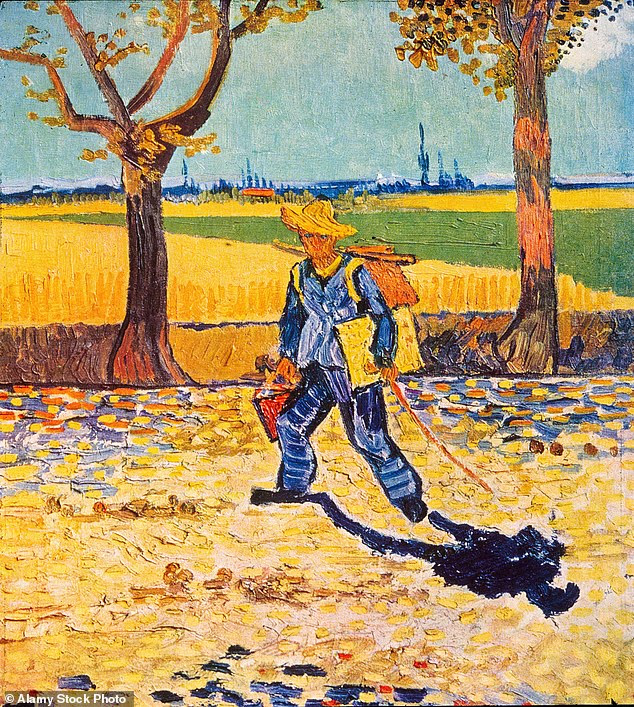
Vincent van Gogh's, The Painter on the Road to Tarascon, painting in oil on canvas
Meanwhile, his email is constantly pinging and his phone buzzing with commissions from clients who include footballers, hedge fund managers, the Cotswolds set, billionaires, shipping magnates, police officers, and a former controversial Tory billionaire donor and pal of Boris Johnson who couldn't stop buying Modiglianis to give away to his pals and still owes him £50,000.
'He'd take them when the paint was barely dry.'
Some want his copies because, rich as they are, even they can't afford the £170 million it would cost for their own Picasso.
Others, because they own the original, but want to keep it safe – perhaps in a tax-free lock up – but also show it off.
His copies are astonishingly good. Too good, some might say. Back in 2016, Henty got a bit of a shock when one of his Picassos turned up at an auction in Brighton – for £1 million.
'It was just a sketch for a bigger work,' he says. 'Picasso's mate Roland Penrose lived down the road from here, so on the back, for a laugh, I wrote, 'To Roland from Pablo' and gave it to a friend. It was definitely one of mine.'
Gave it? 'Yes,' he insists firmly.
Anyway, he came clean – 'I wouldn't normally, but it didn't seem fair' – and the sale was pulled, but the broker, who'd been set to make £400,000, went mad and threatened to burn down Henty's house.
'I had to get security and everything. But it wasn't my fault. It was them that did the crime by selling it on.'
Just last week, he tells me, a group of four huge Basquiat lost canvases from the artist's 'Congo' period popped up for £39.2 million, plus 10 per cent buyer's fee. A pal was interested in buying, until Henty warned him off.
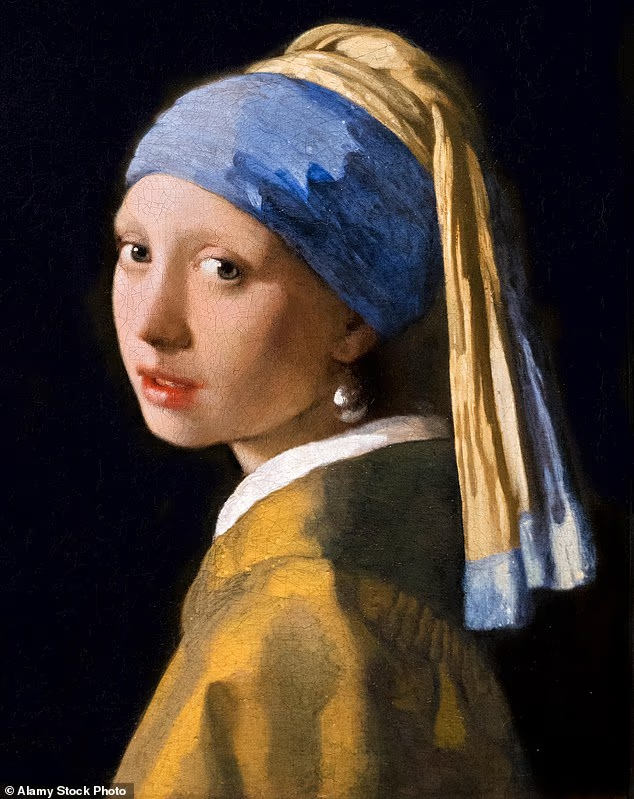
Johannes Vermeer, Girl with a Pearl Earring, on display in the Mauritshuis, The Hague, Netherlands
'I said to him, 'Don't buy them. They're mine!' I painted them last year on some 1970s canvases I'd got from the car boot at Brighton for £60.'
They weren't copies. Knowing some of Basquiat's paintings were lost, he just knocked them out 'in the style of' in a couple of days and sold them for £5,000 but somehow, in the intervening 16 months, they'd acquired provenance – evidence that they were genuine.
So someone was trying to make a lot of money but, again, he insists it wasn't him.
'Mine are copies, not forgeries – not any more,' he adds with a roguish grin. 'My buyers always know that I painted them.'
So while he signs the front as the grand master, they are sold 'in the style of,' or 'after Picasso', or Lowry, or whoever takes his fancy. Because he's very keen not to end up in prison. Not again.
Back in the mid-1990s, he did five years for forging thousands of fake British passports which he planned to sell to anxious Hong Kong citizens ahead of the Chinese handover.
The ruse might have made him millions, if only the words 'Britanic' and 'Magesty' hadn't been mis-spelt.
'I was doing the watermarks not the spelling, but it was bloody annoying,' he says.
Soon after he was released, he was back inside, in Madrid this time, for selling stolen cars. 'I know I know. Stupid. But I was on to a brilliant scam and it was hard to resist.'
Growing up, Henty had always had a rather flexible relationship with the law. His father, a 'completely bent' antiques dealer, was often absent.
His mother wasn't really on the scene at all and Henty and his four siblings ran wild in a council house on the outskirts of Brighton.
'There was very little school, no discipline and we'd nick anything that wasn't nailed down,' he beams.
So when he followed his father into antiques, it wasn't surprising that a bit of fiddling crept in. A touched-up picture here. A forged signature there.
'I'm very good at matching paint,' he says.
But it was in prison that he really honed his craft. Joined art classes, started reading up on the great masters – 'I'd always wanted to study fine art' – and, with the help of two of his brothers, selling dodgy paintings at Bermondsey market.
A quick picture of a cottage garden. A few faked signatures. All when he was in prison. He tells the story of one little picture he bought at the car boot at Arundel and re-signed as a Vanessa Bell.
'I got £700 for it and a couple of years later, I spotted it in a Mayfair gallery for £16,000!'
So he set up on eBay. Selling, selling, selling. At least 1,000 'masterpieces' – Lowrys, Picassos, Singer Sargent. 'I've done so many of some, they're like old friends,' he says. All signed. All, presumably, still out there.
Perhaps because, while his 'channelling' sounds a bit of a shaggy dog stretch, he's always done the legwork. 'You've got to be an art historian – to really know your artists – to be a good forger,' he explains.
So he spent thousands of hours immersing himself in the art world. Studying the works up close in art galleries and auction houses, burying himself in art magazines.
And for one birthday, he booked in for two full days to study Caravaggio's 1601 painting, Supper At Emmaus at the National.
'I just sat there looking at it for hours. To see how he did it. How it made me feel. And when I started dreaming about him, I knew I was ready to start painting.'
Which, he did using correctly pigmented paints. Old canvases from the right era as the artist. And developing clever ageing tricks.
He also has endless 'ageing' tricks – 'I was just ageing a Vermeer this morning with some furniture polish – it's very effective!'
Mostly though, he just stashes them down the side of his log burner until teeny cracks appear in the paint. For the patina, he used to drop the paintings off with his late pal 'Lennie the Bag', a chain-smoker who lived in such a thick smog that it would add a lovely 18th century patina to fake a Rembrandt in a couple of weeks.
And if he's really going to town, he might accidentally drop a fibre from an 18th century apron, or similar, into the paint, so it dates itself.
It must have been a massive blow when it all came crashing down in 2014 following an investigation by a national newspaper and he was banned from trading on eBay.
Though not prosecuted because, legally, he wasn't doing anything wrong – though of course some of the people paying hundreds and thousands for his copies, clearly were. 'If they sell it on, it's their crime, not mine.'
But as luck would have it, instead of heralding the end, the exposure attracted a whole new set of buyers, with a lot more money.
'It was brilliant!' he says. Because today, they come to him, paying £25,000 for a Picasso that might take him half a day which seems bonkers but one thing is certain, he is exceptionally good at his craft.
As a result, there are hundreds, perhaps thousands, of his fakes masquerading as the real thing and bristling with security, alarms and infra-red lights.
So finally, for the billion dollar question: Does he feel guilty? 'No! It's not really my problem is it? It's just a bit of fun.'
Source link