By Michael Every of Rabobank
The Heat You Feel Isn't Just The Summer Sun
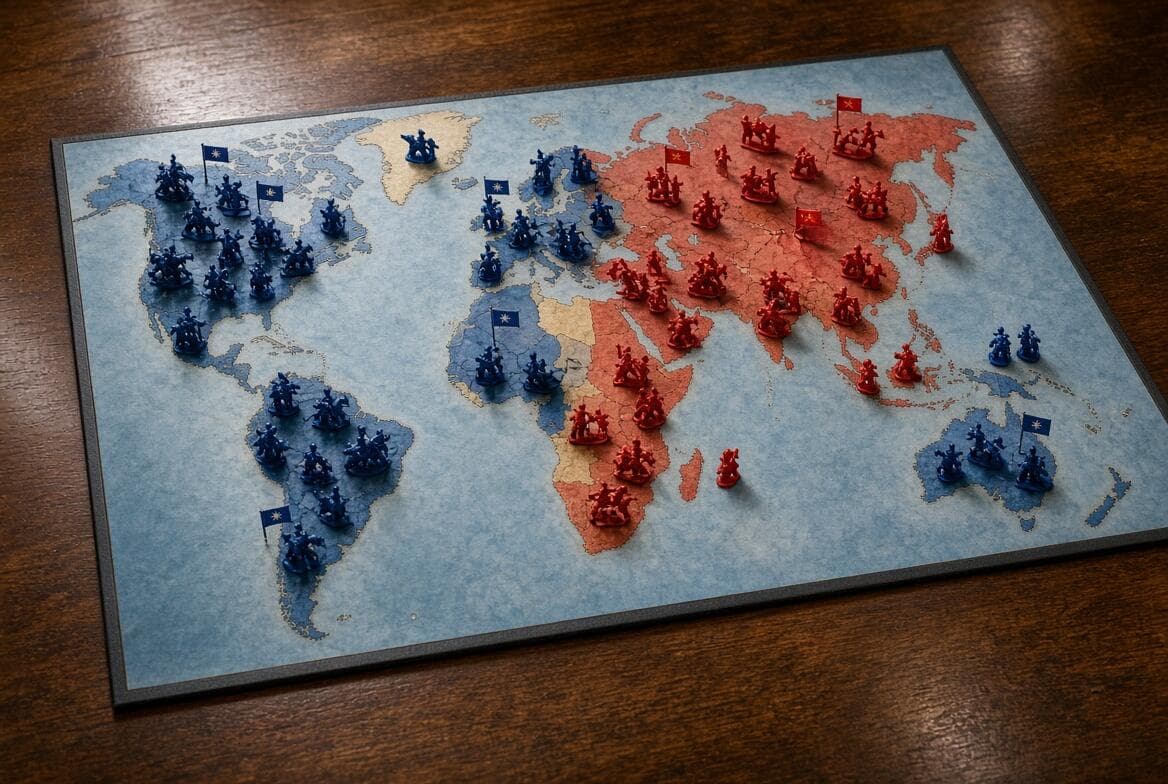
There is a lot of geopolitical heat out there right now; and markets may get burned by it.
The 60-day US-Iran Memorandum of Misunderstanding has lapsed, with Trump and Iran both rejecting any extension while claiming control of Hormuz. In our view, the US is unlikely to restart major military action until after the November midterms. (Note the US just awarded a $23bn contract to Raytheon to accelerate annual Tomahawk missile production to over 1,000 from the current 60 alongside a $59bn Lockheed Martin deal to ramp up Patriot interceptor output from 600 to 2,000.)
Trump's threat to bomb Oman is public diplomacy matching what Tehran threatens privately to ensure Muscat doesn't close off the southern Hormuz passage allowing ship-to-ship oil shuttling that, according to the US, is seeing significant flows. The Saudis are now offering to sell oil near Oman; a sign they may be copying the UAE. That doesn't help with refined products, where the US will announce steps to boost refiners' throughput: by running at 120% of capacity?
Diesel crack hits record 2. This is absolutely unprecedented.
— zerohedge (@zerohedge) August 17, 2026
Industrial economy either grinds to a halt or consumers about to be hit with the biggest energy pass through in history pic.twitter.com/OtAdgrCvb3
However, as previously argued, relative energy calm incentivises Iran to escalate sooner. Israeli intel claims Tehran has achieved a remarkable recovery in its ballistic missile production by ignoring the needs of the civilian economy; the Wall Street Journal reports Iran is preparing to foment unrest in the Gulf, cut undersea internet cables, further destabilize the Red Sea via the Houthis, and move troops into Kuwait to force the US into a boots-on-the-ground game. Despite US efforts to stabilize Lebanon (by disarming Hezbollah) and Gaza (by disarming Hamas), the above dynamic could destabilize the entire Greater Middle East region.
Meanwhile, tensions remain high on the Russia-Ukraine front. Speculation is that after the Duma elections on September 18-20, Putin may escalate via mobilization and closing the border; far less likely, a tactical nuclear strike; or a move vs. a Baltic state. The latter would aim to test NATO's Article 5 resolve within Europe and from the US. This could be coordinated with Iran.
North Korea may also send another 50,000 men to Ukraine. That's as China-friendly South Korean President Lee is proposing an end to the war with the North, arguably why Trump called to scale back scheduled joint military drills. In reality, that claim was too close to their start to make any difference, but was Trump warning Seoul or helping its bid to restart talks with the North while thinking of Ukraine? We shall see – but simplistic takes of the US 'walking away from Asia' are categorically wrong when looking across other news and developments - including Japan revising its national security doctrine after Putin visited the Kuril Islands, which Moscow has held since the end of WW2, to send Tokyo a warning message.
Last week, we had news that the US set 'ideological loyalty tests' for NATO members, including asking about stances on Iran. As Bloomberg put it, this "would upend the post-WW2 transatlantic relationship, which was built on US military guarantees that superseded many political disagreements." Yet NATO's website states it was created to: "Deter Soviet expansionism"; "Forbid the revival of nationalist militarism"; and "Encourage European political integration." That is ideology – and Soviet expansionism was global. One can argue the US is -- rudely -- pushing Europe and Canada to look at new ideological threats, globally and towards integrating with it – albeit on its terms.
Matching that, last week saw a US report naming European countries among those helping China to trans-ship goods to avoid US tariffs.
As Canada braces for 50% US tariffs, the geostrategic logic is clear: either a common external tariff vs. China and trans-shipment, or a higher US tariff vs. those who refuse. Likewise, the US is now telling global partners they cannot be part of its critical minerals and chip/AI Pax Silica and also be members of China's World Artificial Intelligence Cooperation Organization. That's as the EU's Mistral has adopted a Chinese AI as the core of its latest model.
As warned for years, the US looks like it's going to force others to take sides – as will China. That includes US institutions: the Pentagon just ordered 30 US universities to scrutinise their ties with Chinese research partners; and Google just announced it will stop making its Pixel products in China from next year.

For markets, Middle East military escalation is likely to see further spikes in global energy prices; if Russia escalates in tandem, things are worse – potentially vastly more so; and throw uncertainty in Asia into the mix and things are even more volatile. As previously flagged, if the global energy complex were to see a serious crisis, pressure would build for more radical actions than anything the US is likely to announce today on refiners. Geopolitical market fragmentation would be a real risk (i.e., from NAFTA to NAPHTHA) as Bloomberg notes 'The Americas' Challenge to Middle East Oil Won't Let Up'.
The above backdrop obviously needs massive increases in defense spending and 'just for me' vs. 'just in case' (forget 'just in time') thinking on top of fragmentation risk in goods trade even more evident for tech and defense-adjacent AI. That is zero-sum and inflationary before, for some, it can become more cooperative and deflationary. As one example, copper is in a new supply crunch as the realization sinks in that there isn't enough of it physically to address the claims being made on it financially.
This is all happening when most economies are already carrying far too high a level of public debt. Against this, US 30-year bond yields today are 5.31%, the highest since July 2007; UK 30-year Gilt yields are 5.84%, the highest since May 1998; German 30-year Bunds are 3.74%, the highest since August 2007;

Japanese 30-year JGBs are at 4.12%, the highest since that maturity was introduced in 1999, and vs. around 0.65% during Covid.

At the same time, the FT reports that private credit is under strain as troubled loans swell to levels last seen in 2007 – just before the Global Financial Crisis; and the Nikkei Asia claims Japan's life insurers' have unrealized bond losses nearing $200bn (or around 4% of GDP) as yields rise.
In the old world order, it would be a matter of time until central banks stepped in to calm things, "because markets." How can they do so now: with "rate cuts!" that steepen the curve more and an EM-style shift to bills from bonds? Or with rate hikes in an economy that needs to spend much more? Or with yield curve control? Or with rhetoric? Or with prayer?
In our new world disorder, Japan just had to lean on the US to get JPY back down temporarily to help get yields lower; yet it's slipping again at 159.53 today. If the BOJ were to raises rates to support JPY, could its life insurers suffer even more?
Worse, the way the US helped out Japan saw a hyperbolic FT op-ed arguing the US dollar and US Treasuries are no longer the global reserve FX and reserve assets that we like to think of them being. It may not be true, but if it were, how do we price anything in a suddenly crumbling system?
Once the geopolitical situation is calmer, or has a clear winner, let's talk again.
Until then, yes, it's hot out there - and it's not just the summer sun. Try not to get burned.
Source link