First there was melting ice-cream. Then the smell of rotting meat. And finally, the sight of desperate supermarket workers shovelling armfuls of spoiled food into black bin bags.
On Sunday October 11, French supermarkets were hit by an unprecedented cyber attack on refrigeration units across 700 stores. In the worst-affected shops, freezer temperatures reached 80C, equivalent to a typical sauna, and small fires broke out as plastic and cardboard packaging ignited.
Supermarket behemoth Cooperative U was among the worst hit, with about 5 per cent of its 2,000 stores affected. Other chains caught up in the attack included Carrefour, Intermarche, Monoprix and Netto. Food worth hundreds of millions of euros had to be discarded.
The attack made global headlines, but it was only the beginning.
For, just three weeks later, on Monday, a second cyber attack targeted refrigeration systems in about 100 stores across Europe, including in Sweden, Belgium, Ireland, Finland, Luxembourg and the Netherlands. Chilled and frozen food worth tens of millions of euros was ruined: in some cases it had been stored as low as minus 27C before the units were heated to more than 50C.
EU agriculture and food commissioner Christophe Hansen described the second attack as a 'deliberate attempt to disrupt our food supply-chain'.
The attacks across Europe led to shortages in supermarkets and empty shelves. Thankfully, the attacks did not affect refrigeration at the larger processing or storage facilities used by supermarkets, meaning retail shelves can be fully restocked promptly.
However, the glaring shortages have done nothing to assuage concerns over supply chain readiness at the same time as European governments urge their citizens to stockpile for emergencies. Just last week Defence Secretary Wes Streeting told the British public to hoard enough supplies for 72 hours. Other countries have been even more draconian including Sweden whose authorities tell residents to be self-sufficient for up to a week.
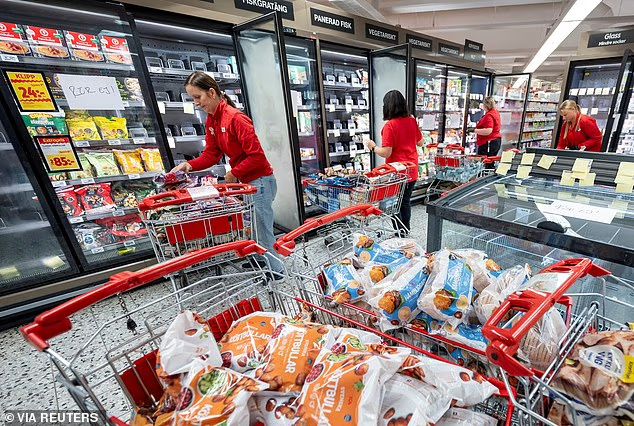
Freezers are emptied, and frozen goods are loaded into shopping carts to be thrown away at ICA Kvantum in Sjobo, Sweden after a hacker raised the temperature in the freezers
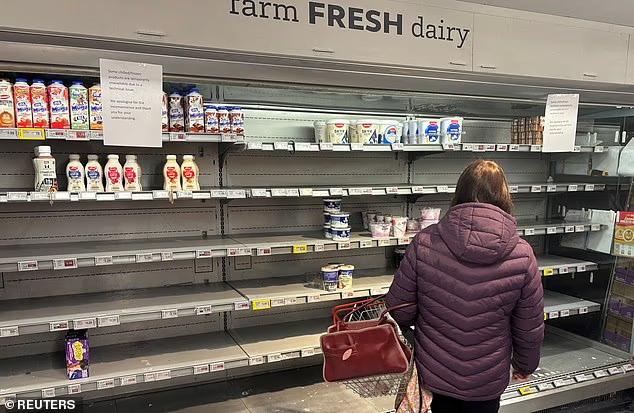
A customer looks at an empty refrigerator at a SuperValu supermarket in Ireland, also hit by the cyber-attack
But while supermarket shelves have for now returned to normal, it has since emerged that far from being a sophisticated hack along the lines of last week's multi-billion-pound cryptocurrency heist believed to have been orchestrated by North Korea, the recent attacks were made possible by 'basic security flaws' in computer software, according to the head of the French cyber security agency ANSSI, Vincent Strubel. Alarmingly, such flaws are thought to be widespread across Europe and Britain's 'operational technology': everyday items used by large businesses, including fridges and fire alarms, that are connected to the internet but are not prioritised for cyber-protection. AI has made exposing such security failings infinitely easier and quicker.
No group has claimed responsibility for the recent attacks and no ransom has been sought, which appears to rule out criminal gangs. That being so, could these hacks be anything other than an unprecedented act of state-sponsored 'shadow warfare'?
In its annual 'cyber security review', published yesterday, the National Cyber Security Centre (NCSC), part of GCHQ, warned: 'By 2028, it is highly likely China, Russia and other nation states will routinely use AI cyber to achieve their geopolitical goals, with the UK facing an increase in scale and speed of sophisticated cyber attacks.'
This year alone, the NCSC has recorded at least 1,831 cyber-attacks on British companies, organisations or infrastructure, 80 of which were of 'national significance'.
Yesterday it emerged that the UK's meat-processing industry is in the midst of one such attack and that teams from the NCSC had worked through the night to alert affected firms to the crisis.
But how much do we really know about the recent attacks? And, crucially, could this be the start of a prolonged cyber campaign against Western Europe, including Britain? Like so much modern technology, supermarket refrigeration units are connected to the internet so that they can be controlled and monitored remotely, often by a single technician supervising multiple stores simultaneously.
Getting access may have been easy. Many of these systems are believed to have been secured under 'default credentials': preset passwords such as 'admin' or '1234' that are listed in instruction manuals that can be freely downloaded online.
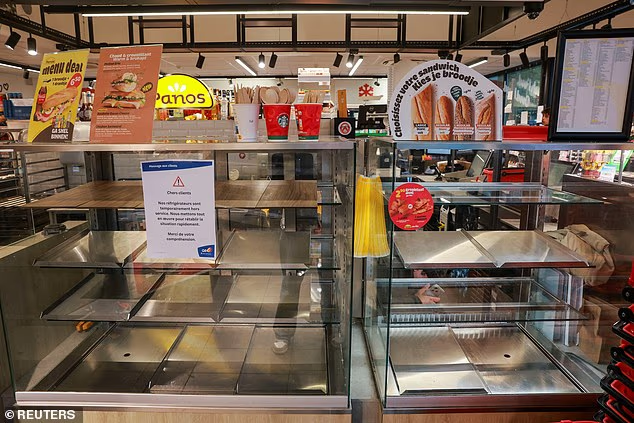
A notice informing customers that refrigerators are temporarily out of service is displayed on an empty case at the Delhaize Shop & Go in Belgium
'It's a preconfigured password,' explains Daniel Des Santos, vice president of research at cyber security firm Forescout. 'It's not a matter of guessing: they're publicly available.'
Once inside, the hackers were able put the units into 'defrost' mode, rapidly increasing the temperatures. The hackers appear to have locked the supermarkets out of their own systems, with the head of one affected store in southern Sweden revealing: 'We can't adjust the temperatures... Hot air is blowing into the freezers. Everything is ruined.'
Order was restored only once the refrigeration systems had been disconnected from the digital network and operated manually.
Source link