
My family has farmed at Dallington, in Northamptonshire, since 1893. It is where my grandfather, Jack Spencer, grew up.
In 1919, my great-grandfather gave our family home there to the people of Northampton, to be used by local servicemen wounded (as my grandfather was) in the First World War. Yet he clung on to the fields nearby.
But last year, my family sold its Dallington farmland – 310 acres of it – and what made the sale inevitable was rubbish.
This wasn’t litter, nor the odd fridge dumped in a gateway – it was lorry-loads of construction waste tipped in the dead of night, asbestos sheeting left to rot in a hedgerow and, on one occasion, 60 burnt-out cars stacked on what used to be good pasture.
Three years ago, the Althorp team had to tackle half-a-ton of plastic bags thrown over a wall.
It was from a local restaurant, and consisted of rotten meat and putrefying human waste.
The final straw came last year when the 250-year-old farmhouse on the land was set on fire and had to be demolished.
The place had only been empty for a heartbeat, as we struggled to find anyone brave enough to live in this Mad Max landscape – but criminals took that opportunity to burn the historic farmhouse down.
Because of the enormous scale of fly-tipping on his farmland in Dallington, Earl Charles Spencer has been forced to sell it

Althorp house, seat of Earl Spencer and childhood home of Diana Princess of Wales, in Northamptonshire
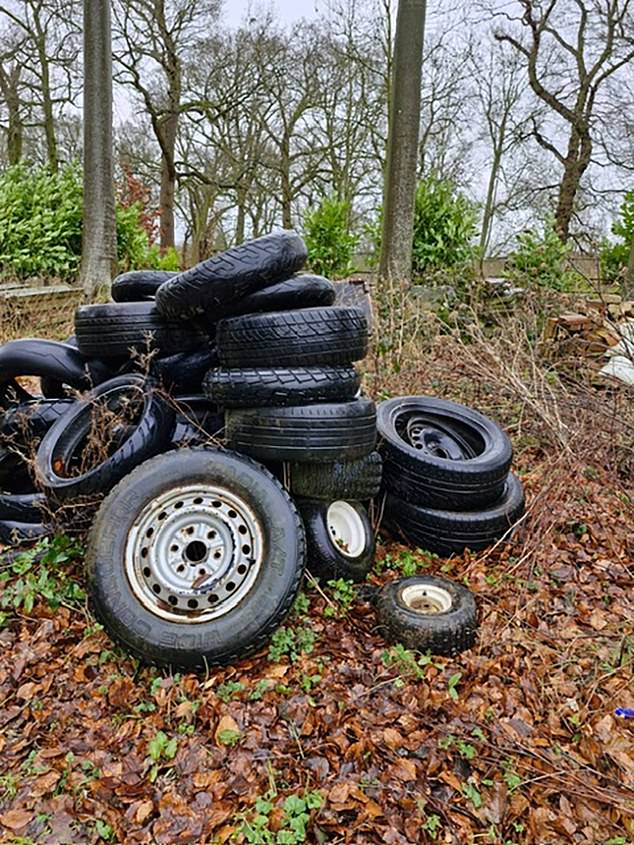
A pile of old tyres dumped on Earl Spencer's estate. At one point, 60 burnt-out cars were left stacked on what used to be good pasture
We have fought dumping and fly-tipping for years. We have put up gates, cameras, warning signs.
None of it worked, because the people doing this aren’t opportunists chucking an old sofa off the back of a van. They are organised.
A House of Lords inquiry heard evidence last year that large-scale fly-tipping in this country is now run by the same criminal networks involved in money laundering, drug dealing and modern slavery.
Waste crime pays, and it pays well, because almost nobody gets caught.
To most people, fly-tipping means a sofa on a verge or bin bags where they should not be. On farmland it is a hydra.
A padlock is cut in the small hours; a lorry reverses through a gateway; by first light there is a load in the field that nobody will own up to.
You cannot plough round it. It leaches into ditches. Livestock go and investigate it. If the farmer leaves it where it lies, he is the one breaking the law.
Clear it and word gets round that the gate is worth a second visit.
Waste left at the roadside is the council’s responsibility. Waste left eight feet further in, through a farm gate, becomes the farmer’s; his to clear, at his own cost and his offence if he does not.
The Country Land and Business Association found nearly three-quarters of the farmers who answered its survey were hit every year, some several times a month, at roughly £1,000 a time. One load cost me £40,000 to remove – but hazardous load runs into tens of thousands.
To deal with the scourge, we keep six full-time skips at Althorp.
How should the government hold fly-tipping criminals accountable and protect hardworking landowners?
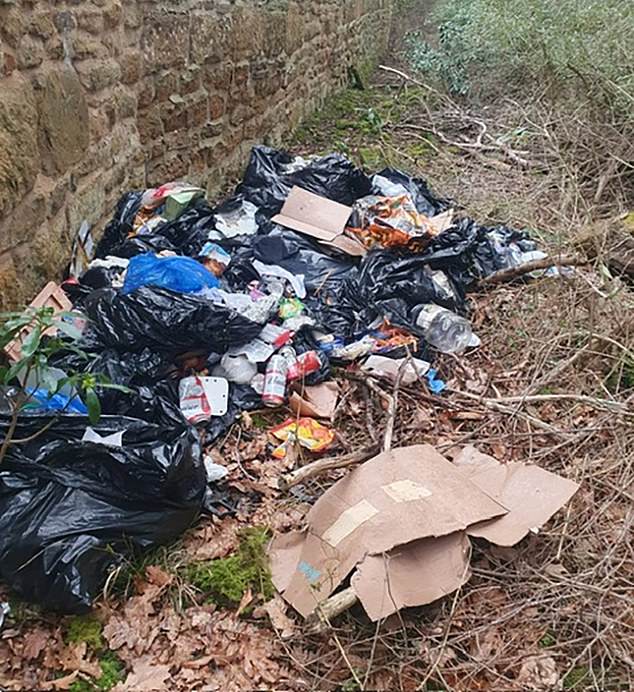
Three years ago, the Althorp team had to tackle half-a-ton of plastic bags thrown over a wall
And in law, a farmer can only recover his costs once the person who dumped it has been convicted.
Councils in England dealt with 1.26million incidents last year, 9 per cent up on the year before, and that is only for reported dumping on public land.
It does not include the fields, gateways and farm tracks, because most of what happens there goes unreported.
There is not much incentive to report a crime that will not be investigated and that you will have to pay to clear up either way.
Waste crime costs this country about £1 billion a year. Last October, the House of Lords Environment and Climate Change Committee wrote to the Environment Secretary to say that serious waste crime had been critically under-prioritised, and to ask for an independent, root-and-branch review of how it is dealt with.
Its chairman said she feared the system was broken. The committee described agencies responding slowly to repeated reports from the public, and a ‘woeful’ lack of successful convictions.
Consider Hoads Wood in Kent, an ancient bluebell wood and a site of special scientific interest.
Dumping there began in 2020, and the public reported it. By the time the Environment Agency shut the site in 2024, it was filled with 30,000 tons of rubbish, 25ft deep in places.
Clearing it is estimated at £10million, and Kent Wildlife Trust anticipates that the damage will still be obvious in 100 years. Three people were arrested last February. Nobody has been prosecuted.
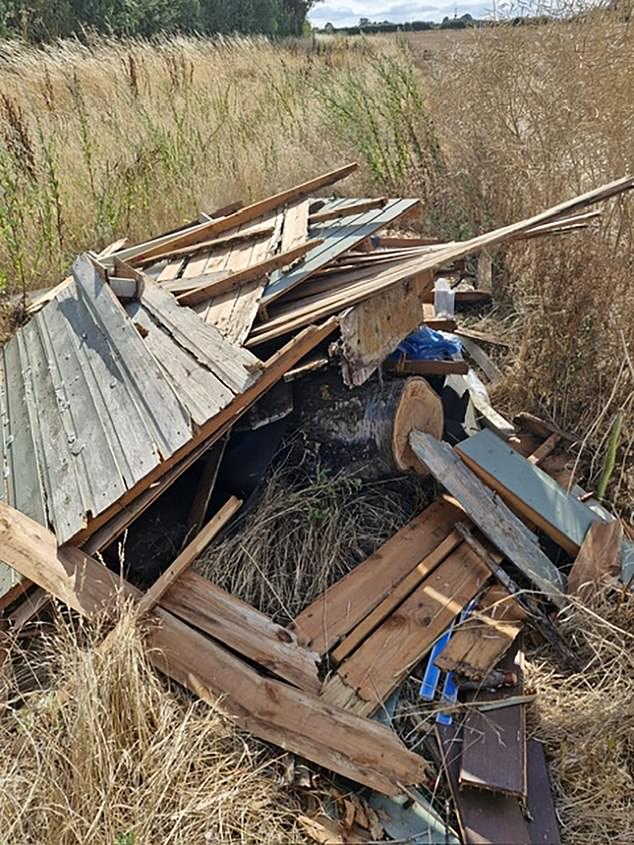
Wooden panels, which appear to have been part of fencing or a garden shed, are left in the middle of a field on the estate
Set that against the enforcement figures. Of those 1.26million incidents, 1,377 led to a prosecution – fewer than one in 900 reaching a court.
Councils seized just 139 vehicles in England. The average fine, which fell last year while dumping rose, was £539.
When the culprit who had dumped waste on Althorp land was traced using filmed evidence provided to the police, the fly-tipper laughed at the £1,000 fine and said it would not stop them from continuing their dirty trade.
Meanwhile, recovering your costs after a conviction is, for most farmers, merely a notional right.
The simplest change would be to stop innocent people having to pay for crimes committed against them.
The Government has said it will look at indemnifying landowners, and I hope it does, because a right to recover your costs after a conviction is worth little when convictions are so rare.
The courts already have the sentencing powers. And lawful disposal ought to be cheaper and simpler, because pricing people out of doing the right thing has always fed the shallow end of this practice.
Fines of up to £5,000 and penalty points have been announced, and none of it is unreasonable.
However, a penalty only deters someone who expects to be caught.
In the end, my family sold its Dallington land to developers. It will now become 1,800 new houses, a secondary school and two primary schools, with money going towards local roads and healthcare.
Northampton needs the housing, so something good comes of it.
I cannot pretend the outcome was a hardship. We had land worth selling and buyers who very much wanted it.
Most of the people this happens to have no developer at the end of the story, just the next gate and the next lorry and no way of knowing which morning it will be theirs.
Since I started writing this, I have learned a truckload of garden waste and timber has been dumped at Althorp. It is never-ending.
Earl Spencer has donated his fee for this article to the charity Keep Britain Tidy.