
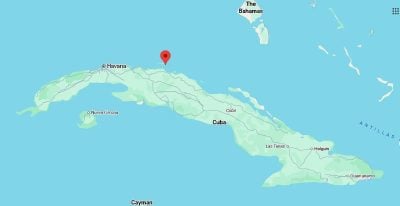
Cuban authorities have provided a detailed account of a thwarted armed infiltration attempt in the northern province of Villa Clara, confirming that the operation was carried out by Cuban nationals residing in the United States with the intent of committing terrorist acts. The Ministry of the Interior released an extensive update on the investigative process regarding the armed aggression against a surface unit of the Border Guard Troops. The incident occurred in the northeastern area of the El Pino channel, near Cayo Falcones in the municipality of Corralillo, where state security forces successfully neutralized the threat.
You can also read this article in other languages by clicking the Translate Website button below the author’s name.
The Villa Clara Incursion
According to the official report, the operation targeted a fast boat registered in Florida with the license plate FL7726SH, which was transporting ten armed individuals. According to Cuban officials, preliminary statements from the detainees revealed that the group’s objective was to carry out an infiltration mission with specific terrorist aims. Upon neutralizing the vessel, authorities seized a significant cache of military-grade equipment, including assault rifles, small arms, homemade explosive devices such as Molotov cocktails, bulletproof vests, telescopic sights, and camouflage uniforms.
All individuals implicated in the event are Cuban citizens currently residing in the United States, with most having documented histories of criminal and violent activity. The Ministry’s statement said that two of the detained, Sánchez González and Cruz Gómez, are particularly notable due to their prior inclusion on the National List of individuals and entities investigated under the framework of United Nations Security Council Resolution 1373, international law, and Cuban legislation. This designation is due to their documented involvement in promoting, planning, organizing, financing, supporting, or executing terrorist acts in Cuba and other nations.
In a related development, Cuban authorities announced the arrest on national territory of Duniel Hernández Santos, an individual dispatched from the United States with the specific mission of coordinating the reception of the armed infiltration team. According to information gathered during interrogations, Hernández Santos reportedly confessed to his participation in the conspiracy.
The Cuban Ministry of the Interior’s response demonstrates a capacity for layered security and investigative work. The initial neutralization of the maritime threat by the Border Guard Troops, followed by the rapid identification of the detained and deceased US linked operatives, indicates a functional domestic intelligence apparatus in Cuba. Perhaps more telling from a counter-intelligence standpoint is the subsequent arrest of Duniel Hernández Santos on Cuban territory. His alleged role as a coordinator sent from the United States to receive the infiltration team suggests that Cuban state security may have had prior visibility or developed leads that allowed them to dismantle not just the maritime cell, but also its support network within the country. Which points to a successful counter-intelligence operation by the Cuban government aimed at uncovering the full breadth of the conspiracy.
The failed armed infiltration in Villa Clara represents a significant security event that must be analyzed not in isolation, but as a potential symptom of a new and aggressive phase in US-Cuba confrontations. The operation’s parameters of a Florida-registered speedboat carrying ten armed Cuban-Americans with military-grade equipment suggests a paramilitary-style incursion. The stated intent of the participants, according to Cuban officials, was to commit terrorist acts. Regardless of the precise operational objective, the very fact that a heavily armed group attempted to breach Cuban territorial sovereignty establishes a new and dangerous precedent in the bilateral dynamic.
Information War Campaign
While the US government has denied official involvement, with Secretary of State Marco Rubio stating it was not a US government operation, the fact that the operatives were US residents and the vessel was Florida-registered places the incident squarely in the realm of US-Cuba tensions, providing Havana with credible suspicion regarding what it views as Washington’s use of exile militancy.
Despite official statements from the United States denying any government connection to the foiled armed infiltration in Cuba, the use of mercenary or proxy forces composed of US-based operatives presents a strategic advantage for plausible deniability. Such a model would allow the US to pursue objectives against the Cuban government through non-state actors while maintaining the diplomatic cover to disavow direct involvement if the operation fails. This dynamic creates a scenario where Washington can officially distance itself from the incident even as the individuals involved are citizens operating from its soil with matériel sourced from within its borders.
Florida Attorney General James Uthmeier has launched an investigation, vowing to hold the “communists accountable,” while Cuban officials frame the event as state-sponsored terrorism emanating from US soil. According to reports, The New York Times cited a U.S. official stating that the shooting involved a civilian vessel from the U.S. attempting to transport family members out of Cuba. This creates a dynamic where both domestic audiences and international observers are presented with starkly different narratives. The US demand for independent access to the survivors probably won’t be met since from a Cuban perspective, this demand may be seen as an infringement on its sovereign right to investigate an armed attack on its forces.
Whether this was a rogue operation by militant exiles or a calculated probe with tacit US approval, the coming weeks will be critical in determining whether this remains an isolated incident or the opening salvo in a renewed era of direct confrontation.
*
Click the share button below to email/forward this article. Follow us on Instagram and X and subscribe to our Telegram Channel. Feel free to repost Global Research articles with proper attribution.
Miguel Santos García is a Puerto Rican writer and political analyst who mainly writes about the geopolitics of neocolonial conflicts and Hybrid Wars within the 4th Industrial Revolution, the ongoing New Cold War and the transition towards multipolarity. Visit his blog here.
He is a Research Associate of the Centre for Research on Globalization (CRG).
Featured image is from the author
Global Research is a reader-funded media. We do not accept any funding from corporations or governments. Help us stay afloat. Click the image below to make a one-time or recurring donation.