
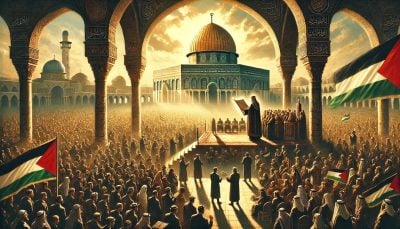
In Part I we introduced the man and the five weapons of his analytical grammar — colonisability, the civilisational triad, globalism, the ideological struggle, and the pipeline of betrayal.
In Part II we turned those weapons on six theatres — Afghanistan, Iraq, Lebanon, Yemen, Iran, the Gulf, and the declining West — and found in each the same diagnosis, written half a century in advance.
One dossier remained. Bennabi never treated it as a case among cases: he returned to it for five decades and regarded it as the axis on which the credibility of an entire civilisation — and of the world order that claimed to civilise it — would finally be judged. This is that dossier. And it has been, in the most terrible sense of the word, accomplished.
“And if you turn away, He will replace you with a people other than you, and they will not be the likes of you.” — Qur’an 47:38, the verse Malek Bennabi cited more insistently than any other.
A note on method. This essay works in three registers, and signals each. Established facts — casualties, rulings, damage assessments — rest on institutional sources (UN OCHA, OHCHR, UNESCO, ICJ) cited in the notes. Bennabi’s own positions are drawn from his published works and from the peer-reviewed scholarship on his thought. And where we extend his grammar to events he did not live to see, we say so: those readings are ours, offered as applications of his categories, and answerable as such.
To read this article in the following languages, click the Translate Website button below the author’s name.
عربي, Русский, 中文, Hebrew, Español, Farsi, Portugues, Français, Deutsch, Italiano, 日本語, 한국어, Türkçe, Српски. And 40 more languages.
Read Part I and II:

Malek Bennabi: An Algerian Genius Confronting the Barbarity of the Contemporary World. Part I
By , April 28, 2026
.

Malek Bennabi: An Algerian Genius Confronting the Barbarity of the Contemporary World. Part II
By , May 12, 2026
Prologue — The Dossier He Never Closed
There are files a clinician opens, examines, and closes. And there is the one he cannot close, because it is not a case among his cases but the mirror in which every other case is read. For Malek Bennabi, that file was Palestine.[1] He returned to it for five decades — in Cairo and in Algiers, in the years of Nasser’s ascendancy and in the bitterness of his final silence — because he understood, with the cold lucidity that made him unbearable to his contemporaries, that Palestine was the test. Not a test of the Palestinians. A test of everyone who claimed to speak for them.
Bennabi refused the consolation his generation reached for reflexively: that Palestine was lost to a superior enemy, to Western gold and Western guns, to a conspiracy too vast to resist. That, for him, was the alibi of the colonisable — the reflex that transfers outward a wound whose deepest cause is inward. His question was harder, and it has not aged a day: how does a civilisation of over a billion souls, seated at the crossroads of three continents and the wealth beneath them, lose a strip of land the size of a province — and lose it again, for seventy-five years, while composing communiqués?
This is the final dossier of our journey. It is also the one in which Bennabi’s grammar ceases to feel like analysis and begins to feel like prophecy — not because he foretold the events, but because the logic he described has, before our eyes, been carried to its end. In Gaza, that logic has been accomplished.
I. The Original Wound
To read 1948 with Bennabi is to refuse the two comfortable stories the twentieth century told about it. The first is the Western story: a nation reborn, a desert made to bloom, a democracy among despotisms. The second is the nationalist Arab story: an innocent people dispossessed entirely by others. Bennabi accepts the fact of the crime without accepting the innocence. Throughout his work — as scholarship on his thought has established — he placed the principal responsibility for the Muslim world’s predicament not on Western colonialism but on the Muslim world itself, against the entire prevailing opinion of his era.[2] His scandalous instrument — colonisability — turns the lens inward: Palestine was takeable because the Arab-Muslim world had entered, centuries earlier, the condition that makes a people takeable — the loss of the idée-force, the decomposition of the social bond, the substitution of rhetoric for capacity. The Nakba is not the disease. It is the symptom that made the disease legible.
.
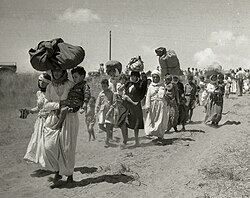
Palestinians from Tantura are expelled to Jordan, June 1948. (CC BY 4.0)
.
This inward diagnosis is indispensable to understanding Bennabi’s treatment of what he called “the Jewish question.” In the second part of The Vocation of Islam, he approached the subject neither as theology nor as race, but through his theory of civilisational cycles and ideological struggle. Written originally in French and later circulated in Arabic, the essay examines the changing position of Jewish communities in European history, the emergence of political Zionism, and the manner in which that project became intertwined with Western colonial expansion at the moment of the Muslim world’s decline.
Bennabi’s argument must be read as a historically situated and contestable interpretation, not as an ethnic generalisation. He suggested that exclusion from Europe’s feudal structures directed segments of Jewish life toward intellectual, commercial and financial networks that later acquired growing importance in modern Europe. Within the vocabulary of his period, he consequently distinguished several historical figures. The “cultivated Jew,” emerging from the Renaissance and the gradual erosion of ghetto isolation, entered Europe’s intellectual life and participated in the production of modern ideas. With the French Revolution came a more fully civic and political figure, integrated into republican institutions and engaged in the struggle against inherited antisemitic exclusions.
The decisive mutation, in Bennabi’s account, was the advent of political Zionism: not Jewish religious or cultural identity, but the conversion of one current of modern Jewish nationalism into an organised project seeking territory, sovereignty and great-power sponsorship. He argued that Zionism prevailed because it aligned itself with the strategic logic of European imperialism. Europe could therefore represent the establishment of a geopolitical entity in the heart of the Arab-Muslim world as emancipation for one people while imposing the territorial and historical cost upon another. In Bennabi’s reading, the ideological operation was complete when a settler-colonial project acquired the vocabulary of universal moral reparation.
Yet Bennabi’s purpose was never to explain the Palestinian catastrophe solely through Zionist organisation or European designs. His conclusion returned relentlessly to the Muslim world. No durable answer, he believed, could emerge from emotional rhetoric, improvised wars or the periodic mobilisation of wounded sentiment. It required psychological, social and institutional reconstruction. So long as Muslim societies remained trapped in what he called the post-Almohadian condition — deprived of a generative idea, disciplined organisation and the capacity to convert moral energy into historical action — they would remain objects of initiatives conceived elsewhere. In his framework, confronting the Zionist project therefore required confronting, at the same time, the civilisational incapacity that had facilitated its success.
From this follows the most uncomfortable lesson Bennabi drew from the confrontation. What struck him in the Zionist enterprise was not primarily its arms or its patrons, but its demonstration of the very thesis at the heart of his oeuvre: the efficacy of an idea served with method, patience and institutions — set against societies rich in slogans and poor in organised ideas.[3] Extending his grammar to the present, the state that emerged from that enterprise has functioned within the region as the armed salient of the order he called globalism: a particular project installed in the heart of the Muslim world while speaking the universal language of civilisation, refuge, and law. In this reading, Israel is not the cause of Arab weakness; it is its precise measure — a foreign body that a healthy civilisational organism would have metabolised and that a colonisable one cannot. The tragedy is symmetrical: the wound is real, and so is the responsibility.
II. The Pipeline of Betrayal at Its Source
If colonisability is the disease, the pipeline of betrayal is the plumbing through which it circulates — and nowhere is that plumbing more exposed than in the seventy-five-year Arab handling of Palestine. Bennabi drafted the image ten months before his death: betrayal not as the sin of individuals but as a system, an invisible network linking capitals through which flow money, demagogy, and submission — “the feeding bottle that suckles the traitors.”[4] Palestine is where the pipeline was laid first and runs deepest.
Count the summits. Count the “red lines.” Count the emergency sessions convened to issue condemnations calibrated never to cost anything. Then count what changed on the ground. The betrayal operates on two registers at once: the betrayal of the spirit — the hollowing-out of the cause into a slogan, a fundraising theme, a stick for domestic use — and the betrayal of the means — the diplomatic, economic, and military capacities never built, because building them would have required precisely the civilisational renaissance the regimes feared more than they feared Israel. The Abraham Accords were not a rupture in this history but its logical terminus: normalisation with a state at war, dressed as peace, financed by the same arms-purchasing dependence that has kept the Arab soil rich and the Arab idea empty.[5]
.
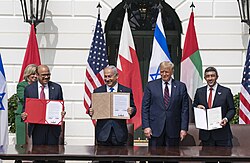
President Donald J. Trump, Minister of Foreign Affairs of Bahrain Dr. Abdullatif bin Rashid Al-Zayani, Israeli Prime Minister Benjamin Netanyahu and Minister of Foreign Affairs for the United Arab Emirates Abdullah bin Zayed Al Nahyan signs the Abraham Accords Tuesday, Sept. 15, 2020, on the South Lawn of the White House. (Official White House Photo by Shealah Craighead)
.
III. Gaza: The Inverted Triad Made Total
In Part II we named the inverted triad: the deliberate production of a society with no man capable of action, no soil that belongs to its inhabitants, and no time in which to inscribe a future. Iraq after 2003 was its case study. Gaza, from 2023 onward, is its perfection.
Consider the three terms. The soil: sealed for nearly two decades, then rendered, quarter by quarter, uninhabitable. The man: killed in numbers the mind refuses to hold — 73,231 dead and more than 173,000 wounded by mid-July 2026, by the Ministry of Health count that the Israeli military itself now accepts as accurate[6] — and reified: reduced to the aggregate categories of the humanitarian bulletin, the ratio of civilians to combatants, the collateral estimate.
And the time: this is the term Bennabi would have pointed to first, because it is the one the news cannot see. The facts here are institutional, not rhetorical. Within six months of the assault, more than 80 per cent of Gaza’s schools were damaged or destroyed; over 5,479 students, 261 teachers and 95 university professors had been killed; Israa University, the territory’s last standing university, was demolished on 17 January 2024. UN experts formally asked whether an intentional effort was under way to comprehensively destroy the Palestinian education system — scholasticide, in the term coined by the Oxford scholar Karma Nabulsi and now adopted in the academic literature.[7] The Central Archives of Gaza, holding 150 years of the territory’s history, were destroyed; by March 2026, UNESCO had verified damage to 164 cultural heritage sites.[8] You do not annihilate a people’s time by killing its present. You annihilate it by destroying its capacity to have a past and a future — its records, its schools, its transmission. That is the inverted triad made total: not the defeat of a society, but the attempted deletion of the conditions of any society at all.
.
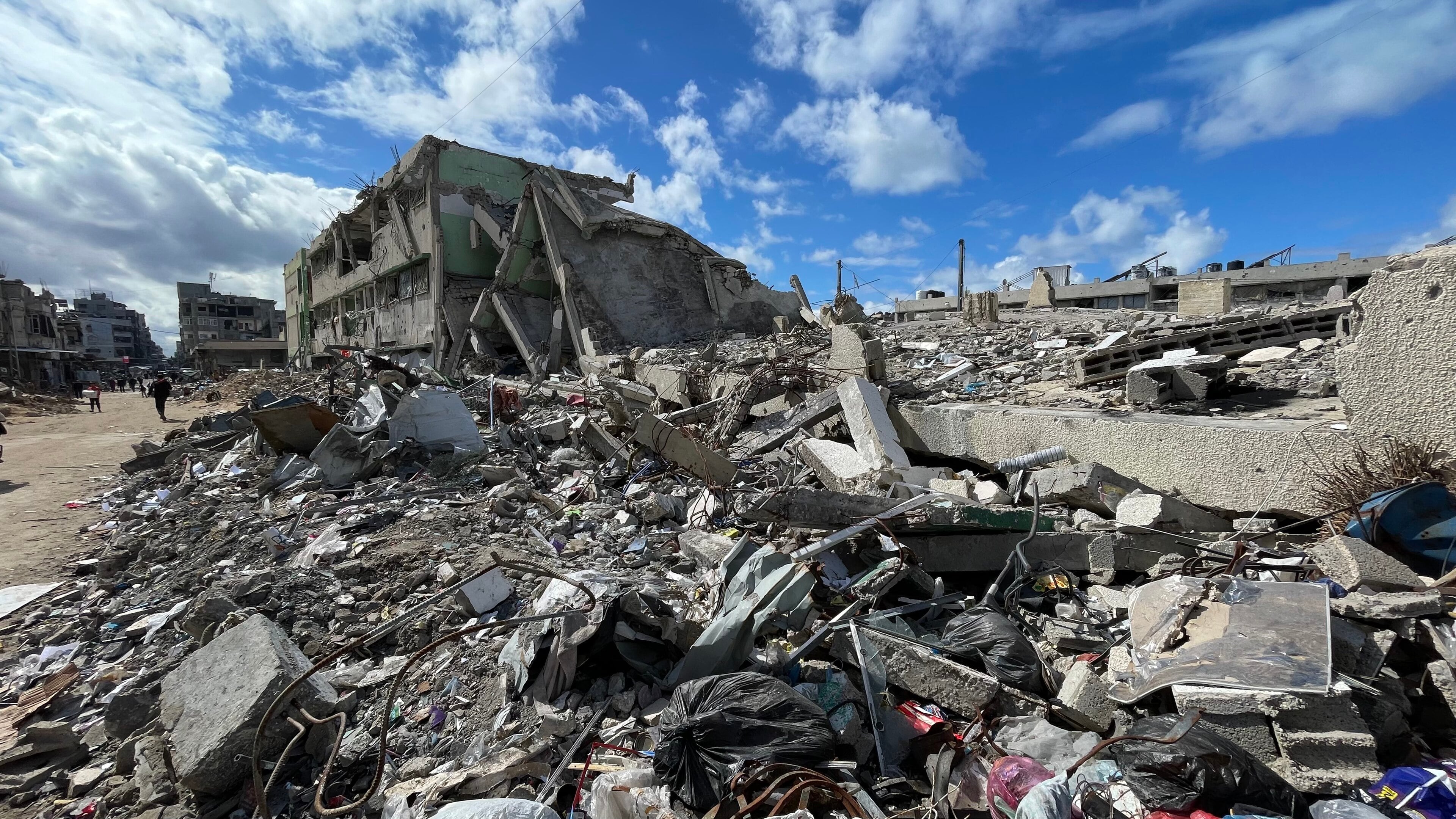
Al-Huda Girls’ School in Jabalia, destroyed by Israeli bombing, February 22, 2025 (CC BY-SA 4.0)
.
And over the whole operation floats the vocabulary of globalism — the semantic theft Bennabi diagnosed in 1959. “Human rights,” “the right to defend oneself,” “the rules-based order”: the universal language, requisitioned in real time to license the particular. When the International Court of Justice found it plausible that rights protected under the very convention written after the Holocaust were at risk in Gaza and ordered provisional measures — and when it ruled, six months later, that the occupation of Palestinian territory was itself unlawful — much of the West that had authored those instruments looked away.[9] The order did not merely fail to protect Gaza. It exposed itself.
IV. The Resistance of the Reified
Here Bennabi’s grammar turns, and the same page that reads as an autopsy begins to read as something else. The reification of man is never complete. The colonial calculus that reduces a people to statistics always underestimates one thing: the resistance of the reified — the refusal of the counted to remain merely countable.[10] Gaza, stripped of army, economy, state, and horizon, did not disappear. It refused to disappear. In that refusal Bennabi would have recognised the purest instance of his central paradox: a people materially colonisable — without the means of a modern society — can generate a resistance that is not colonisable at all, provided it possesses an idée-force.
But Bennabi is not a romantic, and here he becomes demanding to the point of severity. He would not let the word “resistance” absolve us of the harder question — the same he put to Algeria in 1962 and to Iran in this series. Is this resistance colonisable or civilisational? A colonisable resistance is purely reactive; it mobilises the forces of survival and exhausts itself in them, heroic and sterile, generation after generation. A civilisational resistance transforms the ordeal into capital — it forges, in the furnace, the ideas, institutions and knowledge that outlast the fighters. The whole of Bennabi’s programme lives in the distance between surviving and civilising. To honour Gaza is not to celebrate its endurance. It is to insist that endurance become foundation.
V. The Accomplished Prophecy
And yet Gaza has already accomplished what no Arab summit accomplished in three-quarters of a century. It has done to the moral authority of the hegemonic order what no missile could: it has revealed it as empty, and revealed it to the entire Global South at once.[11] The peoples told for three decades that the liberal order was the unsurpassable horizon of humanity have watched that order narrate a catastrophe in the language of self-defence — and they have drawn the conclusion. The order is not universal. It is particular. It always was.
This is the sense in which Bennabi’s is an accomplished prophecy. Not that he named the date or the weapon; he named the logic — that an order whose proclaimed values are sacrificed, visibly and repeatedly, to the interests of power forfeits the one thing no arsenal can restore: credibility. He named it, and Gaza has proven it. The Qur’anic verse he cited more than any other was never, for him, a metaphysical threat but a law of history: “And if you turn away, He will replace you with a people other than you.”[12] Civilisations that will not mobilise their productive forces are, in the end, relieved of the civilisational function and replaced.[13] The warning was addressed to the Muslim world. In 2026 it reads, with uncanny symmetry, as a warning to the declining West as well — two civilisations, each in its own crisis of motivation, each being weighed.
VI. The Renaissance or the Void
A diagnosis that stops at diagnosis is itself a form of colonisability — the intellectomane‘s pleasure in describing a paralysis he has no intention of ending. Bennabi despised it. So the final movement of his thought, and of this series, is not the wound but the way out — a programme, not a prayer. Four axes emerge from his oeuvre, and Palestine is the test of every one.[14]
The first is the reappropriation of the productive forces — not oil rent, not solidarity donations, not the diplomacy of condemnation, but the capacity to produce ideas, diffuse them, and turn them into institutions. A cause defended only by emotion is colonisable; a cause that builds law, science and durable counter-power is on the road to renaissance. The second is the reconciliation with a critical modernity: not the imported shell of technique, but an interior refoundation that dares self-criticism and reads its own texts with rigour rather than nostalgia — the task Bennabi began and that Mohamed Arkoun pressed further.[15]
The third is an authentic multilateralism — founded on sovereign equality and the plurality of civilisational contributions rather than built by and for the hegemon. It is no accident that the two most consequential acts of solidarity with Gaza came not from an Arab summit but from institutions of the South used as instruments: South Africa carrying the Genocide Convention to The Hague, and the widening BRICS giving the Global South, for the first time in decades, an architecture of its own.[16] The fourth is entry into the economy of knowledge: Bennabi saw, before the vocabulary existed, that the next stage of civilisation would rest on cognitive capital, not natural resources. The counter-example is being written in real time: the reconstruction of Gaza’s annihilated universities — the emergency consortia organising degrees for the 88,000 students left without institutions — is, in the strictest Bennabi sense, a civilisational act: the rebuilding of a society’s time.[17]
Palestine, in this light, ceases to be only a wound and becomes a measure. Solidarity that remains reactive — that trends and fades, mourns and forgets — is the colonisable relation to the cause. Solidarity that builds, documents, educates, and constructs the institutions a free future would require, is the civilisational one. The choice between them is the one Bennabi placed before his readers in 1949. It is the renaissance, or it is the void.
VII. The Limits of the Master
Honesty demands that we not turn Bennabi into the oracle he refused to be. His thought has limits his most lucid readers have named, and Palestine tests them too.[18] There is the unresolved tension between an announced universalism and an Islamic vehicle that remains, in his pages, the privileged — nearly exclusive — carrier of renaissance: can a genuinely universal project have a single civilisational bearer? There is the exegetical caution: the reform he demands of the Muslim mind requires a critique of the ideological uses of the sacred text that he approaches and then, whether from prudence or conviction, declines to complete. And there is the missing theory of transition: Bennabi tells us, with unmatched force, what must be done and why; he says far less about how — through which actors, which institutions, on what timeline. This is not a defect that voids the work. It is the labour he bequeathed to those who come after — to us.
Contemporary Debates Around Bennabi’s Sociology
Image: Malek Bennabi (Fair Use)
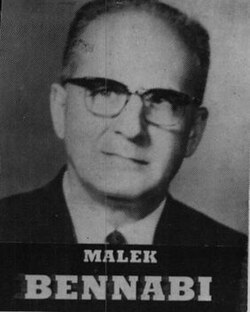
Contemporary scholarship has not left Malek Bennabi’s work without criticism. Although his reputation has steadily grown across North Africa, Southeast Asia and the broader field of decolonial thought, many Western scholars, alongside comparative sociologists and historians of ideas, have identified several recurrent lines of debate rather than forming a single critical consensus.
The first concerns the concept of colonisability. Critics argue that, despite Bennabi’s explicit condemnation of colonial domination, his emphasis on the internal conditions that facilitate foreign rule may inadvertently shift analytical attention from the structural violence of imperialism to the supposed deficiencies of the colonised themselves. A second criticism questions whether Bennabi sufficiently accounts for the overwhelming asymmetry of modern imperial power. A third debate concerns Bennabi’s understanding of religion as the primary catalyst of civilisation. Finally, some scholars question what appears to be a cyclical conception of history and his reliance on conceptual tools inherited from the European intellectual tradition he sought to transcend.
These criticisms have generated substantial responses from Muslim sociologists, Islamic philosophers and decolonial thinkers. Scholars such as Syed Farid Alatas, Wael B. Hallaq, Walter D. Mignolo, Ramón Grosfoguel and Boaventura de Sousa Santos have contributed to broader debates on decolonising knowledge and recognising non-Western epistemologies. Within this perspective, Bennabi’s sociology is interpreted through the Qur’anic concept of Sunan—the objective laws governing the rise, decline and renewal of societies. Colonisability is linked to Qur’an 13:11; civilisational complacency to Qur’an 6:44; the succession of nations to Qur’an 7:34; and the role of wisdom to Qur’an 2:269. From this perspective, Bennabi’s project represents an ambitious comparative sociology of civilisation grounded simultaneously in historical observation, Islamic anthropology and universal social laws.
Conclusion — Bennabi as Compass, Not Oracle
We began with a ghost in the war room: a dead man who governs the living with more lucidity than they govern themselves. We end by naming precisely what kind of instrument he is. Bennabi is not an oracle. He is a compass. He does not hand us answers; he gives us the categories with which to find them. Colonisability is an analytical category, not a destiny. The pipeline of betrayal is a system to be dismantled, not a fate to be endured. The renaissance is a programme to be operationalised, not a myth to be sung. And Palestine — the original wound — is, in the same breath, the possible beginning: the mirror in which the Muslim world sees the truth of its condition, and in which the West, if it dares to look, sees the exhaustion of its own.
Coda — The Place of a Man in the History of Ideas
Step back far enough from Gaza and a longer sequence comes into view. There is a lineage of thinkers who asked not why a battle was lost but why a civilisation ceases to be able to fight — and who answered by turning the question inward. Ibn Khaldun opened it in Tunis in 1377, and named the solidarity whose dissolution precedes every collapse. Vico in Naples proposed that the human world, unlike nature, can be known because we made it. Toynbee catalogued the challenge and the response. Fanon anatomised what domination does inside the skull of the dominated. Each left part of the problem unresolved. Ibn Khaldun described a cycle he doubted any consciousness could break. Toynbee wrote a morphology in which the observer stands outside the specimen. Fanon diagnosed magnificently and died at thirty-six with the reconstruction unbegun.
Bennabi’s place in that sequence is precise, and it helps explain why his work has travelled beyond the century that first neglected it. He took the Khaldunian question and refused the Khaldunian fatalism. He accepted the wound Fanon described and refused to let it become an identity. He wrote from inside the specimen — a colonised man analysing colonisation without asking for pity, and without the pretence of standing above his own case. What he produced was neither a closed philosophy of history nor a manifesto, but something rarer: an engineer’s grammar of civilisation, built to be used, tested and revised. That is why his work continues to be studied across Arabic, French, Turkish and Southeast Asian intellectual worlds: a grammar, unlike a doctrine, travels.
And this is where his relevance detaches itself from Gaza altogether. The categories are portable, and the diagnosis is not the property of the wounded. A society that outsources its thinking to imported models is colonisable in Riyadh and in Brussels alike. A polity that consumes knowledge without producing it is colonisable in Cairo and in a Midwestern town whose factory closed. A civilisation whose proclaimed values are visibly sacrificed to its immediate interests has entered a crisis of motivation whether its capital is Baghdad or Washington. Bennabi wrote for the colonised, and lived to see them free and still unwell. The twenty-first century has quietly universalised his patient list.
“The new civilisation,” he wrote in 1949, “must be neither a civilisation of a proud continent nor that of a selfish people, but of a humanity pooling all its potentialities.” It was a strange sentence to write amid the ruins of the twentieth century, and a stranger one to read amid the ruins of Gaza. Yet few sentences point more clearly away from the descent. It is not a consolation; it is an assignment — and the reason his work is a compass rather than a monument.
Bennabi died in Algiers in October 1973, in a newly independent country already confronting the contradiction that had occupied his life: political sovereignty without a completed civilisational renewal. Half a century later, institutions and powers that never absorbed his work repeatedly rediscover fragments of his diagnosis without knowing its author. Historians of ideas may one day record what our century has been slow to admit: that one of the most penetrating descriptions of modern disorder was written, in the language of exile and through a borrowed technical vocabulary, by an Algerian engineer too few of his contemporaries were prepared to hear. The clinician left the diagnosis and the elements of a prescription. Whether the patient rises remains, as it always was, our decision and not his.
*
Click the share button below to email/forward this article. Follow us on Instagram and X and subscribe to our Telegram Channel. Feel free to repost Global Research articles with proper attribution.
Amir Nour is an Algerian researcher in international relations and the author of several books, including The Monstrosity of Our Century, the War on Palestine and the Last Western Man (Clarity Press, Atlanta, 2026).
Laala Bechetoula is an independent Algerian journalist and geopolitical analyst. He writes regularly on contemporary wars and the geopolitics of the Islamic world for platforms including Countercurrents, Global Research, Mondialisation.ca, Réseau International, Le Quotidien d’Oran and Sri Lanka Guardian.
They are Research Associates of the Centre for Research on Globalization (CRG).
Notes
[1] Bennabi’s engagement with the Palestinian question runs through his Cairo period (1956–1963) and his mature works, where the fate of Palestine functions as the revealing symptom of the condition of the Muslim world rather than a discrete conflict; see notably L’Afro-asiatisme (Cairo, 1956; repr. Algiers: Dar El Bay’a, 2006) and Le problème des idées dans le monde musulman (Algiers: El-Bay’a, 1970). For scholarly treatments of his framework, see Samir Merdaci, ‘Malek Bennabi, écrivain et penseur algérien: un précurseur des études coloniales,’ Akofena, no. S10 (2023).
[2] Malek Bennabi, Les conditions de la renaissance (Algiers: En-Nahda, 1949; repr. ANEP, 2012), on colonisability as the internal condition that precedes and summons colonisation. On Bennabi assigning principal responsibility for the Muslim world’s predicament to the Muslim world itself, against the prevailing opinion of his era, see Yahia H. Zoubir, ‘Democracy and Islam in Malek Bennabi’s Thought,’ American Journal of Islam and Society 15, no. 1 (1998). For the standard scholarly treatments of colonisability as an analytical tool, see Fawzia Bariun, Malik Bennabi: His Life and Theory of Civilization (Kuala Lumpur: ABIM, 1993), and her earlier ‘Malik Bennabi and the Intellectual Problems of the Muslim Ummah,’ American Journal of Islamic Social Sciences 9, no. 3 (1992): 325–37; Badrane Benlahcene, The Socio-Intellectual Foundations of Malek Bennabi’s Approach to Civilization (Herndon, VA: International Institute of Islamic Thought, 2011); and Mohamed El-Tahir El-Mesawi, ‘Religion, Society, and Culture in Malik Bennabi’s Thought,’ in The Blackwell Companion to Contemporary Islamic Thought (Oxford: Wiley-Blackwell, 2006), pp. 213–56.
[3] Bennabi’s central thesis on the efficacy of organised ideas versus societies rich in things and poor in ideas: Le problème des idées dans le monde musulman, op. cit., pp. 55–83. On his distinction between globalisation as economic process and mondialisme/globalism as a political project of normative domination, see Mondialisme (Algiers: Dar El Hadhara, 2004), pp. 17–30, and the discussion in Benlahcene, Socio-Intellectual Foundations, op. cit., chap. 4, as well as Alwi Alatas, Malik Bennabi on Civilization (Selangor: Budaya Ilmu, 2010). Register note: the application of Bennabi’s concept of globalism to the regional function of the Israeli state is the present authors’ extension of his grammar to a dossier he did not live to see in its current form, not an attribution to him.
[4] Malek Bennabi, Naissance d’une société (Cairo, 1962; repr. Algiers: Dar El Bay’a, 2006), p. 188; the ‘pipeline of betrayal’ passage is from the preface drafted 10 February 1973. Cf. Part I, n. 12.
[5] On the Abraham Accords (15 September 2020) and Gulf arms dependence: Dalia Dassa Kaye & Shira Efron, ‘Israel’s Dangerous New Bet,’ Foreign Affairs, November/December 2021; Stockholm International Peace Research Institute (SIPRI), Arms Transfers Database, 2024.
[6] Gaza Ministry of Health figures as reported by the Health Cluster: 73,231 Palestinians killed and 173,686 injured between 7 October 2023 and 12 July 2026 — UNRWA, Situation Report #230 on the Humanitarian Crisis in the Gaza Strip, July 2026; UN OCHA, ‘Reported Impact Snapshot — Gaza Strip,’ 8 July 2026. In late 2025 the Israeli military accepted the Ministry of Health tallies as accurate (Haaretz, reported December 2025), noting they exclude the missing under rubble and deaths from starvation and disease.
[7] UN Office of the High Commissioner for Human Rights, ‘UN experts deeply concerned over “scholasticide” in Gaza,’ press release, Geneva, 18 April 2024: with more than 80% of Gaza’s schools damaged or destroyed, the experts — including the Special Rapporteurs on the right to education and on the occupied Palestinian territory — asked whether there was ‘an intentional effort to comprehensively destroy the Palestinian education system.’ The release records more than 5,479 students, 261 teachers and 95 university professors killed in six months, and the demolition of Israa University, Gaza’s last remaining university, on 17 January 2024. On the concept itself and its scholarly elaboration, see ‘Scholasticide in Gaza,’ Journal of the British Academy 13, no. 1 (2025); Bilal Hamamra, Fayez Mahamid & Asala Mayaleh, ‘Educide in Gaza: The Systematic Destruction of Education during Genocide,’ Power and Education (2025); and Ihsan S. Rabaia & Lana Habash, ‘The Hidden War on Higher Education: Unmasking the “Educide” in Gaza,’ POMEPS Studies 51 (2024): 8–13.
[8] Ibid. (on the destruction of the Central Archives of Gaza, containing 150 years of history); UNESCO, ‘Impact on Cultural Heritage in the Gaza Strip — Preliminary Damage Assessment,’ verified damage to 164 sites as of 24 March 2026, including 128 buildings of historical and/or artistic interest, 14 religious sites, 9 monuments, 2 museums and 8 archaeological sites.
[9] International Court of Justice, Application of the Convention on the Prevention and Punishment of the Crime of Genocide in the Gaza Strip (South Africa v. Israel), Order on provisional measures, 26 January 2024 (with further orders of 28 March and 24 May 2024); ICJ, Advisory Opinion on the Legal Consequences arising from the Policies and Practices of Israel in the Occupied Palestinian Territory, 19 July 2024.
[10] Malek Bennabi, La lutte idéologique dans les pays colonisés (Cairo, 1962; repr. Algiers: El-Bay’a, 2006), pp. 72–85, on the reification of man; Colonisabilité (Algiers: ANEP, posthumous, 2000), pp. 33–40. Cf. Part II, n. 14.
[11] On Gaza as catalyst of the delegitimation of the ‘rules-based order’ and of the multipolar shift, see Amir Nour, ‘The War on Gaza: A New Global Order in the Making?’, Global Research / Centre for Research on Globalization, 2024 (two parts).
[12] Qur’an 47:38 (Sūrat Muhammad).
[13] Malek Bennabi, Vocation de l’Islam (Algiers: ENAG, 1954; repr. 2006), on the loss and transfer of the civilisational function among peoples.
[14] The four-axis reading of Bennabi’s renaissance programme synthesises Les conditions de la renaissance, Le problème des idées dans le monde musulman (1970), and Le problème de la culture (Algiers: ENAG, 1959; repr. 2006). See also Mourad Adjabi, ‘La pensée de Malek Bennabi à l’épreuve de la géopolitique mondiale contemporaine’ (2024).
[15] Mohamed Arkoun, Pour une critique de la raison islamique (Paris: Maisonneuve & Larose, 1984).
[16] ICJ, South Africa v. Israel, op. cit.; BRICS Johannesburg Summit Declaration, 23 August 2023 (expansion to Saudi Arabia, Iran, Ethiopia, Egypt, the UAE and Argentina). Cf. Part II, nn. 22–24.
[17] On the roughly 88,000 higher-education students left without institutions after the destruction of all of Gaza’s universities, and on emergency academic reconstruction initiatives, see ‘Scholasticide in Gaza,’ Journal of the British Academy 13, no. 1 (2025); and the OHCHR release of 18 April 2024, op. cit., on the international obligation to finance and rebuild the education system.
[18] On the limits of Bennabi’s thought, see Omar Benaïssa, Malek Bennabi: penseur de la civilisation (Paris: L’Harmattan, 2017), esp. the discussion of the tension between islamocentrism and universalism.
Featured image source
Global Research is a reader-funded media. We do not accept any funding from corporations or governments. Help us stay afloat. Click the image below to make a one-time or recurring donation.