Canada went tropical last week (October 24, 2026). I would have written "Hell freezes over in Canada," but Canada is frozen most of the year, so that wouldn't work.
A political earthquake like nothing before has shaken the Great White North to its tundra core.
I've previously vented my disdain for our Frozen Banana Republic neighbor, which locks up Christians, dismisses citizens in need of health care, and treads upon the rights of the common man while claiming to be nice in the process.
The country has drifted, then rushed to the political left over the last ten years. Aside from ongoing Conservative wins in Alberta and Saskatchewan, Canada was turning into a Liberal graveyard. Even one prairie province, Manitoba, is governed by the New Democratic Party (NDP), which is further left than the national Liberal Party.
After last week, change looks like it's coming, and for the better.
A miracle happened in British Columbia, one of the country's most liberal provinces: Conservatives have won, big time. Imagine Republicans taking over the state legislatures in California and New York. Far-fetched, right? Total fantasy, for sure.
Yet something similar just happened in British Columbia.
The BC Conservative Party swept the provincial election, winning a commanding majority. Premier-designate Lorne Doerkson campaigned on cutting red tape, cutting taxes, increasing energy and resource production, and making the province business-friendly.
Unlike other Conservative parties, the BC Conservative Party spent decades on the political margins. For years, anyone who wanted to get the NDP out of power generally had to vote for the BC Liberal Party, which served as the centrist/center-right alternative. The Liberals renamed themselves BC United in 2023, but the Conservative Party, reinvigorated when former BC Liberal MLA John Rustad joined it that year, rapidly gained ground. In 2024, BC United suspended its election campaign, leaving the Conservatives as the NDP's principal opposition. Rustad and his team almost won the election, taking 44 seats to the NDP's 47, with the Greens winning two. Premier David Eby's NDP held on by a single-seat majority.
So close, and yet so far.
The diminished yet still majority NDP government doubled down on its rapacious left-wing policies. The BC Conservative Party ousted its leader, Rustad, then elected a more conservative fighter, Kerry-Lynne Findlay. A few months later, still dealing with a mix of more liberal members and staunch conservatives, party members feared Findlay's approach would alienate swing voters, and she was forced to resign. Another round of infighting threatened the NDP's main opposition, and the BC Conservatives settled on interim leader Lorne Doerkson, while other members became Independent MLAs or joined the more populist OneBC party.
The NDP smelled an easy win, which would have given it another four-year mandate, so Eby called a snap provincial election to beef up his one-seat majority. Eby's arrogance got the better of him and worked in the Conservatives' favor. Despite the infighting, the BC Conservatives united under Doerkson, set aside their disputes, and focused on defeating the NDP.
They succeeded, with preliminary results showing Conservatives leading in 63 of the province's 93 seats, a commanding majority. Eby won his riding (what Canadians call their electoral districts), but announced his resignation as NDP leader the same night.
He should have known better. Thankfully, the voters did better.
British Columbians were desperate for a course correction. An October Ipsos poll found that the voters' biggest concerns were the cost of living (57%), health care (39%), and housing affordability (30%). Under NDP mismanagement, British Columbians endured skyrocketing food and energy prices, unattainable housing costs, and a strained health care system, where long wait times, rural hospital service disruptions, and difficulty accessing medical care left many residents frustrated.
Other grievances included open-air drug use, mass immigration, rising crime, LGBT-dominated education, and a government whose regulatory policies discouraged private investment and resource development. The province's economic struggles and mounting costs of living gave voters plenty of reasons to demand change.
Not only that, but a novelty in left-wing governance reared its ugly head in the province: the undermining of private property rights under the guise of honoring Indigenous rights. British Columbia has become the center of a major legal controversy over Aboriginal land title and the security of privately owned property.
In 2025, a British Columbia Supreme Court ruling involving the Cowichan Tribes recognized Aboriginal title to approximately 732 acres of land in Richmond and held that Aboriginal title takes precedence over certain fee-simple property interests. The ruling did not simply order whole neighborhoods handed over to Indigenous owners, but it raised profound concerns about the reliability of private property titles. The City of Richmond and the provincial government appealed the decision.
The controversy extends beyond that single court ruling. The province's Declaration on the Rights of Indigenous Peoples Act (DRIPA), intended to align provincial laws with the United Nations Declaration on the Rights of Indigenous Peoples, has become a flashpoint in disputes over land use, resource development, and government authority. Critics argue that the law has increased legal uncertainty and complicated economic development, while supporters see it as an essential step toward reconciliation.
Historians will write that @Dallas_Brodie and @One_BCHQ prevented the Conservative Party from hiding from issues like DRIPA and SOGI.
— Jim McMurtry (@JimMcMurtry01) October 26, 2026
Huge win!
I spoke with a friend in British Columbia, and she has nothing but optimism for her province. She has witnessed what she considers the worst evils perpetrated by the left-wing NDP government, and she celebrated the different conservative factions uniting to oust the NDP.
As expected, the NDP tried to tie President Trump to the BC Conservative Party, claiming that a BC Conservative government in Victoria would sell out the province and bring extreme right-wing tyranny and disaster to British Columbia.
The strategy failed. An early-October Angus Reid Institute poll found that only 10% of British Columbians considered Trump, U.S. tariffs, and related trade issues among their leading concerns in deciding how to vote. Cost of living, health care, jobs, and housing ranked far higher.
Canadians have not suddenly turned around and fallen in love with President Trump, either, but BC voters refused to be distracted by "Orange Man Bad" when their own homes, families, and communities were facing economic hardship and declining public services. The NDP's Trump-bashing could not overcome dissatisfaction with its provincial record.
This is a historic win. Trump-bashing no longer appears to be the political left's guaranteed winning strategy. The whole conservative ecosystem, from the United States to Latin America and throughout Europe, should recognize this victory as a possible sign of a conservative resurgence against left-wing agitprop and increasingly intrusive government.
Is this a sign that we can stop hating Canada now? Time will tell. My contact told me that there will always be room for improvement. Canada's conservative parties nationally and provincially have failed and succeeded on some fronts, but things are looking better with the British Columbia group.
The most important message from this massive political upset in the most unlikely of places is this: if the pain is bad enough, if the voters get tired enough, if independent media and political organizations are brave enough, an oppressed populace can oust the awful tyrants in their midst and restore goodwill and proper rule in their communities and country.
With glowing hearts we see thee rise, The True North strong and free!
From far and wide, O Canada, we stand on guard for thee. God keep our land glorious and free!
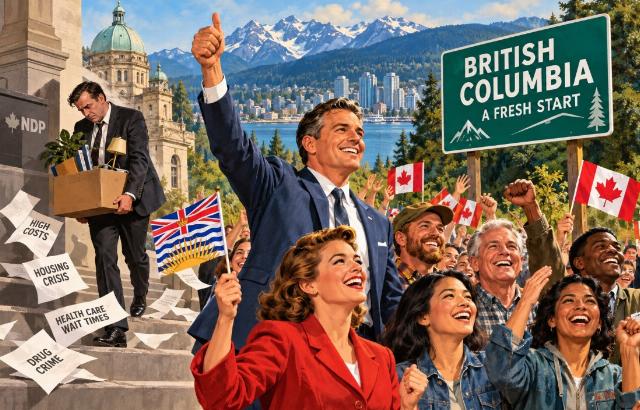 Image created using AI.
Source link