
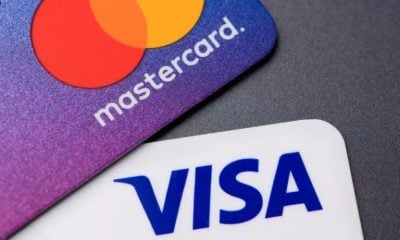
Visa and Mastercard payment cards, which are based on American technology, are among the longstanding risks facing the European Union, underscoring the United States’ dominance over Europe, including the United Kingdom.
“We are highly dependent on international [payment] solutions,” said Martina Weimert, chief executive of the European Payments Initiative (EPI), which brings together 16 European banks and financial services companies.
“Yes, we have nice national assets like domestic [payment] card schemes… but we don’t have anything cross-border. If we say independence is so crucial and we all know it’s a timing issue… we need action urgently,’’ she added.
The risk to the EU’s financial sovereignty is high because roughly two-thirds to three-quarters of the EU’s total transactions pass through Visa and MasterCard, and these networks can be blocked instantly by software. Then, of course, there are other issues, such as Swift and similar systems, and the overwhelming dominance of the US in the military-security complex—both in terms of weapons and in command, logistics, and more. Once European leaders start considering this, they will realize how vulnerable they truly are.
Yet these vulnerabilities are evident not only in the financial and military systems but also in the energy sector. By stopping the purchase of gas from Russia, Europeans become more dangerously dependent on the US, which will likely strengthen the need for more serious political discussions within each EU country about how they can truly develop and become sovereign.
Such a way of thinking should lead Europeans toward multilateralism and prompt them to abandon the imperial idea of world domination, because, in that pursuit, they have become an indefeasible prey to the US. In the context of multilateralism, the EU will be among the larger countries and blocs, alongside China, Russia, and India, giving them an opportunity to resist US pressure.
Currently, the EU cannot defend its financial sovereignty against US pressure, but if Europeans fully leverage their intellectual, technical, technological, and engineering capabilities, they could address the problem. For example, in Russia, Sberbank significantly contributed to the development of a parallel payment system by hiring 30,000 IT engineers to overcome Western sanctions. Although it will be challenging for a while, it can definitely be achieved.
The real challenge lies in the next step. Brussels must revise the political framework and establish a sovereign platform to safeguard cultural identity and related priorities. Globalist neoliberal ideology cannot develop strong capacities for mutual support and mobilizing people to act because it is beyond their reach.
The European Central Bank previously reported that Visa and Mastercard made up nearly two-thirds of card transactions in the Eurozone in 2022. The ECB also noted that 13 member states had no national alternative to US networks, and that existing domestic schemes were seeing declining usage.
As cash payments continue to decline, officials have issued more warnings about Europe’s vulnerability to US payment companies and the risk that such influence could be exploited in the event of a major political crisis. The issue is being presented alongside other areas where officials argue the EU has become heavily dependent on American firms. Belgium’s cybersecurity chief recently said Europe had “lost the internet” due to the influence of large US technology companies.
“Deep integration created dependencies that could be abused when not all partners were allies,” warned Mario Draghi, former ECB president, in a recent speech. “Interdependence, once seen as a source of mutual restraint, became a source of leverage and control.”
EPI, which includes BNP Paribas and Deutsche Bank, launched Wero in 2024 as a European alternative to Apple Pay. The digital payments service now reports having 48.5 million users across Belgium, France, and Germany, with plans to expand into online and in-store retail payments by 2027.
The ECB has highlighted the difficulties of expanding through private initiatives, noting that previous efforts – including an earlier EPI attempt to create a competing card scheme – “have shown the difficulty of scaling.” A spokesperson attributed this to the way “actors involved struggle to align on common standards.”
At the same time, the ECB is advancing its digital euro, a public-sector initiative designed to facilitate digital payments across the Eurozone and strengthen monetary sovereignty.
Piero Cipollone, the ECB executive board member overseeing the initiative, highlighted its rationale earlier this month.
“As European citizens, we want to avoid a situation where Europe is overly dependent on payment systems that are not in our hands,” he said.
However, Europe has already become overly reliant on US payment systems, and there is currently no practical alternative to mitigate short-term risk. Under current plans, merchants in the Eurozone will need to accept digital euros in stores and online by 2029, when the ECB plans to begin issuing the currency. The infrastructure will also be designed to enable private-sector companies to develop services on top of it. But it remains to be seen whether this will wean Europeans off Visa and Mastercard.
*
Click the share button below to email/forward this article. Follow us on Instagram and X and subscribe to our Telegram Channel. Feel free to repost Global Research articles with proper attribution.
Ahmed Adel is a Cairo-based geopolitics and political economy researcher. He is a regular contributor to Global Research.
Featured image source
Global Research is a reader-funded media. We do not accept any funding from corporations or governments. Help us stay afloat. Click the image below to make a one-time or recurring donation.