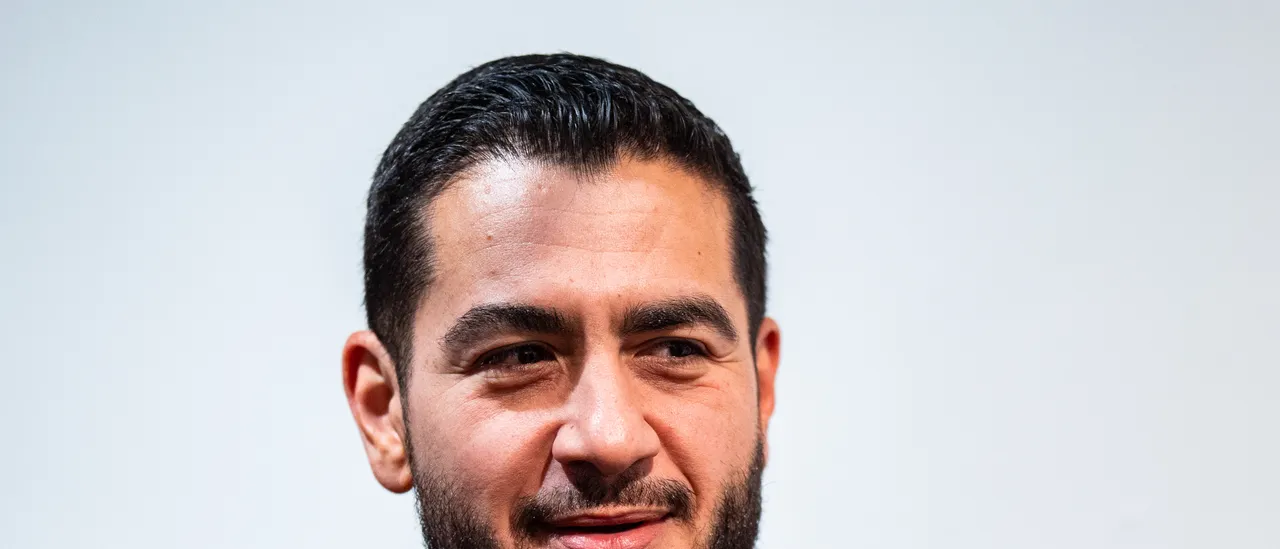
Democratic Michigan Senate nominee Abdul El-Sayed fended off an establishment Democrat's endorsement against him Tuesday by defeating former Republican Michigan Rep. Mike Rogers on Election Day, according to The Associated Press.
El-Sayed and Rogers ran neck-and-neck in the race to fill the seat of Democratic Michigan Sen. Gary Peters, who is retiring in January. Democratic Michigan Rep. Haley Stevens endorsed Rogers two days before the election, stating in a Sunday X post that she did not belong in El-Sayed's campaign.
"As you may have seen, our Democratic nominee for U.S. Senate, Abdul, said that I was no longer welcome in his campaign and that I should stay away," Stevens said. "And he's right, and that's why I am endorsing Mike Rogers for the United States Senate today. I don't belong in Abdul's campaign. I do not stand with Hasan Piker, who gets trafficked on our college campuses."
I am endorsing Mike Rogers for the United States Senate today. pic.twitter.com/pQgfSBuhOJ
— Haley Stevens (@HaleyforMI) November 1, 2026
New @RebellionPac ad dropping in Michigan. We have to suffer here at home, so Israel can get all its wars. That’s why they buy politicians like Mike Rogers. He promised to serve Israel “unconditionally,” but never made that promise to you. pic.twitter.com/mtgVOyNczg
— Cenk Uygur (@cenkuygur) October 24, 2026
El-Sayed refused Stevens' demands, saying she was "relitigating" the primary season. He said Saturday that he did not want Stevens to join him at a campaign event held two days before the election, saying he wanted "no distractions."
"Now the stakes are even higher — defeating Trump's hand-picked candidate, taking back the Senate, and defending our democracy," El-Sayed's campaign said in response to Stevens. "That should be the priority for all of us right now. So while Congresswoman Stevens seems intent on relitigating a primary that ended three months ago, let's all focus on the task at hand."
Stevens angered Democrats when she appeared at a campaign church event in Detroit with Rogers and made her endorsement. Senate Minority Leader Chuck Schumer called her endorsement a "despicable betrayal."
"This is a despicable betrayal from Rep. Stevens," Schumer said. "Senate Democrats are united in our support for Abdul El-Sayed, because we know he will fight for the economic interests of working families in Michigan, unlike Mike Rogers, who is a tool of Donald Trump and billionaire donors."
This is a despicable betrayal from Rep. Stevens.
— Chuck Schumer (@chuckschumer) November 1, 2026
Senate Democrats are united in our support for Abdul El-Sayed, because we know he will fight for the economic interests of working families in Michigan, unlike Mike Rogers, who is a tool of Donald Trump and billionaire donors.
Rogers celebrated Stevens' endorsement, arguing that she showed courage by putting "Michigan First."
"Congresswoman Stevens showed courage and bravery in putting Michigan first," Rogers said on X. "She spent her career in Congress delivering for Michiganders, and her decision to support our campaign is no different. We agree on our love of Country, supporting minority businesses, investing in Michigan's future, fixing Michigan's crippling education system, and putting Michiganders first … I'm grateful for her support, and I look forward to continuing our partnership when I am in the U.S. Senate."
El-Sayed raised $1.2 million within the first four hours after Stevens' endorsement. He raised over $53.8 million between Jan. 1, 2025 and Oct. 14, while Rogers raised over $23 million between Jan. 1, 2025 and Oct. 22, according to the latest Federal Election Commission (FEC) filings.
El-Sayed defeated Stevens by one point in the August primary after running as the further-left candidate. Further-left candidates fared well in primaries against their more moderate opponents, especially as young, college educated voters turned out in large numbers for the further-left candidates.
Stevens won more than 50% of the vote in counties where less than 30% had a college education, while El-Sayed won nearly 60% of the vote in counties where at least 30% of residents held a bachelor's degree, according to Politico. President Donald Trump made inroads with blue collar and working-class voters in Michigan during the 2024 election and won the state by a one-point margin against former Vice President Kamala Harris.
The American Israel Public Affairs Committee's (AIPAC) super PAC, the United Democracy Project (UDP), spent $30.6 million during the Democratic primary season and wanted to support Rogers during the general election, but Rogers reportedly told AIPAC not to spend money in support of his campaign. UDP spent $20 million opposing El-Sayed and $10 million supporting Stevens, according to FEC filings.
Rogers changed his tune during the Oct. 8 debate by saying he welcomed support from AIPAC.
"Anybody that wants to help my campaign, stop a guy who can't condemn terrorism in our own country because he's so close to the people who are supporting the Muslim Brotherhood, I'll take all of that help," Rogers said.
AIPAC reportedly planned to donate up to $9 million to a pro-Rogers super PAC, the Great Lakes Conservative Fund, in late October, anonymous sources told The New York Times. The spending was deliberately timed for after the Oct. 14 deadline so it would not appear on FEC filings before Election Day.
Current FEC filings do not show any contribution from AIPAC or UDP going to Rogers' super PAC. UDP spent $95,000 on mailers to oppose El-Sayed on Oct. 9. Rogers' spokeswoman, Abigail Ronson, is reportedly a registered federal agent for the state of Israel, according to DropSite News.
El-Sayed said during the debate that questioning whether Iran or Israel is a bigger threat to the U.S. is a "ridiculous hypothetical."
"I think both of them have proven dangerous in their own way. One at risk of attacking us. One getting us into wars we have no business fighting," El-Sayed said.
The senator-elect accused Israel of committing genocide throughout his candidacy. He called Israel a "rogue state" in July that committed "human rights abuses, genocide and apartheid." He argued during the debate that the U.S. should stop sending blank checks to Israel's military.
El-Sayed also repeatedly criticized Trump's economic policies, particularly the 50% tariffs on Canadian goods. Trump announced in July that 50% tariffs would be imposed on various Canadian goods, including wood, alcohol and large motorcycles, under Section 338 of the Tariff Act of 1930, to force trade concessions.
Rogers initially defended Trump's tariff policy and the Iran war, but changed his tune on both issues. His campaign released an advertisement calling for an end to a "tariff war" with Canada to help lower prices for consumers in the state, given that the state's economy is strongly tied to the neighboring country, although he previously defended the tariffs.
"President Trump is right to put America First - and tariffs are necessary, but are not a size-fits-all solution," Rogers said in an Aug. 29 statement. "Elissa Slotkin and Gary Peters are missing in action. Michigan deserves a Senator who will work with President Trump to broker a trade deal with Canada that supports our farmers and gets the best deal for Michigan autoworkers and manufacturers."
Rogers argued that imposing the tariffs on Canada helped Michigan during an interview with The Detroit Free Press.
The Ambassador Bridge, which connects Detroit, Michigan, and Ontario, Canada, connects roughly 25% of all commercial and surface trade between the U.S. and Canada, according to Bridge Michigan. Hundreds of millions in car parts, engines and assembled vehicles are transported between Detroit and Ontario daily across the bridge.
Sixty-eight percent of independent Michigan voters disapproved of Trump's 50% tariffs on Canada, according to a poll by The Washington Post and Schar School.
Rogers said in a Sept. 21 ad that the Iran war needed to end immediately. He previously described Iran as an "imminent threat" and called U.S. military action a "win-win-win" for the nation. A Silver Bulletin survey from Friday found that 57% of Americans disapproved of Trump's handling of the Iran war, while 36% approved.
Source link