In 1982, a year after earning my doctorate in organic chemistry at the Indian Institute of Science in Bangalore, I spent an anxious day at the U.S. consulate in Chennai, waiting to learn whether I would receive a J-1 visa to work at Johns Hopkins University as an exchange scientist. Several of my friends had been refused. I was approved, and I have never forgotten that day.
Becoming a permanent resident took about five more years. My employer had to advertise the job, and my lawyer and I had to document why no American applicant met the requirements. Only then did the government let me stay. I resented the paperwork then. I respect it now. It existed to protect American workers, people I would never meet, from a newcomer willing to work for less.
That is the protection illegal immigration tears down, and it is the part of the story the loudest voices for "compassion" at the border never mention.
Compassion with one eye closed
Advocates of lax enforcement speak as if compassion points in only one direction, toward the migrant. But every illegally hired worker potentially competes for a job an American could have held, at a wage an American must now match. Compassion that sees only one person in that transaction is not compassion. It is selective sympathy, and someone else pays for it.
The wage gap explains why. The OECD puts the average American full-time wage in 2024 at about $70,600, against roughly $9,700 in Mexico at market exchange rates. A worker crossing that gap can accept far less than the going American wage and still come out ahead. An American roofer with a mortgage and children in school cannot.
The familiar reply is that these are jobs Americans will not do. But Americans do them every day. Most construction workers, landscapers, and housekeepers in this country are citizens or legal immigrants. The question is not whether Americans will do the work, but at what wage.
The burden falls on those least able to carry it. The Pew Research Center estimates that unauthorized immigrants made up about 15 percent of the construction industry's workforce in 2023, and as much as 40 percent in some construction occupations, with nearly one in five landscapers and household workers in the same category. Even the National Academies of Sciences, which found immigration's average wage effect small, concluded that the losses fall on native-born workers without a high school diploma and on earlier immigrants. The averages hide the victims. The gains, meanwhile, go to the households and firms that pay less.
Honest employers lose too. The contractor who pays full wages, workers' compensation, and payroll taxes is underbid by the one who hires off the books. Even the illegal worker can lose: Without legal status, he may be afraid to complain about unpaid wages or unsafe working conditions. An underground labor market rewards unscrupulous employers at the expense of law-abiding workers and businesses.
Losses hurt more than gains
Behavioral science offers another reason to consider the American worker's losses. The Nobel laureate Daniel Kahneman and Amos Tversky showed that losses hurt roughly twice as much as equivalent gains please. A family cut from three meals a day to two suffers far more than a family raised from two meals to three rejoices. The change is one meal either way. The experience is not.
I call this the compassion differential, and the evidence on job loss illustrates the costs of losing what one already has. Workers displaced in mass layoffs lose about 30 percent of their earnings, with little recovery a decade later, and such layoffs are linked to shorter lives. The house, the school district, and the retirement plan were built on an income that is suddenly gone.
The economic migrant, by contrast, measures against the life he left. For him, being turned away is a step up denied. For the American worker who loses his livelihood to illegal competition, it is a step down forced. Refugees fleeing persecution are a separate case, and asylum law exists for them. But a disappointment and a wound are not morally equal. When a choice must be made, compassion must put the American worker first.
Liberals once agreed
This was once a liberal position. Barbara Jordan, the civil rights icon who chaired President Clinton's immigration commission, insisted that policy protect American workers "with an appropriately higher level of protection to the most vulnerable in our society." Cesar Chavez fought growers who used undocumented workers to break his union's strikes. Today's progressives have abandoned that tradition, and business-minded Republicans who quietly enjoy cheap labor share the blame.
The remedy is not cruelty. It is the gate that let me in: mandatory E-Verify, real penalties for employers who hire illegally, and legal channels only where genuine shortages exist. America was generous to me because it first made sure I was not taking an American's place. Real compassion begins with the people already here.
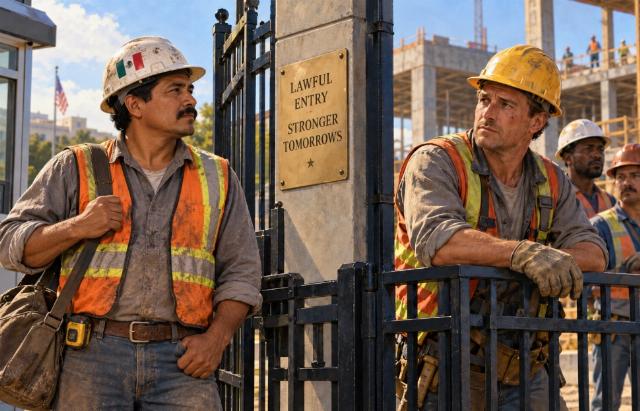
Image created using AI.
Meda Parameswara Reddy, Ph.D., is the Director of the Reddy Center for Critical and Integrated Thinking. A former R&D executive holding 30 U.S. patents, he has published 87 articles, appearing in Proc. Natl. Acad. Sci. (PNAS), RealClear Markets, Science and Defense platforms; Washington Examiner, SpaceNews, The Fulcrum, The Humanist, American Thinker, and South Asia Monitor (on the editorial board, and also hosts the show "SAM Dialogues with Dr. M. P. Reddy.") Website: mpreddyinsights.com | Contact: [email protected], https://lnkd.in/gn2zQJbs
Source link