Shocked residents in a group of sleepy villages have discovered they will be surrounded by a mammoth data centre and solar farm, larger than Heathrow Airport.
The inhabitants of Tilney St Lawrence and nearby settlements near King's Lynn, Norfolk, have reacted with anger and astonishment after learning of the vast proposed project only two weeks ago.
Within days, the Fenland community, amid some of the best farmland in the world, went on a 'war footing', determined that they will see off the Big Data moguls threatening their way of life.
A petition set up to oppose the plan has already collected a remarkable 43,000 signatures in just a week.
The planned development dwarfs any similar facility currently in the UK and covers a mind-blowing 4,700 acres, around 2,600 football pitches – making it 50 per cent larger than Britain's biggest airport.
Developers say the Longmarsh Green Energy project will require up to one gigawatt of power at any given time, while the solar farm alongside it will generate up to 1.3GW – more than any other solar farm in the country.
But the campaigners of newly formed Stop Longmarsh say those figures are misleading as the solar energy is not constant and they claim up to 85 per cent of the power needed to run the data centre will still have to be drawn from the national grid, even if a larger amount is fed back into the grid at other times of day.
The £25billion centre, planned to go live in 2032, will be spread across two nearby sites and is, the developers say, 'critical for future UK economic growth'.
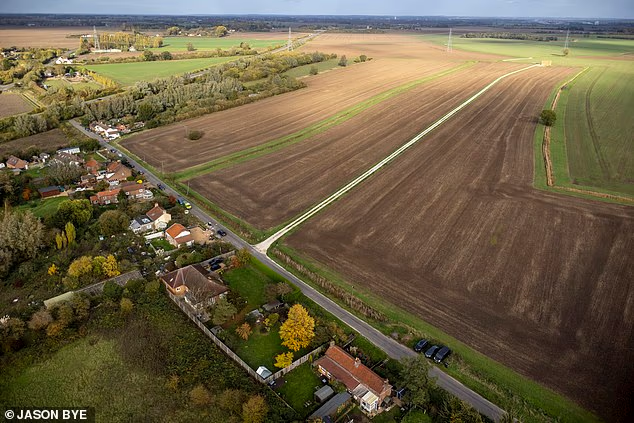
The inhabitants of Tilney St Lawrence and nearby settlements near King's Lynn, Norfolk, have discovered they will be surrounded by a mammoth data centre and solar farm
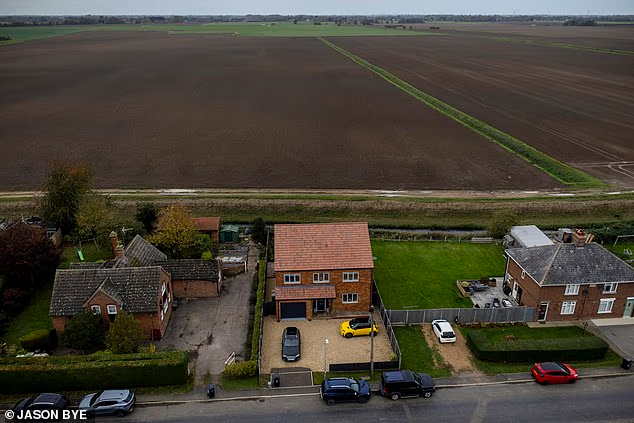
The planned development dwarfs any similar facility currently in the UK and covers a mind-blowing 4,700 acres
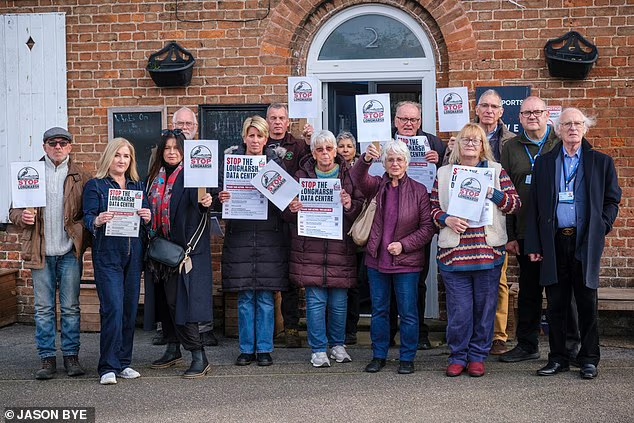
Within days, the Fenland community, amid some of the best farmland in the world, went on a 'war footing', determined that they will see off the Big Data moguls threatening their way of life
But locals are worried about the effect the eight-storey high and 600m long data 'campus', as well as the vast expanse of solar panels will have on their current idyllic views across open fields, with a constant background noise and light pollution at night.
And with Britain's food security a hot topic, the loss of fertile growing land is uppermost in their minds.
If the vast acreage to be given over to the tech project were planted solely with wheat, it would produce a staggering 25.5million loaves – enough to meet the entire nation's bread needs for three days, say the campaigners.
They have demanded to know why it cannot be built on a brownfield site instead of prime agricultural land, but say they have received no satisfactory answer.
Then there's the effect on local wildlife, including a heronry at nearby Tilney-cum-Islington designated as a Site of Special Scientific Interest, where around 80 nests make up the largest breeding colony of grey herons in Norfolk.
Tilney St Lawrence Parish council Chairman Barry Ayres told the Mail that the announcement had dealt a body blow to the community.
'The scale of this thing is out of this world,' he said. 'Why are they building it on agricultural land and not on any of the many brownfield sites in the area?
'We have invited the developers to a public meeting of the parish council on Monday (November 2), but they say they're not coming.
'It's provoked a huge storm of opposition because there are so many unanswered questions. A building of that size out in the country is completely the wrong place, and we're told there will be a constant noise from the site.
'That's not to mention the huge amount of construction traffic needed to build the place and reach it via our little narrow roads.'
Retired environmental scientist Dr Martin Little, 76, who led a successful previous 'David and Goliath' fight in the area against a huge incinerator, has now turned his intellectual guns on the new 'invaders', Evolution Power Ltd, backed by Finnish global sustainable energy giant Korkia.
'You have to ask yourself why Finland is coming to Fenland,' he said with a smile.
'The UK government is so keen to allow these huge data projects that they'll do anything to attract them, even if local people can see the flaws, and have completely sound objections.
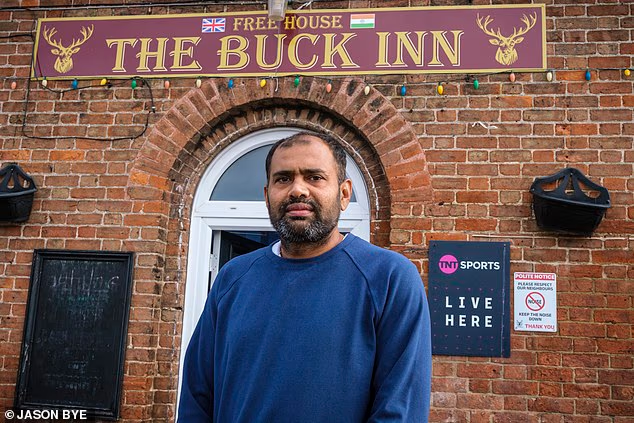
Sam Patel, 40, who runs The Buck Inn pub is one of many resident raging at the data centre plans
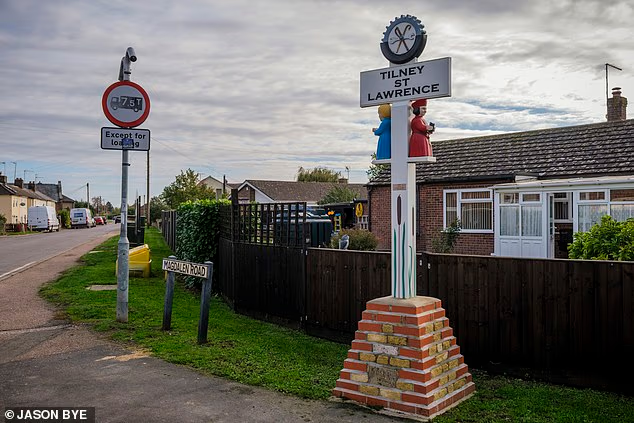
Tilney St Lawrence, a small village in Norfolk, has a population of just 1,500 people
'We feel like native Americans back in the days of the wild west and they've discovered gold in our midst and they want to trample our objections into the ground, and no doubt us too.'
EPL was founded in 2021 and is run by directors Giles Frampton and Conor McNally.
Partnering with Korkia – which is behind energy projects in Europe, North and South America – the company has 'ambitious' plans for renewable schemes in the UK.
Those have included a 262-acre scheme near Luton Airport, which was rejected by the local council but approved on appeal.
Earlier this year Sevenoaks District Council turned down proposals for a solar farm on greenbelt land.
Dorset Council refused permission for the incinerator in 2023 but the decision was overturned by the government following an appeal.
On her petition, organiser Emily Gerard said: 'After living overseas, I made a decision to come back to Norfolk for its natural beauty, its peace, and its slower pace of life alongside friends and family.'
She posted an idyllic view of a golden wheat field at harvest time from her in-laws' home in Tilney-cum-Islington, which looks directly onto part of the proposed site.
'If these plans go ahead, this view could be transformed by a vast data centre development spanning thousands of acres of our countryside.
'The impact would reach far beyond what we see from our windows, affecting the surrounding community, our rural way of life, and the habitats of the wildlife that calls this place home.
'Progress shouldn't have to mean sacrificing our countryside. And once a landscape like this is gone, we cannot simply get it back.'
Another resident in Tilney-cum-Islington, events manager Tracey Lloyd, 52, who moved to the area from London 18 months ago, says she will happily lie in the road to stop the construction traffic if it comes to it.
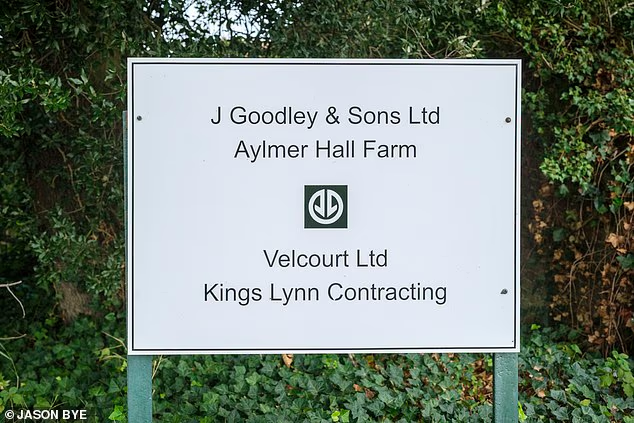
The Goodley family have decided to make millions by selling or leasing their land to the Finnish-backed energy giant planning the data centre and solar farm
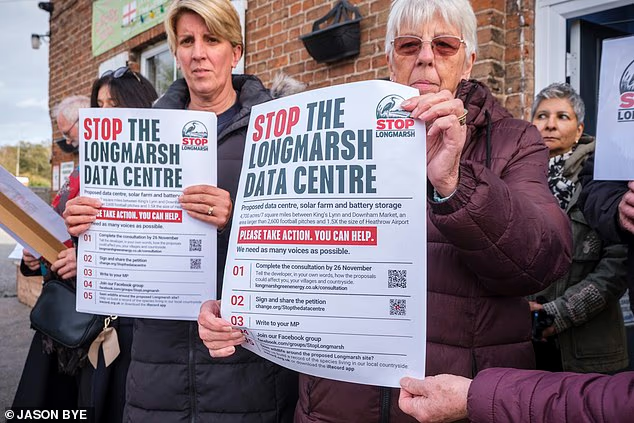
A petition set up to oppose the plan has already collected a remarkable 43,000 signatures in just a week
'We are on a war footing here and they might think they'll be able to ride roughshod over a rural community waving pitchforks, they're very wrong.
'We've got extremely intelligent, well-connected people living around here and we're organised. They've picked a fight with the wrong village.
'Make no mistake, if we need to get every car in this village to block the road, that's what we'll do.
'We're about to be imprisoned by solar panels with a constant noise and this has rendered my house completely unsaleable.'
Interior designer Amanda Naish, 53, moved to the area three years ago from Hertfordshire, in what she described as her 'escape to the country'.
Looking out over the fields with her daughter Trinny, 20, she said: 'We're all looking out for each other, and we are all determined to stop this. This has brought people together in a very short time, many of whom had never met each other from neighbouring villages.
'The scale of this thing is difficult to comprehend.'
Some locals worry if the rich array of local birdlife, including those protected herons, might mistake the vast swathe of reflective solar panels for a lake and crash into them? Others worry that the solar glare could affect fighter jets taking off and landing at the nearby major airbase of RAF Marham.
Guidance published by the Civil Aviation Authority says that reflected sunlight from solar panels is a potential concern for pilots. Solar installations can also sometimes deflect radar signals and cause interference.
Then there are the pylons which will be necessary to carry power from the solar park to the data centre, some of which will straddle farmland.
Fourth-generation farmer James Kitchen, 37, and his 65-year-old father Philip, run 650-acre Shore Boat Farm, which will be surrounded by solar panels under the new plan, as well as huge pylons crossing their land.
Their neighbouring farming family the Goodleys are the ones who have decided to make millions by selling or leasing their land to the Finnish-backed energy giant planning the data centre and solar farm.
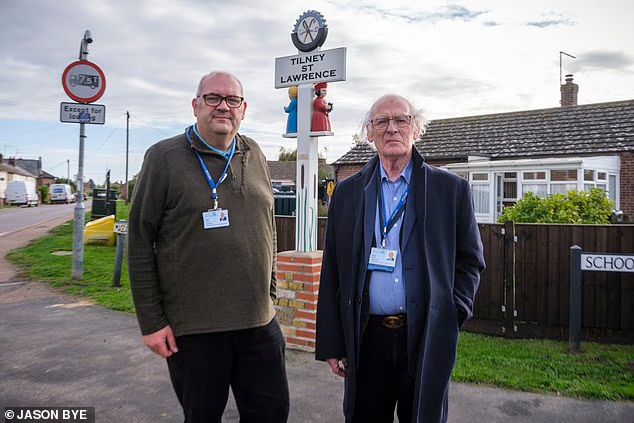
Parish council Chairman Barry Ayres (right) told the Mail the scale of the data centre is 'out of this world'
Added James: 'We have a row of pylons planned to go across our farm buildings and our garden. We take huge pride in what we do looking after this landscape producing arguably the best quality food in the world.
'To think that this land could be lost to something like this, I feel food should be our priority.'
The communities surrounding the area designated for the data park are a mixture of born-and-bred locals and 'incomers' who are welcomed for the vitality they bring to the villages.
One such is Sam Patel, 40, who moved to Tilney St Lawrence eight years ago from Harrow, north-west London after buying the village's only shop. Then he took over the Buck Inn opposite, which proudly displays both the union flag and its Indian equivalent outside.
'This is a farming community and it's completely the wrong place to site a development like this,' he told the Mail.
'There are so many other places where it would make more sense, not land which is needed to grow food.'
Inside the pub, mother-of-two and lifelong resident Maria Lynch, 48, said she nearly threw the glossy brochure sent to all residents by Longmarsh in the bin, mistaking it for junk mail.
'I couldn't believe it,' she said. 'You can't really understand the scale, but when I got to understand the scale, I couldn't believe they were going to plonk this in such a tiny village.'
Her father, Mervyn Footer, 74, said: 'We named our bungalow Oasis, because that's how we felt in the middle of the most beautiful countryside, surrounded by nature. Now we're going to be looking out on a seven-storey building and it's heartbreaking.
'The leaflet was very sneaky showing the odd solar panel and no sign of any huge buildings.'
His wife Marianne, also 74, said that the only positive aspect of the bombshell news was that it had brought the far-flung villages together as one against a common enemy.
'These days people don't necessarily know so many others in neighbouring villages, but the thought of this thing right in the middle of the area has formed alliances and friendships which will hopefully last.'
For some, the solar farm will be in the middle or far distance, but Robin James, whose house currently has an uninterrupted view of miles of countryside, will soon have a security fence to look at, just across the road, then a seemingly limitless expanse of solar panels.
Retiree Robin, 67, who moved there 28 years ago from Berkshire, told the Mail: 'I know you don't have a right to a view, and of course I'm not against progress, it just seems this is not the right place for something like this.
'My three-year-old grandson loves just sitting here watching the tractors in the field going past. This thing makes no sense. The amount of the work needed with construction traffic on our tiny one-track roads doesn't bear thinking about.
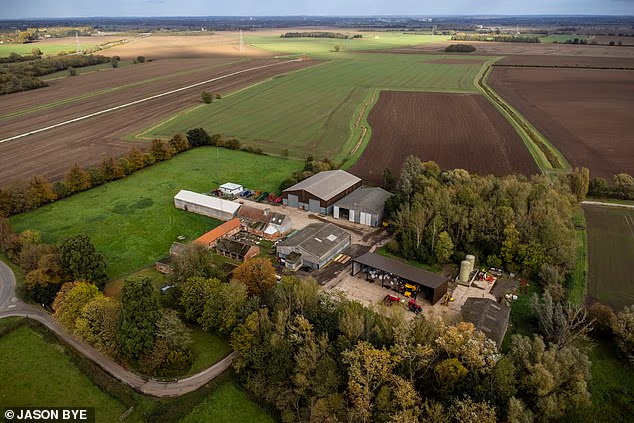
Locals are worried about the impact the vast expanse of solar panels will have on their current idyllic views across open field
'The plans are very vague, but that huge data centre will be in my line of sight as far as I know.'
As we spoke, a rainbow formed, which seemed, appropriately enough, to end somewhere close to Aylmer Hall, owned by the Goodley family, whose ancient farming land will be given over to solar panels and the data centre under the plans -- giving them a pot of gold of untold magnitude.
The scale of the project is so large that it will not be decided by any local council, but instead by the Energy Secretary using a Development Consent Order following a Planning Inspectorate enquiry.
According to Longmarsh, their data centre would use a closed-loop cooling system that recirculates liquid rather than continually drawing water from the mains, reducing impacts on local water supplies.
'Longmarsh Green Energy would bring significant local and national economic benefits, providing secure renewable energy and data centre capacity,' said a spokesman, 'both of which are critical for future UK economic growth.
'Our design includes measures and commitments to reduce local effects, and we welcome feedback on these, together with suggestions regarding how the project could support local community projects and initiatives.'
But people living nearby feel they are being rushed, with public consultation only running for less than a month longer, until November 26.
A formal Nationally Significant Infrastructure Project decision would be expected by July 2028, with construction to begin the following year and completion around 2032.
Labour MP for South West Norfolk Terry Jermy told the Mail: 'I strongly oppose the proposal for Longmarsh, particularly so with the added element of an AI data centre, just as I have consistently opposed large-scale solar farm projects in my constituency.
'We cannot accept the large-scale loss of viable agricultural land - food security should be of critical importance.
'Further, I am concerned about the resource implications that would be necessary for a proposal of this scale. We are in an exceptionally water distressed area of the country, and though I note that measures to limit the developer's impact on local water supplies are proposed, even the closed-loop system being discussed for the data centre will require significant quantities of water to operate.
'This causes me great concern and the resources necessary for this level of infrastructure would undoubtedly impact the resources available to local farmers, growers, and the wider agricultural sector.
'We must also assess the potential environmental harm and increased wildfire risk, and the loss of land that could impact our food security. New technologies are wanting to change our nature quite literally, but we must assess how they risk changing farming and our environment amongst other issues, and demand that any proposal has a clear community benefit.'
In a statement, Longmarsh Green Energy told the Mail:
'We understand the use of agricultural land is of interest. As part of our submission Longmarsh Green Energy will undertake an assessment of agricultural land impacts in line with Natural England guidance.
'According to published local authority registers there is no available brownfield site of any material size (e.g. over 5 hectares) within 25 kilometres of the Walpole substation that is not already allocated for housing.
'The data centre campus is subject to ongoing design but is expected to include up to 10 buildings with a maximum height of 25m, within a broader landscaped campus area. The nearest homes are expected to be over 400m from the campus boundary, with the nearest village settlement over half a mile away.
'We are committed to ensuring that during construction routes would be designed to avoid nearby villages, where possible.'
Asked why the company had turned down invitations to send representatives to the meetings held by local parish councils to answer residents' concerns, they replied:
'We have already received helpful feedback during the community consultation. This will be carefully considered alongside outputs from stakeholder engagement and further technical work as we develop the proposals.
'We are also committed to working with residents nearest to the proposals to develop site-specific mitigation measures, including appropriate planting, screening and landscape treatments prior to submission.
'We would welcome written responses from the Parish Councils so that we can consider their feedback in the next phase of the process.'
A spokesman for Longmarsh Green Energy, responded to the campaigners' claim that 85 per cent of the power for the data centre would be drawn from the national grid.
He said: 'Given the variation in UK weather throughout the year, it would not be possible for solar to provide a constant source of supply for the data centre and nor have we suggested that this would be the case.
'When fully built out the data centre campus is likely to require around 6,000 gigawatt hours of electricity per year, with the co-located solar generation expected to provide around 20% of this.
'The project plans to use batteries to balance the co-located solar generation and any grid imported electricity and this will also help to balance the local grid network.'
The Goodley family were contacted for comment.
Source link