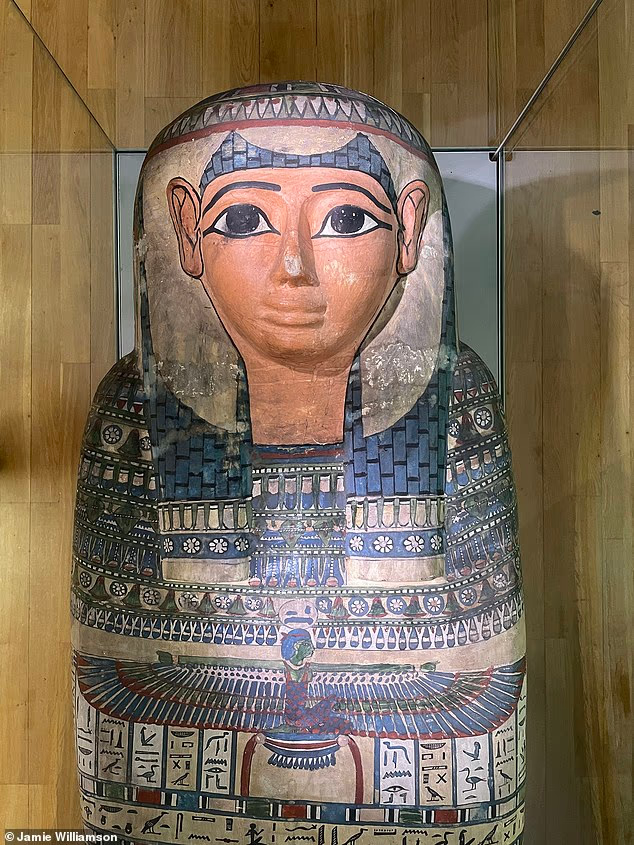
An Egyptian mummy which has been displayed for more than 200 years has been covered from public view after museum chiefs ruled she 'deserves privacy in death'.
Bosses at the Hunterian Museum, in Glasgow, covered the remains known as Lady Shep-En-Hor with a conservation-grade textile-like material, meaning visitors can no longer see the ancient wrappings beneath it.
The move comes after the Mail revealed a separate decision by council-funded arts organisation Glasgow Life to remove Egyptian human remains from display at Kelvingrove Art Gallery and Museum because of ethical concerns – and the absence of documented consent from the 'deceased individual'.
The Hunterian, part of the University of Glasgow, has decided that human remains originating outside the UK should no longer be put on open display, although Lady Shep-En-Hor's ancient Egyptian sarcophagus will remain on show.
Eminent historian Sir Tom Devine, Fraser Professor Emeritus of Scottish History at the University of Edinburgh, said: 'In the case of human remains where there is no possibility of seeking permission from living relatives, I see no 'ethical problem' in displaying mummies as long as they are treated with respect and the displays are managed by qualified personnel in established museums.'
The sarcophagus is thought to have been in the museum's collection since 1820
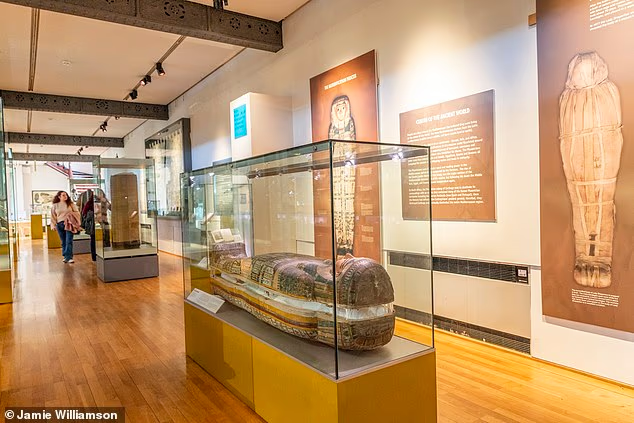
Lady Shep-en-hor's remains was originally found in Thebes but now resides at Glasgow's Hunterian Museum
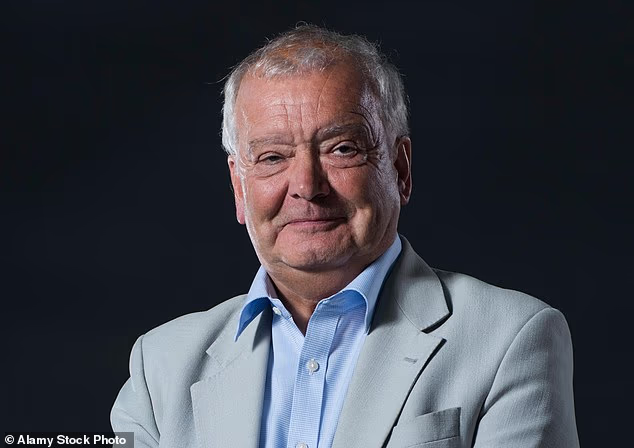
Esteemed historian Sir Tom Devine said he saw no 'ethical problem' displaying mummies as long as the remains were treated with respect
Glasgow Life, the arm's-length charitable organisation funded by Glasgow City Council, said a mummified head was among the items removed at Kelvingrove.
The changes came to light after a visitor posted an image on social media platform X of a sign stating: 'We have removed human remains from this display as a mark of respect.'
Glasgow Life chiefs said 'human remains' would no longer be on show as this 'reflects contemporary museum practice'.
Tory culture spokesman Murdo Fraser said it was 'woke madness at its most ridiculous'.
The items removed include a painted coffin containing the remains of the priest Nekht, a mummified male head, a mummified right hand recovered from the Valley of the Kings in Luxor, Egypt, and a mummified foot.
Lady Shep-En-Hor has been part of the Hunterian's collection since 1820 and has been on display almost continuously for more than two centuries.
She is believed to have lived more than 2,000 years ago.
Lady Shep-En-Hor was buried alongside her mother and father in the Western Necropolis of Thebes in Upper Egypt.
The three mummified people are thought to have been excavated by Italian explorer Giovanni Battista Belzoni between 1817 and 1819.
After reviewing the display, the Hunterian considered completely removing the remains, placing them into storage or repatriating them to Egypt. Instead, it retained the ancient sarcophagus on display but covered the mummified remains, saying Lady Shep-En-Hor 'deserves privacy in death'.
In contrast, National Museums Scotland is standing by the display of human remains, including mummified remains, and says it has no current plans to remove them. It said such remains are selected and curated sensitively.
Commenting on the Kelvingrove row, Reform UK Scotland MSP Jamie Langan said: 'It's been obvious for some time that parts of our heritage sector have been captured by ideologues and chancers more interested in pushing their own progressive agenda than in preserving history.
'Perhaps they should hold a séance and ask Nekht to sign a consent form.'
Glasgow Life told the Mail the removed human material was now kept at Glasgow Museums Resource Centre which has 'specialist stores for human remains to be held and cared for'.
Source link