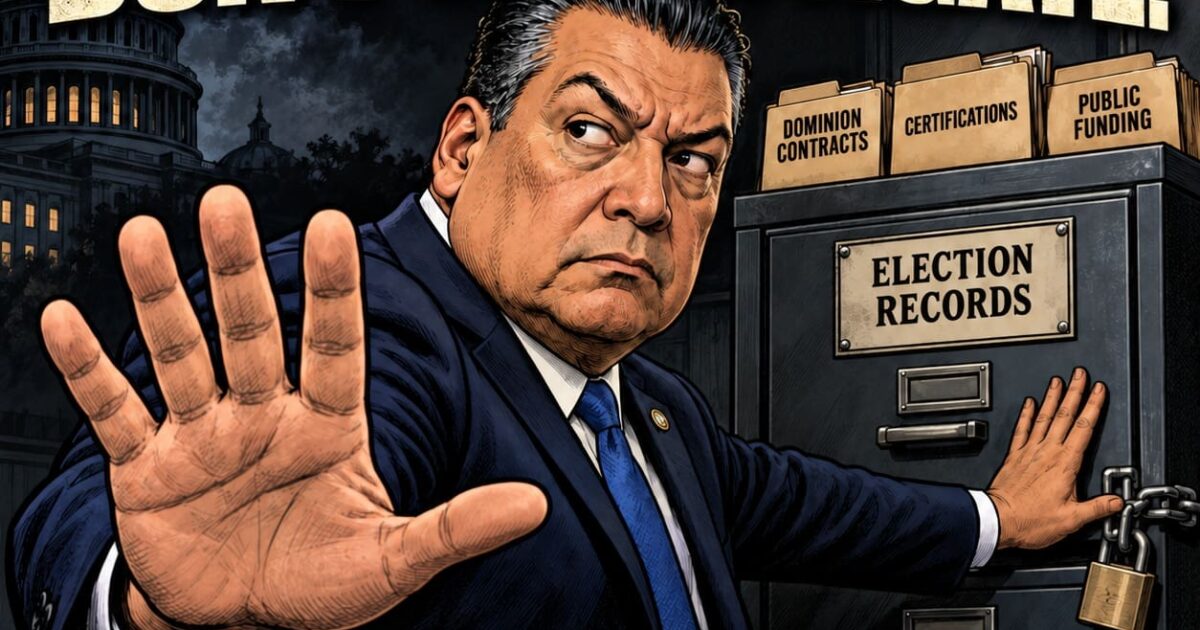

Alex Padilla Set Up California with Dominion Voting Machines While Secretary of State, Now Senator Padilla Fights to Prevent Them from Being Examined
By Christine Bish
Forty counties and the election system Padilla is fighting to protect
Forty of California's 58 counties were using the same Dominion central vote-counting system by 2020. That number belongs at the center of every conversation about Alex Padilla's defense of California elections.
Padilla ran the state office that certified voting equipment and administered the money helping counties replace it. His decisions helped shape what counties could buy with public assistance. Now he is urging the Justice Department to drop voter-roll lawsuits and demanding limits on seizures of election materials. He tells California election officials, "We have your back."
What, exactly, is Alex Padilla protecting? His own record is a good place to start.
I began following that record in November 2020, when I asked Sacramento County's voter registration office why it had chosen Dominion. The answer sent me looking for contracts: I was told there had been two bids, but Dominion was the only system certified to qualify for reimbursement of up to 75 percent. I recorded that explanation in a December email. Several people helped me collect county contracts in 2021.
Sacramento committed to Dominion in late 2017, with its contract taking effect in January 2018. The county's own public explanation says Dominion was the only bidder that held the certification Sacramento required. The new state reimbursement program did not become law until June.
Dominion was selling the value of that approval. In a proposal included with San Luis Obispo County's January 2018 contract, the company advertised its product as the "only system in California" certified to the standard cited in its pitch. Exclusivity was part of the sales presentation.
Dominion cleared the newer state standards in October 2017, 13 months before competing vendor Hart received its qualifying approval. When the new reimbursement program began, that newer certification became a condition for funding new systems. Sacramento's experience shows how a county could receive competing bids and still have only one that met its requirements.
Counties' cost concerns were already on the record. Legislative analysts reported doubts about affording the new vote-center model. The Legislature and Governor Jerry Brown created a roughly $134 million replacement program in 2018, initially requiring an equal county match. Padilla's office administered it, and qualifying earlier purchases could be reimbursed.
Padilla also put his own authority behind the spending. His office said he earmarked $20 million in federal election funds to help counties buy new equipment as they moved to the vote-center model. In February 2019, he directed counties to retire older systems under a transition schedule with an extension process. Hart was already qualified by then.
That June, the Legislature and Governor Gavin Newsom added roughly $87 million. For counties such as Sacramento, the state's share rose to 75 percent of qualifying costs within their allocations, including under the earlier funding allocation. Sacramento had already chosen Dominion. The revised rules made a larger subsidy available for eligible purchases already made.
Then there is the fine print. Sacramento's Dominion software license bars the county from reverse engineering, decompiling or analyzing the software without the company's prior written permission. The records of authorized testing and independent reviews deserve close attention.
The contract also subjects confidentiality to California's public-records law. If Dominion marks requested information confidential, the agreement calls for notice to the company and release unless it obtains a court order. A confidentiality label should lead to a demand for the legal basis, the records covered and any order preventing disclosure.
The political paper trail continues after Padilla moved to the Senate. In May 2021, three lobbyists named on Dominion's federal account made personal contributions totaling $1,000 to his Senate campaign. The lobbying disclosure identifies Nadeam Elshami, Brian McKeon and Zachary Pfister; the campaign filings show the payments.
Today, Padilla is helping lead the fight over how Washington can examine election administration. His August 5 letter asked DOJ to abandon lawsuits seeking states' voter rolls. His October 15 letter sought a promise against seizing ballots and equipment while they remained necessary for voting, counting and certification. The senators cited privacy and disruption concerns and acknowledged federal inspection and copying through proper demands.
California also won an emergency ruling on October 28, when a federal judge rejected DOJ's proposed ballot restrictions involving a disputed list of suspected ineligible voters. That courtroom fight now sits alongside a public record of approvals, contracts and spending that reaches back through Padilla's tenure.
Padilla has a political legacy in the system he is defending. Californians should be able to examine it from the voter rolls that determine where mail ballots are sent to the equipment that counts accepted ballots. The bid evaluations, certification decisions, testing records and actual reimbursement payments can show how much choice counties had and what taxpayers received.
California's Democratic leaders are asking voters to trust the election structure they helped shape. They should be prepared to open its records to lawful scrutiny. Forty counties using the same Dominion counting system is reason enough to follow every purchasing decision and every public dollar behind it.
Padilla has promised election officials that he has their backs. Californians are entitled to know who is watching theirs.
Reporting records
Source documents supporting the article and the underlying investigation. Links in the article open selected records; the full list preserves contract locations, legal provisions and the fundraising ledger.
- Sacramento County Election Integrity Full Document
County account of the 2017 bid and certification requirements, use of Dominion since 2018, and availability of testing and manual-tally records. Accessed October 30, 2026. - Secretary of State CCROV 18206 dated August 29 2018
Pages 1–2. Initial matching formula, CVSS requirement for new voting systems, and eligibility for qualifying contracts after April 29, 2015. - Voting Systems Used by Counties November 3 2020 General Election
Printed page 15. Counted the Tabulation System column: 40 Dominion, 12 Hart, 5 ES&S, 1 Los Angeles VSAP; 58 unique counties. - Christine Bish email dated December 28 2020
Author's contemporaneous account of a November 2020 meeting with the Sacramento registrar; explains the reimbursement statement she was given and the origin of the contract investigation. - Dominion proposal in the San Luis Obispo January 23 2018 contract
Original file 20180123-Item13_Dominion_Voting_Contract.pdf. PDF page 117 / printed page 92 contains the Secretary of State requirement. The quoted spelling of VVSG is from PDF pages 127 and 130 / printed pages 102 and 105; page 117 has a malformed acronym. The proposal's 4.14 claim and its wording of the standard are reproduced as written. They are distinct from the later 5.2 CVSS approval. Original and excerpt are in the accompanying source archive. - Dominion Democracy Suite 5.2 signed approval
Page 5, signed October 16, 2017. Page 1 identifies testing against California Voting System Standards. - Hart Verity 3.0.1 signed approval
Page 4, signed November 16, 2018. The interval from the Dominion 5.2 approval is 396 days, exactly 13 calendar months. - Los Angeles VSAP Tally 1.0 approval and staff report
Staff report PDF pages 4, 8 and 10 describes mail-ballot tabulation and internal Los Angeles use. Signed approval dated August 21, 2018 is available at https://votingsystems.cdn.sos.ca.gov/vendors/LAC/vsap-cert.pdf. - ES&S EVS 5.2.1.0 CA approval in CCROV 17126
Signed November 27, 2017; notice dated November 28. An earlier Unity approval was signed April 14, 2017. These approvals predate the later CVSS-compliant version. - Secretary of State CCROV 19015 dated February 27 2019
Pages 1–3. Three-system CVSS list, withdrawal of older approvals, transition dates and extension process. - Secretary of State CCROV 19056 dated July 23 2019
Pages 1–2 amend the matching requirement for both funding years. Attachment A, PDF page 3, lists Sacramento's allocations. Allocations are not payment totals. - Secretary of State press release AP19 020 dated February 27 2019
Pages 1–3 explain the newer standards, funding restriction, three certified systems and replacement deadline. Page 2 says Padilla designated $20 million in federal HAVA funding for new equipment as counties transitioned to the Voter's Choice Act. - Voting Systems Used by Counties September 14 2021 Recall Election
Printed page 12. Same 40 Dominion ImageCast Central 5.10A entries as the 2020 table. - Sacramento Dominion contract MA00036417
Contract reproduced with Change Order 3. Page 1: contract dated November 22, 2017, effective January 13, 2018, and RFP 8484. Page 17: confidentiality and public-records provisions. Page 19: software license restrictions, including analysis without prior written permission. - Sacramento January 2018 amended Election Administration Plan
PDF pages 80–81, Appendix J. Replacement commitment and equipment-cost planning estimates before the June 2018 program. - Legislative Analyst report dated March 30 2017
Considering the State's Role in Elections. Section on counties unlikely to implement the new model in 2018 documents equipment and implementation-cost concerns. - Legislative Analyst report dated March 16 2018
Voting Equipment for Counties. The proposed $134 million funding included reimbursement for counties that had recently updated equipment. - AB 1824 Chapter 38 Statutes of 2018
Approved June 27, 2018. Section 1 added Elections Code 19402, including earlier-contract eligibility, CVSS certification, payment documentation and dollar-for-dollar matching. - SB 82 Chapter 29 Statutes of 2019
Approved June 27, 2019. Sections 78–79 amended the program; section 19402(c)(5) specifies three-to-one reimbursement, subject to allocation, with a small-county exception. - Brownstein registration to lobby for Dominion
Federal lobbying registration effective January 14, 2019. - Dominion lobbying disclosure for the second quarter of 2021
Contemporaneous Brownstein account roster names Elshami, McKeon and Pfister. Reported lobbying income is separate from campaign contributions. - Alex Padilla for Senate FEC filing 1527030
PDF pages 152, 410 and 479 show the May 19, 2021 personal contributions from Elshami, McKeon and Pfister. - Itemized Padilla fundraising research ledger
44 dated receipts with source URLs and transaction identifiers. The $27,000 federal total is gross receipts identified in 82 recovered filings; Senate 2023 Q4 and 2026 Q3 reports were not recovered. Leadership-PAC raw-file coverage ends August 2026. No matching itemized federal refund was found in those recovered filings. - California Secretary of State campaign and lobbying data
Brownstein's 2010–2014 receipts appear in filings 1522827, 1637693, 1819567 and 1854270. Latest amendments retained; duplicate late-contribution notices excluded. - Padilla statement to California election officials October 23 2026
Official statement opposing DOJ demands concerning ballots sent to allegedly ineligible voters. Contains the quotation used in the opening. - Padilla and Senate colleagues letter on voter rolls August 5 2026
Pages 1–3 ask DOJ to abandon litigation seeking state voter-registration lists and cite the NVRA quiet period, privacy concerns, disputed SAVE data and court orders. The letter also recognizes list maintenance as an important function outside the restricted period. - Padilla Durbin and Whitehouse letter on election materials October 15 2026
Signed October 15; announced October 16. Pages 1 and 4–5 seek a commitment against seizure of materials needed for voting, counting and certification. Page 2 expressly acknowledges federal inspection, reproduction and copying through appropriate demands. - United States v California order denying temporary restraining order October 28 2026
Case 2:26-cv-12025-DOC-ADS, Document 149. Pages 2 and 26 state the denial; the opinion addresses constitutional authority, the disputed data and requirements for emergency relief. Described as an emergency ruling, not a final disposition of every related proceeding.
The post Alex Padilla Set Up California with Dominion Voting Machines While Secretary of State, Now Senator Padilla Fights to Prevent Them from Being Examined appeared first on The Gateway Pundit.
Source link