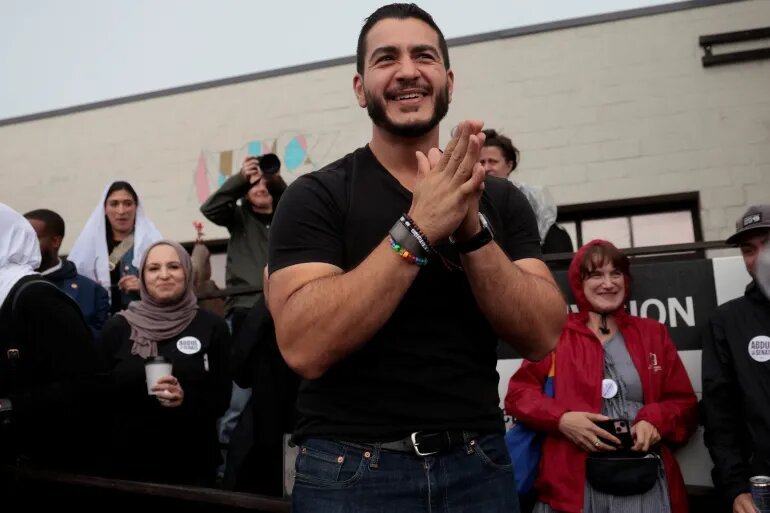
Abdul El-Sayed, who said in 2009 that following Sharia was an "obligation" and whose campaign confirmed in August that he still follows it in his
personal life, won Michigan's U.S. Senate seat on Nov. 3, becoming the first Muslim elected to the Senate. His win followed a CAIR turnout drive and calls from clerics describing voting as a "religious duty" for the "Ummah." Commentator Wajahat Ali warned that "the fire will rise" if El-Sayed lost, a warning Muslim reformers condemned as Islamist intimidation.
In his victory speech in Detroit early on Nov. 4, El-Sayed introduced himself by his full name, Abdulrahman Mohamed El-Sayed, and delivered part of his speech in Arabic. He told supporters, "Up until right about now, you might have noticed I always say 'inshallah,' or 'God willing,' whenever the outcome of this race was mentioned. But today, tonight, we can turn that inshallah into alhamdulillah!" Alhamdulillah means "praise be to God."
He also addressed Vice President JD Vance using the Arabic term "habibi," telling him, "JD, habibi, there is this delicious irony in the fact that you're constitutionally obligated to swear me in in January."
Yasir Qadhi, chairman of the Fiqh Council of North America (FCNA), which provides Islamic legal guidance to Muslims in the United States and Canada, and resident scholar at the East Plano Islamic Center in Texas, urged Muslims to vote in an Oct. 29 post on X. He said, "it is our ethnic duty, it is our civic duty, it is our religious duty to go and support those candidates and choose those that represent the best of our interests."
He concluded, "And so, today, tomorrow, pray Jumma and go to vote for the Ummah." Jumma is the Friday congregational prayer; the Ummah is the worldwide Muslim community.
CAIR, which describes itself as the nation's largest Muslim civil rights and advocacy organization, announced its final turnout push on Oct. 29, projecting 3.13 million advertising impressions and up to 750,000 text messages to Muslim voters in 10 states, including Michigan and Texas. By Nov. 1, CAIR estimated that 88,148 people on its 250,099-person outreach list, or 35.2%, had voted early or by mail.
Its Muslims.Vote website encourages American Muslims to view civic participation as an "amanah," an Arabic term for a sacred trust. In an Oct. 30 statement, CAIR said, "We urge every eligible Muslim voter to visit Muslims.Vote today and make a specific plan to cast their ballot."
A CAIR survey conducted with CAIR Action, its political advocacy arm, polled 861 Muslims from Oct. 16 to 25. It found that 72% planned to support Democrats and 6% Republicans in their state's November election. CAIR estimates that more than 3 million registered Muslim voters live in the United States.
At an Oct. 25 rally in Port Huron, Michigan, Trump said, "I'm here to keep a jihadist Muslim Brotherhood member from becoming a United States senator." At the same rally, Rogers said, "The Muslim Brotherhood celebrated exactly one victory in the United States in the primary this year. Abdul El-Sayed's."
When a town hall attendee asked whether he would disavow the Muslim Brotherhood, El-Sayed answered, "absolutely." However, he has never issued a statement formally and explicitly rejecting the group. After Trump mocked his name at the rally, El-Sayed told supporters in Grand Rapids that evening, "I will be Senator Muhammad to you, bro."
In a 2009 New York Times interview about his Sharia-compliant mortgage, El-Sayed, then a 24-year-old medical student, said, "Ultimately, the question is, when I die and I stand before God and go through everything I did in my life, I don't want to say I did it the easy way instead of the Shariah-compliant way. Not because of fear but because of obligation." In August 2026, his campaign confirmed to the Washington Free Beacon that he still follows Sharia in his personal life.
Speaking to CAIR's Oklahoma chapter in October 2022, El-Sayed linked the forces behind the state's ballot measure banning Sharia to those behind the Trail of Tears, the Tulsa race massacre and the Oklahoma City bombing. "I don't have to tell you that the same exact forces that drove native peoples from their land two centuries ago, destroyed Black Wall Street a century ago, bombed a building decades ago, and tried to ban Sharia law not a decade ago, that those forces are alive and well today," he said.
During his 2018 gubernatorial campaign, he pointed to a bookshelf and told documentary filmmakers, "You're going to want to not get these things in the shot. We're trying to keep the shot secular." That year, when journalist Laura Loomer asked whether he had described himself as "Sharia-compliant," he replied, "I didn't say that."
On March 12, Ayman Mohammad Ghazali, a naturalized U.S. citizen from Lebanon, rammed a car into Temple Israel in West Bloomfield, Michigan, and opened fire. Four of his relatives had been killed in an Israeli airstrike in Lebanon the previous week. The Israel Defense Forces said two of his brothers killed in the strike were members of Hezbollah, a U.S.-designated terrorist organization.
El-Sayed condemned the attack in a video but said "hurt people hurt people" and "violence is a cycle," according to NOTUS, a Washington political news site. On Aug. 29, he apologized to the Michigan Democratic Party's Jewish caucus, saying, "What I was trying to do was offer context for why it happened, but it wasn't the time for context."
What's wrong with Allahu Akbar, James?
— Wajahat Ali (@WajahatAli) November 2, 2026
Please tell us. https://t.co/qbOZOQ95NV
Source link