Below is State of the Day, a morning newsletter from the Daily Caller Editorial Desk. Sign up here.
__________
Hey everyone,
Welcome to State of the Day,
They won the game, but now they must agree on the playbook,
Trump United Democrats — To Succeed, They Must Stop Power From Dividing Them
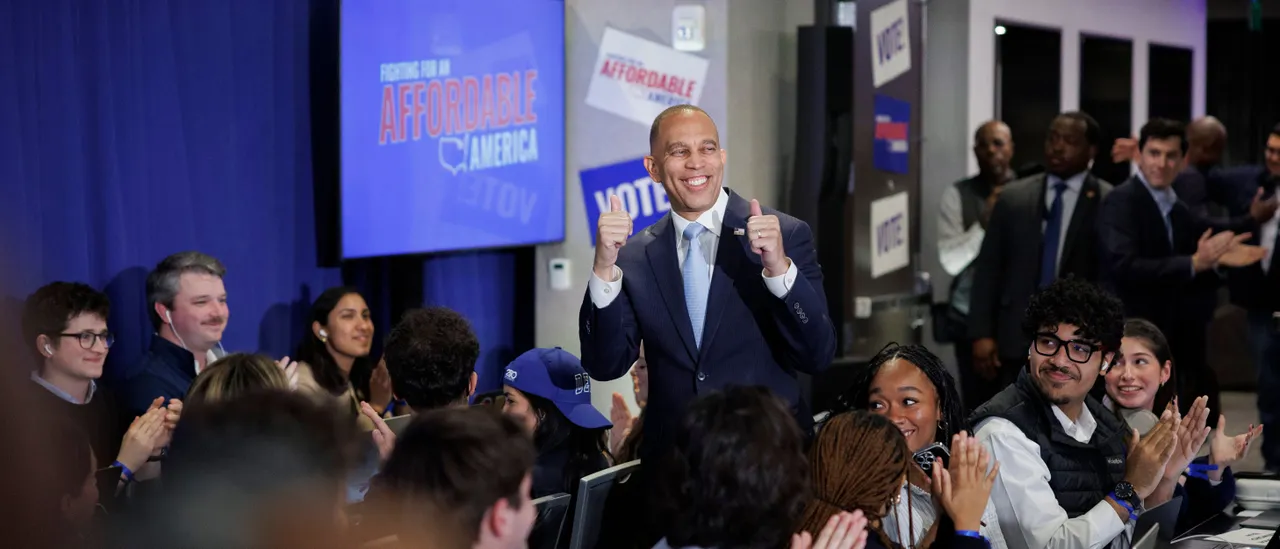
Last night, Democrats took control of both chambers, picking up dozens of seats and giving the party commanding majorities in Congress. Winning those seats was no small feat, but deciding what to do with them, and who among them gets to call the shots, will undoubtedly dictate the party's future.
Last night's election wasn't simply a referendum on President Trump and congressional Republicans. It was also a test of the competing visions for the Democratic Party's future — and a preview of the ideological battles awaiting its new majority.
Voters sent Democrats from opposite ends of the political spectrum to Capitol Hill, from Washington state's Blue Dog Marie Gluesenkamp Perez to New York City's DSA-backed Darializa Avila Chevalier.
Last night's data offers an even clearer picture of the patchwork Democratic Party emerging.
Exit polls highlighted some of the biggest issues driving voters to the polls, including the Iran war, rising grocery costs, government corruption, and utility costs, just to name a few.
But with a new majority, Democrats will have to decide who will lead them in next year's Congress.
Hakeem Jeffries will finally get his shot at the speaker's gavel, while Chuck Schumer will have to contend with a Senate caucus that may not be as friendly to him as in years past.
Those leadership decisions will offer the first clues about which faction has the upper hand — and whose vision will shape the party's legislative agenda.
Will Democrats empower the progressive candidates and activists who helped energize their base, or will moderates who delivered crucial victories in competitive districts have the upper hand?
Those decisions won't be merely philosophical. They'll determine who gets committee gavels, whose legislation reaches the floor, and how much Jeffries and Schumer must concede to keep their competing factions together.
The election results may give both sides reason to believe voters vindicated their approach.
Will Democrats embrace the increasingly influential progressives among them, or push for a moderate — and arguably more broadly appealing — approach?
One takeaway is that younger, further-left progressives energized the Democratic base most.
While many Democrats centered their campaigns on denouncing Trump and congressional Republicans, candidates further to the left offered voters their own policy proposals. They weren't just promising to unleash hell on the president; they were promising to change things.
If the election results and voter data lend credence to that strategy, Democratic leaders may find it increasingly difficult to dismiss the demands of the party's progressive wing as fringe politics.
But Democrats who won competitive districts by appealing to more moderate voters will have their own claim to the party's electoral mandate. And those competing interpretations of what voters wanted could make governing considerably more difficult than campaigning.
So what does all this mean in practice?
The first tests will come when Democrats begin deciding which priorities deserve the attention of their new majority — and which campaign promises will have to wait.
Progressives may demand aggressive action on their signature proposals, while moderates push leadership toward an agenda they believe can maintain the party's fragile coalition.
Over the next two years, Congressional Democrats will help define the party's agenda and serve as its most visible opposition to Trump.
There are some things the disparate factions have in common.
Democrats across the board will be eager to investigate suspected White House corruption and block Republican priorities wherever they can.
But opposing Trump is one thing. Deciding what policies should replace the president's is another thing entirely.
The real test, however, may come as the 2028 presidential race takes shape.
The consequences of what Democrats do with their majority in Congress will reverberate beyond Capitol Hill. The party's next presidential nominee will inherit the successes — and failures — of their time in the driver's seat and the coalition they built — or destroyed — in the process.
Democrats can briefly bask in the glory of last night's sweep.
But now they must decide what to do with that power. As Republicans proved over the last two years, it's not an easy position to be in.
— From The Editors' Desk
Trump Announces End To $4 Billion In Annual Aid To Israel — Ashley Brasfield, Daily Caller
President Trump made a last-ditch announcement on Election Day, but what does it really mean? The U.S. sends billions in taxpayer dollars to Israel every year, but before you rejoice or complain, the funding mechanisms deserve a closer look. The NDAA has yet to be finalized, and Congress still holds the power of the purse through the appropriations process. Read more on the actual implications of this announcement from the Daily Caller's Ashley Brasfield.
Lone Fox News Host Says She's Anti-War, America First. The Smears Start Flying — John Loftus, Daily Caller
Rachel Campos Duffy, Fox News regular and wife of Transportation Secretary Sean Duffy, was the subject of a slew of online attacks after ever so slightly criticizing the Trump Administration's approach to the Iran War. Online commentator's claimed she crossed over to the "dark side," while she defended her comments as "anti-war" and "America First." The Caller's John Loftus digs into the tidal wave of criticism that hit Duffy and why her position may not be as extreme as the reactions suggest.
Google Will Turn Off Search for Schools That Reject A.I. — Dana Goldstein and Natasha Singer, The New York Times
Welcome AI or get shut out. That's the message Google sent to schools across the country, announcing that schools that opt out of AI capabilities for their students will also lose access to Google Search. The move comes as the use of AI in schools becomes an increasingly controversial issue among Americans.
US intelligence sharing has fractured under Trump, officials say — Erin Banco and Jonathan Landay, Reuters
As Election Day crowded out most coverage yesterday, Reuters' Erin Banco and Jonathan Landay uncovered how intelligence sharing among U.S. agencies and with Congress has fractured under Trump, at times temporarily stopping altogether. The disruptions followed major events like the Iran war and the capture of Maduro, raising concerns among former officials and experts that policymakers are being left with an incomplete picture of global threats.
Source link