
Article III of the Constitution allows Congress to establish courts below the Supreme Court, which includes federal District and Circuit Courts. If Congress can establish them, it can abolish them. In 1801, in the waning days of John Adams' presidency, Congress did just that and abolished the district and circuit courts of the District of Columbia.
These two courts display widespread intransigent partisanship and demonstrably poor scholarship, exemplified by this week's ruling on the new White House construction. Given the difficulty of removing so many bad judges in these two courts by impeaching them, it's time to repeat John Adams' move: Abolish these courts. Cases that normally would be heard in them should be assigned to courts elsewhere.
The case which most showcases the lunacy of the D.C. courts is National Trust for Historic Preservation in the United States v. National Park Service, et al. As is often the case in poorly reasoned opinions, the author substitutes words for reason.
As you may know, the old East Wing of the White House which, among other things, contained underground security facilities (bunkers, bomb-shelters, and military and medical infrastructure), presidential offices and some minimal public meeting spaces, was torn down and construction begun on a replacement with a larger number of more modern offices and a ballroom to provide a larger, much-needed entertainment and meeting space, better security facilities, and protection against drone attacks. Up to now, rented tents and outdoor porta potty facilities have had to be utilized for state events, and the assassination attempt at the White House Correspondents Dinner surely underscores the need for a safe venue for such things. Except for the congressional appropriation for the upgraded secure facilities in this new wing, the remainder of the cost is being borne by private contributions to the National Park Service, which is administering these funds.
But this is hate Trump city, and Alison Hoagland, a board member of the National Trust, said that she takes monthly walks past the White House and that the aesthetics of the new construction would cause her harm.
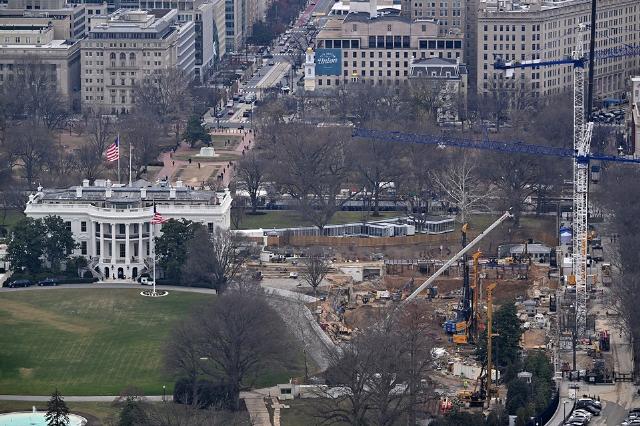
In the real world, monthly aesthetic harm to one person's delicate sensibilities would not upend a needed improvement to the White House grounds, which are exempt by its terms from the National Historic Preservation Act (which establishes the Trust). The litigation has been long and involved back-and-forth court rulings between the district and circuit courts.
The courts have now finally agreed the below-ground construction would not be halted, but this week ruled the above-ground work must be, even though that is a structural impossibility and a security (and aesthetic) nightmare.
The first question that every court must decide before proceeding further in any case is whether or not it even has jurisdiction to hear and decide the matter. The majority opinion doesn't get to this until page 30 of its opinion, and then, for all its flowery verbosity, it got it wrong, just as the dissenting judge notes:
...the district court had no jurisdiction because the Trust has no standing to stop construction at the White House. The ballroom is also likely within the President's authority to make improvements to the Executive Residence at the White House. Finally, the balance of equities overwhelmingly favors the government. The district court elevated the aesthetic displeasure of a single passerby over the government's security interests in the ballroom and the security risks of leaving an open construction site at the President's home and office.
In assessing the balance of equities between Ms. Hoagland's claimed aesthetic harms and the needs of the White House, Judge Rao shows the Court "improperly glossed over, ignored or discounted the government's evidence demonstrating the  security harms from construction of the ballroom." Nor could it, as Rao noted, "compensate for the slight aesthetic harm by resorting to hyperbole and its view of the legal merits. Every day the project is delayed increases the security risk according to declarations from senior military and Secret Service officials. Moreover, the creation of the above-ground ballroom "will alleviate security vulnerabilities that currently impact large events involving the President."
As a practical matter, the underground and above-ground facilities cannot be separated out at this point.
The Secretary of the Army has further explained why the underground national security facilities cannot be adequately protected by the concrete slab and modest topping structure allowed by the district court's injunction… The ballroom's dimensions and structure are essential for security. According to the Secretary, "[t]o provide adequate subterranean protection without" the "height and mass" of the ballroom, "engineers would need to dig impractically deep."...The ballroom provides a critical "dual-layered system" of protection for the national security facilities, "comprising a sacrificial outer cover coupled with a hardened inner structural element." …Corroborating the Secretary's account, the Commanding General of the U.S. Army Corps of Engineers has similarly described how the "height and mass" of the ballroom "provide crucial, physical layers to shield" the national security facilities. The height of the ballroom will also provide an "essential elevated platform to engage and neutralize aerial systems," such as drones, that pose an increasingly serious threat to White House security. …There is no dispute that the Secretary's declaration and the Army Corps memorandum are authentic, credible, and "go[] to the heart of the contested issue," so it would be "inconsistent with this court's own equitable obligations to pretend that [they] do[] not exist."
Congress authorized “alteration” and “improvement” of the Executive Residence. It authorized the National Park Service to accept donations and appropriated the resulting trust funds. The ballroom serves official presidential functions and forms part of an integrated security…
— Apple Lamps (@lamps_apple) August 7, 2026
Congress authorized "alteration" and "improvement" of the Executive Residence. It authorized the National Park Service to accept donations and appropriated the resulting trust funds. The ballroom serves official presidential functions and forms part of an integrated security project. At the absolute minimum, the government's interpretation is reasonable, which is fatal to the National Trust's extraordinary ultra vires claim.
A court lacking a clearly injured plaintiff cannot appoint itself architect, preservation board, appropriations committee, and security supervisor of the White House.
I have no doubt that despite all the language in the majority opinion, the impetus for this absurd decision is the desire to hamstring the President in all things large or small and have him leave office with unsightly, dangerous, and insecure construction on the White House grounds.
It's altogether possible, as Shipwreckedcrew suggests, that the Supreme Court will just summarily order relief to the Administration and remand the case to the District Court, referencing Judge Rao's dissent on the Trust's lack of standing to bring this matter.
If not, it seems perfectly obvious to me that the D.C. courts care little about established law or presidential (and national) security and deserve to be abolished.
Image: G. Edward Johnson
Source link