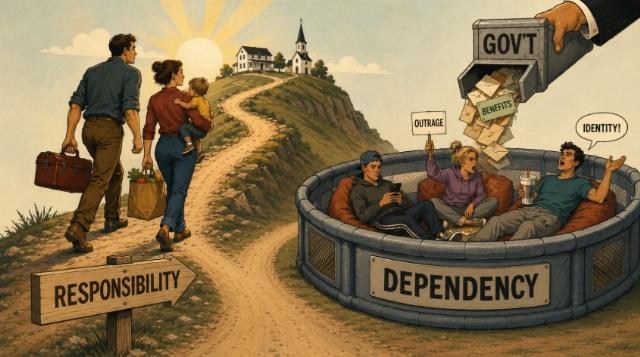
Humans require meaningful struggle, sometimes intensive struggle, to achieve their potential. When societies attempt to eliminate the essential struggle for survival, people must voluntarily assume responsibility, something they’re frequently unwilling to do. If they don’t, they invent artificial alternative struggles.
Governments too often accelerate that process by subsidizing dependency and insulating people from the consequences of their actions. The result is social policy that rewards the wrong behaviors, to the detriment of society but to the advantage of some politicians.
Consider how simple life is for those who wake up hungry each day in parts of the developing world. Their daily mission is brutally clear: feed the family, avoid violence, and survive another day.
Thanks largely to the spread of market capitalism—and aided by America’s unmatched tradition of private philanthropy—fewer people live in extreme poverty today than at any point in recorded human history. Virtually no one in the Western world faces that kind of existence. That is unquestionably good. Yet the disappearance of natural struggle also removes the forces that once compelled people to develop discipline, responsibility, and resilience.
Prosperity itself isn’t the problem. Prosperity without responsibility is.
Throughout history, people found meaning through faith, family, productive work, sacrifice, community, and raising children according to moral principles. These voluntary burdens replaced the burdens of survival while producing stable and prosperous civilizations. When people abandon those responsibilities, they rarely stop searching for meaning. They simply begin looking for it in all the wrong places.
America offers perhaps the clearest illustration of this principle in the modern world.
Over several generations, the government has steadily assumed responsibilities once carried by families, churches, neighborhoods, and voluntary associations. Each new promise has come with a hidden cost: fewer opportunities—and fewer expectations—for individuals to solve their own problems. As government expands, the institutions that cultivate responsibility steadily weaken.
Millions of healthy young adults delay marriage, postpone careers, remain financially dependent upon parents, and drift through extended adolescence. Rather than assuming adult responsibilities, many continue to search for their identity well into their thirties and beyond.
Church membership has fallen sharply over the past several decades, with a parallel increase in loneliness and anxiety. Institutions that once provided purpose, discipline, and community continue to weaken while government increasingly attempts to fill the void.
Politics has ceased to be merely a means of governing. For millions, it has become a primary source of identity and purpose, turning every election into an existential struggle and every political disagreement into a moral crusade.
Identity politics, perpetual outrage, tribalism, social media activism, class envy, and victimhood are artificial struggles created to fill the void left by the disappearance of genuine daily struggle. The point is not left versus right. The point is that people who no longer find meaning in productive lives often seek it through symbolic, but ultimately meaningless, conflict.
History repeatedly demonstrates this pattern. Post-war Britain’s expanding welfare state fostered growing dependence upon government while gradually eroding habits of initiative and self-reliance.
The Soviet Union took the process much further, producing what scholars called Homo Sovieticus—citizens conditioned to be passive, resentful, and incapable of self-direction. Different societies, different systems, the same lesson: when governments assume responsibilities individuals should bear themselves, the human capacity for self-government steadily atrophies.
One of my most important rules is simple: whatever you subsidize, you get more of.
Subsidize work, and you encourage work. Subsidize investment, and you encourage investment. The corollary: subsidize dependency, and you inevitably create more dependency. America has the largest dependent class it has ever seen, and it’s growing, not shrinking.
America’s current political and social turmoil is a direct consequence of a government that has grown far beyond its constitutional restraints and intended purpose. It promises more than it can possibly deliver and, in doing so, dehumanizes millions who become increasingly frustrated, angry, and disillusioned. Government interference increasingly displaces the institutions that once rewarded effort, family formation, devotion to moral norms, and adherence to the natural law principles that developed over centuries.
Or, as Zohran Mamdani proudly declared: “We will replace the frigidity of rugged individualism with the warmth of collectivism.”
That statement should chill every freedom-loving American to the bone because collectivism does not eliminate struggle. It merely transfers responsibility from individuals to the government while concentrating power in the hands of political elites whose goals rarely align with those of the people they subjugate.
Throughout history, consequences have taught lessons that lectures never could. Modern governments increasingly shield people from the consequences of their own destructive choices. Predictably, those choices become more common. Permanent welfare erodes the human impulse to solve problems. It gradually reduces people to a kind of custodial existence—not unlike zoo animals: fed, sheltered, protected, yet deprived of agency, initiative, and purpose.
Government is not our savior; it frequently reveals itself as our destroyer. It should be treated like a fire alarm: kept under glass with the label, “Break Glass in Case of Emergency.” Government policy is often wrong, and the most expensive solution is frequently the one adopted first. Dependency, family breakdown, fraud, bureaucratic expansion, and declining civic responsibility are too often treated as unfortunate side effects when, in fact, they are predictable consequences of policies that reward dependence over independence.
Civilization cannot permanently replace hardship with comfort, responsibility with entitlement, or purpose with politics. Human nature does not disappear simply because society becomes wealthier. If people no longer struggle to survive, they must willingly choose the harder path of responsibility. If they refuse, they will manufacture conflicts to fill the vacuum.
Prosperity is among civilization’s greatest achievements. But prosperity alone cannot satisfy the human soul. Unless it is accompanied by responsibility, faith, family, productive work, and voluntary sacrifice, people will search for meaning elsewhere. America’s cultural turmoil is not simply the product of bad policy. It is a prosperous civilization searching for meaning in all the wrong places—and one that will never find it there.
God Bless America.
Image created using AI.
Author, Businessman, Thinker, and Strategist. Read more about Allan, his background, and his ideas to create a better tomorrow at 1plus1equals2.com.