Britain could face a Christmas tree shortage in future years after the country's hottest summer on record and severe drought led to a smaller crop for many farmers.
The exceptionally dry weather in England and Wales meant many young saplings did not survive their first year while the growth of more established crops was stunted.
Extreme weather has led to concerns over the health of this year's harvest and a possible shortage in future, given trees are normally cut after growing for eight years.
Clive Collins, owner of Catsfield Christmas Tree Farm in East Sussex, said a very late frost in May had also affected the growth of older trees.
He told the Daily Mail there were also fewer imports of Christmas trees this year due to logistical issues such as lorry driver shortages as well as soaring fuel costs.
Mr Collins – who has been farming trees for more than 30 years and has 16,000 in his plantation – said severe weather has also reduced numbers available for export.
He added: 'This is making importing very expensive. As a result, there is a shift towards domestic sourcing and British consumers will be relying more heavily on the millions of trees being grown domestically on UK plantations.
'There should still be sufficient trees this year – and we have plenty at Catsfield. The weather has affected the quality of some trees – although we have plenty of top quality ones at Catsfield – so people might struggle to find their perfect tree.

Clive Collins is the founder and owner of Catsfield Christmas Tree Farm in East Sussex
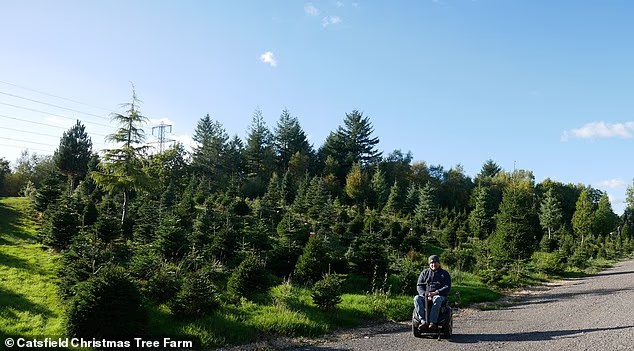
Mr Collins says his crop was impacted by a very late frost in late May as well as the hot weather
'It's not just the heat that has affected the trees - we lost a number of very young trees this year – but a very late frost in late May in the South East damaged some of the tree buds of older trees which affected their growth.
'We have just planted 1,800 to replace the ones we lost this year – autumn planting is becoming more common because of unpredictable weather. More rain will help the roots. Growing Christmas trees is not as straightforward as people might think.
'You can't just plant and leave. They need to be fertilised, protected from birds and other wildlife, pruned and monitored throughout the year.
'It takes seven years to grow a 6ft tree – not including the two years it takes to grow a sapling - these are usually imported from Denmark. It's a constant learning process as new techniques and species are introduced.'
He added that the industry suffers from the 'hog cycle' – where 'the price of trees is high so everyone plants Christmas trees – seven years after that there are too many trees then price goes down – people stop planting and then there's a scarcity'.
Oliver Combe, who runs York Christmas Trees with his wife and son, said he had lost about 2,000 of his newly planted trees because of the hot and dry summer.
The 57-year-old, who will supply this year's 10 Downing Street tree, is now planting in autumn in an attempt to promote good root growth before summer droughts.
He said it had been a 'tough year' for growers with 'no proper rain since Easter', adding: 'For the first time ever we have had losses in what we planted last year.'
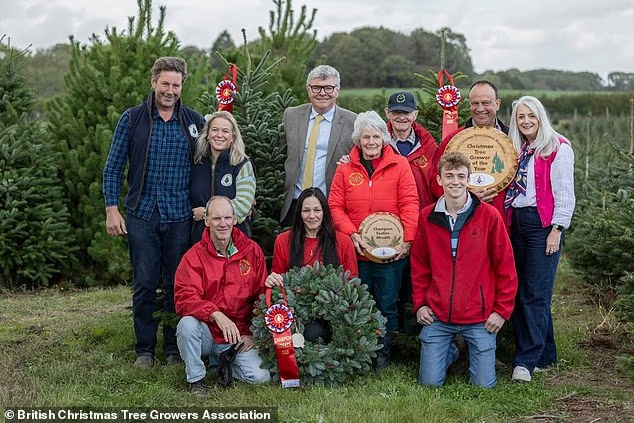
The winners of the British Christmas Tree Growers Association were announced last month - including Will and Ella Miles (far left) from Welford Christmas Tree Farm in Northamptonshire
Mr Combe added that he was now looking at irrigating crops with a supply from two ponds on his farm, which he hopes will hold enough water for when needed.
He told the Telegraph: 'The summer of 2018 was pretty extreme. We did think it was an exception before but very, very hot summers are becoming the norm.
'We used to have drier Aprils and Mays but it seems to be drier for longer. We all think 'oh, it will balance out over August', but one of my fields is still bone dry.'
Growers are urging the public to only buy their tree from the start of December when it will have had several frosts and therefore hopefully last longer after being cut.
James and Ruth Wallis, who run Sutton Hall Farm near Lewes in East Sussex, said the severe weather had resulted in them losing 20,000 trees planted two years ago.
Mr Wallis, whose harvest is set to fall by a third this year, told the BBC: 'The drought has made it harder for trees to absorb nutrients, and some have turned yellow.'
The farm does not hold an irrigation licence and therefore could not water its trees, so decided to leave weed growth on the smaller trees to protect them from the heat.
Mrs Wallis added: 'The financial consequences are significant. You invest a huge amount of time and effort into producing a quality tree, so it's very disappointing.'
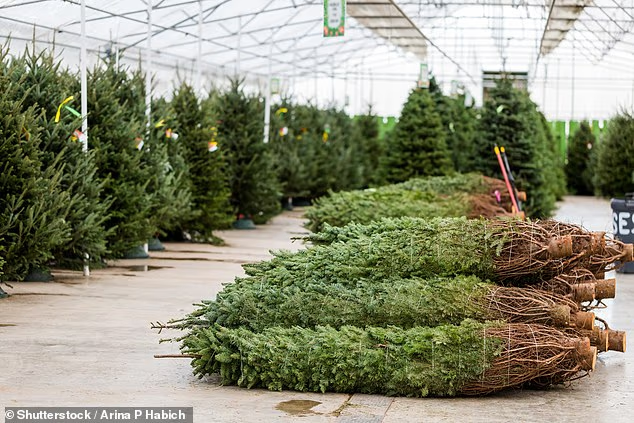
Christmas trees are normally cut after growing for eight years (stock image)
Will and Ella Miles, whose Welford Christmas Tree Farm in Northamptonshire will supply two trees to Downing Street this year, saw 4,000 saplings die in the drought.
They are now planting young trees in the autumn to give them longer to establish their roots ahead of hot weather and therefore make them more drought resistant.
Russell Parkins of the British Christmas Tree Association reflected on a 'tough year', adding: 'There are enough trees, but it's a challenge to keep them in good condition.
'We've applied more fertiliser into the tree so there is more moisture in the ground. As the trees shut down for winter, it can still maintain the nutrients.'
Severe drought remains in place across parts of south-west England and Sussex, including areas in Cornwall, Devon, Dorset, Somerset, East Sussex and West Sussex.
But all of north-west England, including Greater Manchester and Cumbria, was moved to recovery status last week – after England's wettest week for two years.
Much of Wales remains in drought after the UK's hottest summer since records began in 1884. At least 120 per cent of average rainfall is expected to be needed over the next six months for the entire country to be out of drought by next spring.
Source link