'Age shall not weary them, nor the years condemn,' as the time-honoured exhortation reminds us. That is why, as we salute our Fallen on Remembrance Sunday, five heroes from more than a century ago will be up in lights – quite literally – tomor
row.
In honour of this year's 110th anniversary of the Battle of the Somme, the Commonwealth War Graves Commission (CWGC) and the Speaker of the House of Commons have joined forces to project images of some of those who died there on to the Palace of Westminster. British casualties during the four-month battle in France were more than 400,000, with 19,240 killed on the first day alone.
Once dusk has fallen on a day of remembrance at the Cenotaph in London and across Britain, Big Ben will light up with photographs – including one of Company Sergeant Major Edward 'Dick' Thomas of the 16th Battalion Welsh Regiment. A police sergeant who played rugby for Wales before the war, he was killed on July 7, 1916 at Mametz Wood, though his body was never found.
Appearing on behalf of Scotland is another former rugby international, Lieutenant Eric Milroy, killed on July 18, 1916 in the attack on Delville Wood. Forever being urged by his mother to avoid injury on the rugby field, he wrote to her on the eve of the battle: 'I am just warning you that there is to be no "keeping well back".'
Thereafter, she would always leave the light on in the front room at night, just in case Eric might try to find his way home. He, too, has no known grave. The names of both men are engraved on the CWGC's Thiepval Memorial to the Missing of the Somme.
Tomorrow's display will feature VAD (voluntary civilian) nurse Barbara St John, who was running a 35-bed surgical ward at Etaples when she contracted scarlet fever and died in October 1916. Representing Northern Ireland is Captain James Davidson, who was killed commanding the machine guns of the Ulster Division's 108th Brigade just weeks after announcing his engagement.
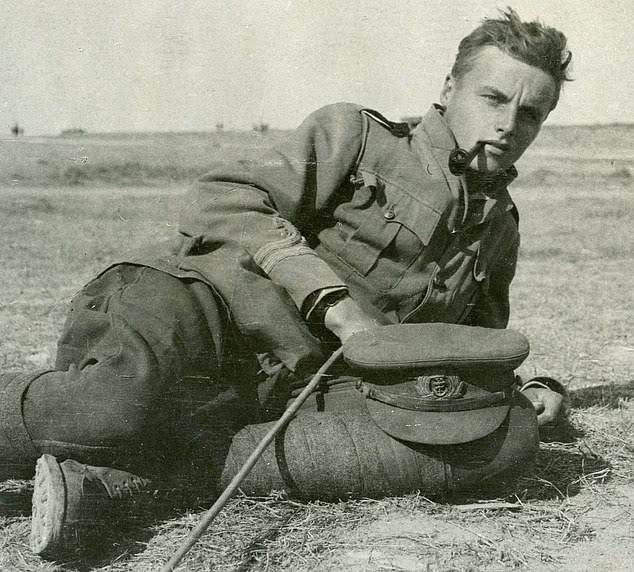
Lieutenant The Hon Vere Harmsworth was just 21 when he died leading his men in the final stages of the Somme offensive at the Battle of Ancre in November 1916
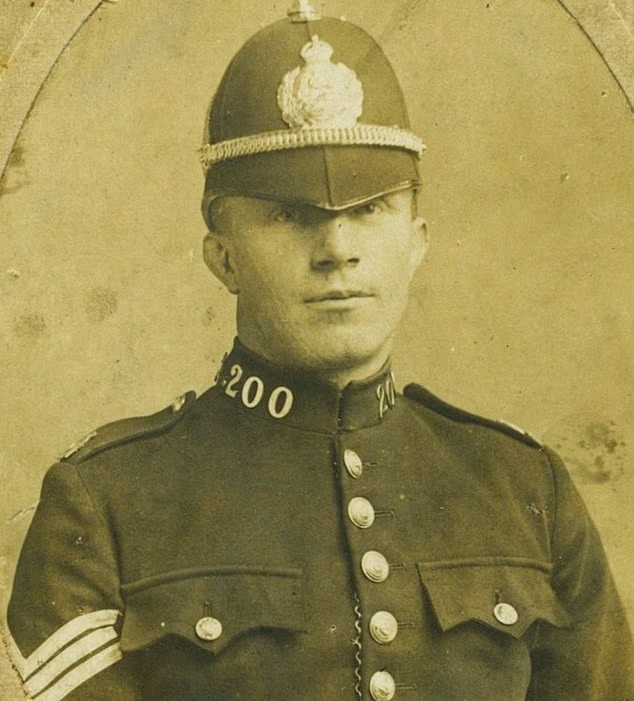
Company Sergeant Major Edward 'Dick' Thomas of the 16th Battalion Welsh Regiment. He was killed on July 7, 1916 at Mametz Wood, though his body was never found
As for England, Lieutenant The Hon Vere Harmsworth was just 21 when he died leading his men in the final stages of the Somme offensive at the Battle of Ancre in November 1916. The son of the first Viscount Rothermere, publisher of this newspaper, he had already had a remarkable war.
Educated at the Royal Naval College on the Isle of Wight, Harmsworth had trained to be a Royal Navy officer but gunfire had wrecked his hearing just before the outbreak of war. Undeterred, he signed up for the Royal Naval Division (RND), a light infantry unit created by Winston Churchill for naval reservists and surplus sailors on dry land.
Harmsworth was interned in 1914 during the German advance on Antwerp but managed to escape captivity in Holland and rejoin the RND just in time to join the assault on Gallipoli. Having survived that heroic failure, he was sent home to a desk job which he regarded as a betrayal of his men.
He then managed to be reposted to rejoin Hawke Battalion in France, as they prepared for the first wave at the Ancre. 'I am happy and my health is excellent. Surely this proves that I have found my calling,' he wrote to a favourite uncle, just before the battle, in a letter carefully preserved by the family. 'You can see I am a curious specimen and that if I get knocked out in this show, no one will lose by it at all. I may have been born just to live my 21 years and then fade away.'
As for the battle, he wrote: 'If it goes alright and the artillery does not fail us, it will be an "A" show, but otherwise absolutely bloody.' He was not wrong.
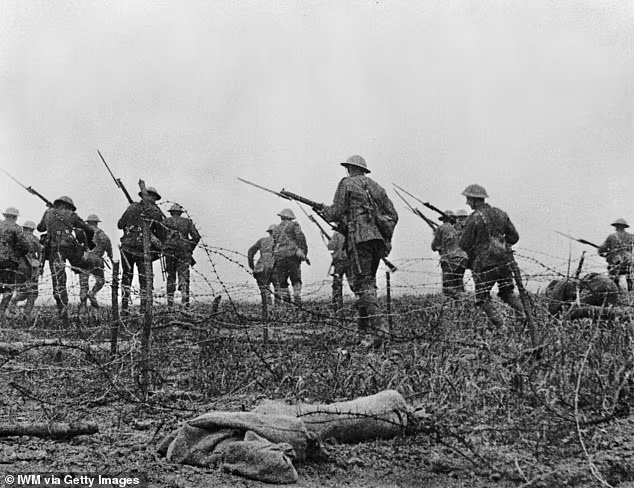
British casualties during the Battle of the Somme in France were more than 400,000, with 19,240 killed on the first day alone
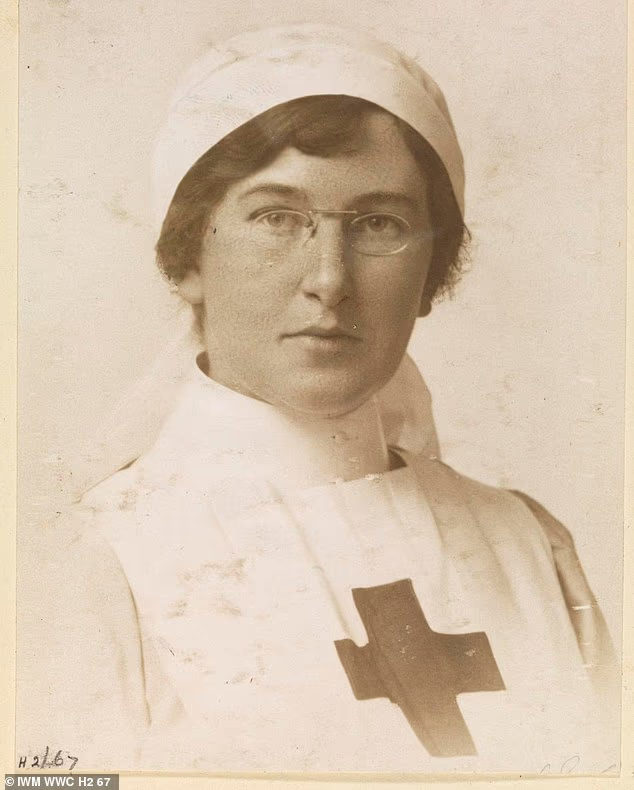
VAD (voluntary civilian) nurse Barbara St John was running a 35-bed surgical ward at Etaples when she contracted scarlet fever and died in October 1916
Launching the attack on three German lines, he was shot in the throat clearing the first and shot in the shoulder clearing the second. 'Almost immediately he got up and collected such men as were near him, and led the attack on the third line,' wrote his commanding officer. 'Just before reaching it, he was hit by a shell, and instantly killed.'
Some historians have suggested that Harmsworth might have been in line for a Victoria Cross but for the fact there were no fellow officers left to write the citation. As the division's war diary records: 'The Hawke Battalion after the first few minutes of the attack no longer existed.'
Ahead of tomorrow's display, the Speaker, Sir Lindsay Hoyle, spoke of the impact of the Somme on every corner of the kingdom. 'We cannot imagine the grief and suffering that was experienced by local communities, including in my own, to lose so many men in one battle,' he said.
It is why the CWGC continues to keep every grave and memorial from every campaign since 1914 in immaculate condition, while its charitable foundation supports educational projects such as tomorrow's 'For Evermore' display. As its director Claire Horton points out: 'Behind every name we care for was a life that mattered and still matters.'
Source link