Terry Byrne's life has been forever changed by Alzheimer's disease. Once an IT sales manager with little prior knowledge of dementia, the 70-year-old now finds much of his life revolves around the illness.
Terry, from Dorset, cared for his late wife Jen when she was diagnosed with early-onset Alzheimer's in 2018. Jen passed away in August at the age of 75.
Her death followed years of steady (and sometimes sharp) decline which stripped business owner Jen of her cognitive abilities – while Terry struggled to cope with the 'brutal' emotional and financial realities of dementia.
'People say someone has passed away 'peacefully'. Jen didn't. It was horrific,' Terry tells the Daily Mail as it launches its Dementia Carers Together appeal in association with Alzheimer's Society.
Jen's final weeks were traumatic for Terry, who was forced to watch his wife of 11 years gasp for breath as her body became weaker. At the very least, he feels Jen was unaware that she was dying.
'But who knows? Who can tell?'
The couple first met in 2003 when Terry was moonlighting as a fitness instructor and Jen was a regular attendee of his class.
They married in 2015 and just a year later, Terry noticed his wife's memory was beginning to falter – something he initially put down to her 'getting older'.
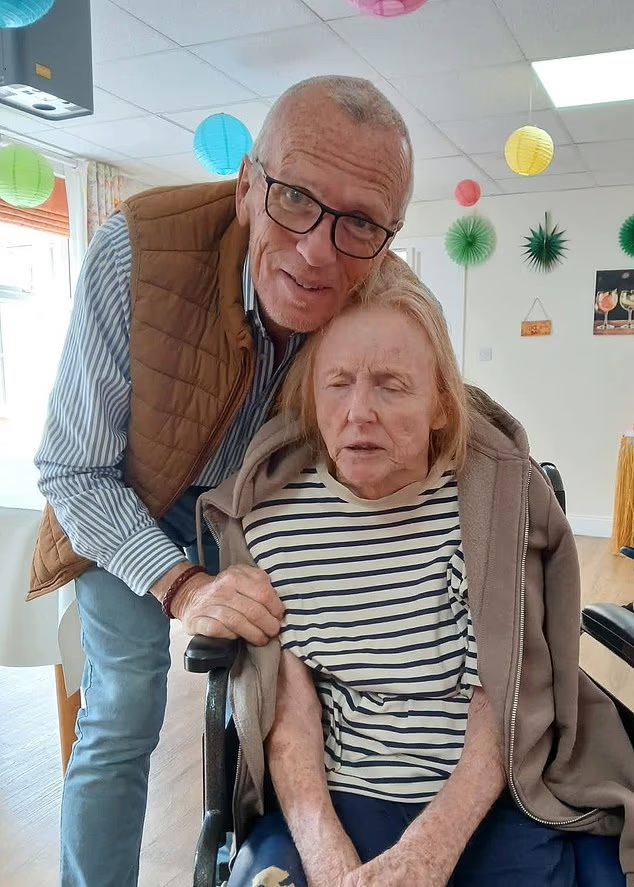
After calling an end to Jen's first best interests meeting when he realised he'd be separated from his wife during lockdown, Terry eventually concluded he needed professional help and made the decision to move his wife into a care home
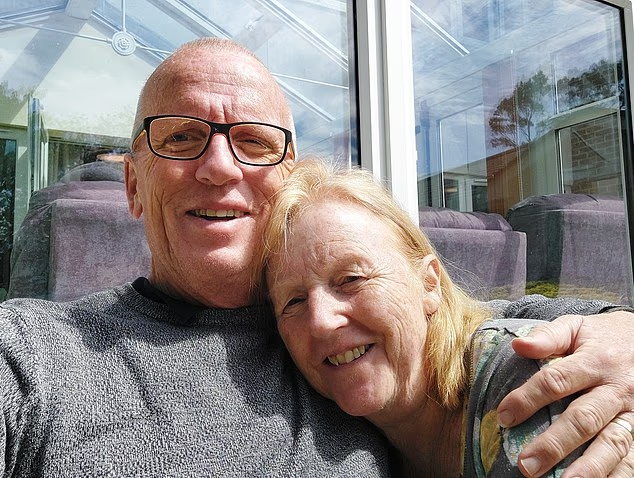
Terry Byrne and his wife Jen, from Dorset, met at an exercise class at which he was an instructor and she was an attendee. But a few years ago, when Jen was diagnosed with early-onset Alzheimer's, their lives changed forever
'I said it was about time she retired. I suppose you go into denial.'
He wondered if Jen, who was a dog groomer, was under more stress than usual as she began to forget the appointments of regular customers.
But it was a panicked phone call from his wife in 2016 that forced Terry to take Jen's symptoms seriously.
Jen seemed frightened and distressed as she stood outside in the rain after taking the dogs for a walk. She didn't have her keys and couldn't find the spare set, so she was trying to break into the house.
When Terry arrived home that evening, the spare key was in its usual place.
A 'lightweight' memory test followed, which didn't show much damage at all to Jen's memory. But Terry pushed for an appointment at a memory clinic, where she was assessed more strenuously. The diagnosis finally came in December 2018 when Jen was 67.
'[The doctor] looked her straight in the eye and said, 'Mrs Byrne, you have dementia by Alzheimer's'. And that was it. That was how we found out.'
Amid the devastation of the diagnosis, Terry gave up his substantial salary to become Jen's full-time carer. He never regretted his decision but describes the financial and emotional toll of unpaid care as 'horrific'
He received a severance package from his company when he left – but he didn't anticipate how quickly the money would dry up on 'just living'.
He applied for carer's allowance for himself – working out to £67 per week at the time – and attendance allowance on Jen's behalf. As Jen had been self employed, she received only a state pension.
'You have to fight tooth and nail for every single pound,' he says.

Jen had always been an active and independent woman, running her own dog grooming business for years
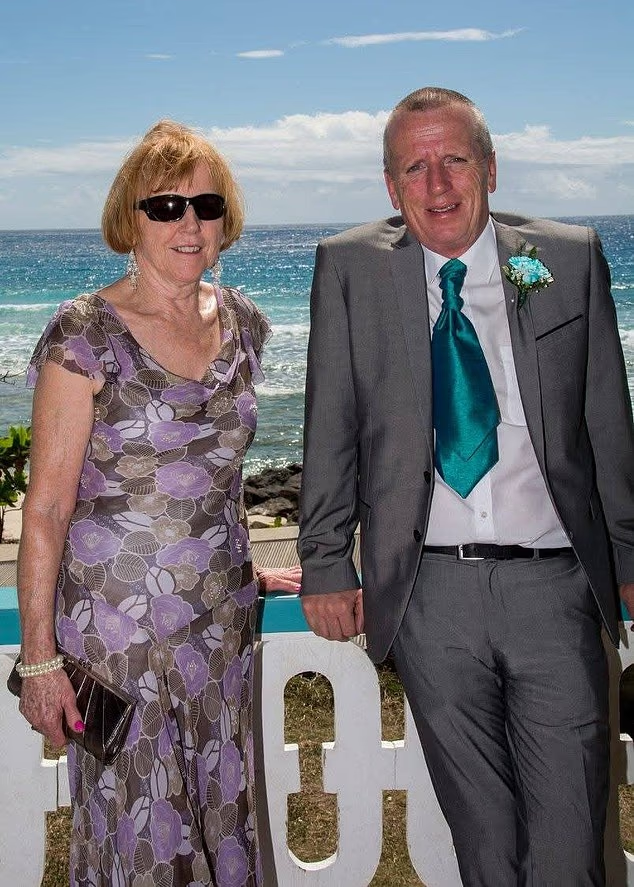
Jen and Terry shared a love of fitness, having met at Terry's exercise class back in 2003
He also relied on a day centre which Jen visited up to four times a week.
Day centres for people with dementia operate throughout the UK and offer vital respite care for unpaid carers. However, they are not automatically free and can cost around £60 a day in some cases. The fees can be subsidised but applicants must complete a lengthy assessment to qualify for this.
'Everything you get, you get dragged over hot coals to get there,' Terry says.
With a background in IT and research, and a little younger than many unpaid dementia carers, Terry was able to research the state support he and Jen were entitled to – but he says most carers don't have access to this vital information.
'The carers are 75, 80 years old. It's not easy, it's a real challenge.'
Exclusive polling for the Daily Mail reveals 66 per cent of people who care for, or have previously cared for, someone with dementia do not feel well supported in their caring role.
The YouGov survey of 2,328 UK adults also found three quarters (76 per cent) would not feel prepared to cope with behaviour changes such as anger, distress or confusion.
It's a feeling Terry knows well. Though he had sought support from the NHS-provided community mental health team, which he describes as 'lifesaving', he found himself at breaking point in the last months he cared for Jen in their marital home as she became increasingly agitated and confused.
Shortly after a lockdown was imposed on the UK public in light of the Covid pandemic, Terry called a best interests meeting to assess if Jen should move into a care home. However he called an abrupt end to this meeting when he learnt that, due to Covid restrictions, he would not be able to visit his wife in the home.
He insisted he could continue to care for Jen at home until restrictions were lifted – but what followed were some of the 'worst months of [his] life'.
Alzheimer's was progressing fast in Jen's brain, causing her to lash out in anger. Terry tried everything he could to calm his wife as she smashed objects of sentimental value, ripped up papers and even tried to throw furniture at him.
He recalls the day he walked into the conservatory to find Jen holding the footstall over her head, preparing to throw it at her husband.
'The despair and anger in her eyes were unbelievable.'
During this time, Jen also suffered a series of transient ischaemic attacks (TIAs) which saw her admitted to hospital. It was at this point that Terry knew he could no longer cope at home.
He arranged a second best interests meeting where it was agreed with near certainty that Jen should move into a care home.
Terry had no doubt he was making the right decision for his wife. But the pain of moving Jen into care still affects him deeply.
'It's not a decision anybody takes lightly... I just felt terrible. I felt awful for doing this. It's another area where carers aren't really given any kind of emotional support.'
And financially, it was another hit as Terry was stripped of around 80 per cent of his income.

'[Attendance allowance was] £401 every four weeks, but as soon as [Jen] went into care I lost it,' he explains, adding he also lost the £67-per-week carer's allowance. 'I had no money.'
As he was over the age of 60 and still living in the marital home when Jen moved into the care home, Terry qualified as a 'protected' resident, which means the house couldn't be sold to pay for Jen's care.
But, still needing an income, Terry decided to retrain. After benefitting immensely from the day centre, he realised he wanted to give back to other families who needed respite care.
He completed a course to become a professional carer and began working at a different day centre – one which specialises in caring for people with learning disabilities.
For two years, caring for others – earning £9 an hour – became Terry's purpose as he took shifts at the day centre
He then moved into private professional care – scheduling shifts around visiting his wife. It was a routine he observed daily until last year, when he paused work to spend more time with Jen, who was in ailing health.
This summer Jen stopped drinking water. After years of watching his wife lose cognitive function, he knew this signalled she was coming to the end of her life.
Remarkably, Jen survived for another five weeks – ending in 'dreadful' final days until she passed away.
'It was devastating. Tearful and upsetting, but also such a relief.'
Now, a few months on from his wife's death, Terry has decided to return to the home where Jen spent her final days to work as a paid carer.
'The fact I'm going back into a care home environment where dementia is the primary thing - I question my own sanity sometimes,' he jokes. 'But you know what? I know those residents and I like them very much.'
Though Terry's life is forever affected by the horrors of Alzheimer's, he feels solidarity with other dementia carers thanks to their shared experience.
'No one - not the consultants, not the top specialists in the world - understands it like someone who has lived it. Until you have actually looked after someone at home, [carers] are the only people who really understand it.'
Dementia Carers TogetherDementia Carers Together is raising money to fund new courses across the UK to give tens of thousands of struggling unpaid dementia carers vital emotional and practical support.
For further information, visit dailymail.com/dementia
How you can donate
Online: Visit mailforcecharity.co.uk/donate
By Text: To donate £10, text CARER to 70115. To donate £20, text LOVE to 70115. To donate £30, text HEART to 70115. Texts will cost your donation amount plus your network charge.
By phone: Call 0300 1234577. Standard charges may apply.
By cheque: Send cheques made payable to Mail Force Charity to:
Dementia Carers Together, 42 Phoenix Court, Hawkins Road, Colchester CO2 8JY
Source link