60 Minutes Buries Odd El-Sayed Answers on Trans, Saudi Arabia to Extended YouTube Version
Nicholas Spinnato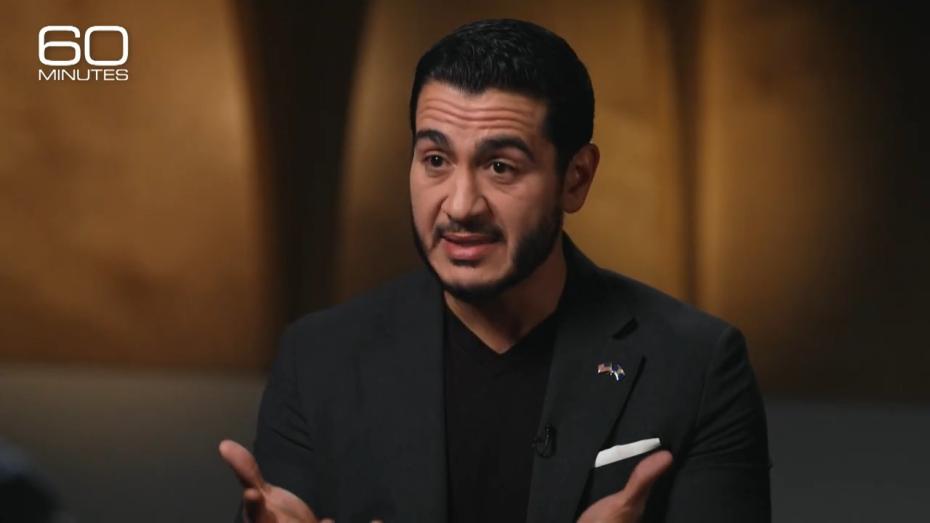
After Sunday's newest episode of 60 Minutes featured interviews with Michigan Senate candidates Abdul El-Sayed and Mike Rogers, multiple portions of the interview with El-Sayed that did not air on the show's Sunday broadcast story titled "Battleground," which only lasted 13 minutes, have raised eyebrows. In the full interview posted on 60 Minutes' YouTube page, lasting over an hour, answers that did not make the broadcast included slight support for border security, along with an odd answer of trangenderism in schools, and a portion that seemed to deny that Saudi Arabia tries to influence U.S. politics.
ABDUL EL-SAYED on how Democrats got border security wrong under Biden.
— Searchlight Institute (@SearchlightInst) November 2, 2026
DOUTHAT: Why didn't the Biden administration enforce the border?
EL-SAYED: The politics at the time were complicated by a lot of advocacy. Right? And I think we've learned a lesson. pic.twitter.com/zi5Lmi0ilT
The full “context” of the quote does not make it any better.
— Nick (@nspin310) November 2, 2026
In response to the 'transgender kids on sports teams' question, El-Sayed clearly relates to Douthat's Trans question and says, “The notion that you are going to prevent your child from being exposed to something that… https://t.co/4NhSe6paBb pic.twitter.com/9sh4ivTGcI
After the border admission, Douthat turned to ask about the relation of El-Sayed's Muslim faith to some of the Democrats' "very socially liberal" views:
A lot of Muslims have, like a lot of Christians, have traditional and traditionalist conservative positions on issues like abortion, same-sex marriage, transgenderism. I've had Michigan Democrats tell me that Donald Trump made inroads with Muslim American voters in this state on those issues.
Do you feel any tension between your faith and being part of and a champion of a very socially liberal and culturally liberal party?
In response, El-Sayed went on a long tirade about rights and stated he was a "constitutionalist" and believed "rights are rights."
But Douthat continued pushing: "Is there any area where, as a religious Muslim, in a party that has a lot of secular voters. You think secular liberalism gets something wrong?"
Later, about more complaints from El-Sayed that the conversation was really about rights. Douthat mentioned the issue of transgender kids in sports:
What about, since this a flashpoint in these debates, what about the rights of parents to control over their children's education because a lot of places where there's tension between Islam and Muslim voters and what I'm calling cultural liberalism are around issues like what is taught in school, what happens with transgender kids on sports teams, and so on, right? Like, these are places where rights are in conflict, right? What do you think happens there?
In response, El-Sayed claimed "manufacture these social issues," like Transgenderism in schools, and claimed the social issues debate didn't matter since the information is available on cell phones anyway:
I don't know that that's actually true. I think we manufacture these social issues because here's the thing about it: Ross, you have an iPhone in your pocket, probably. There's an iPhone or a Samsung. You have a phone in your pocket, right?
You can get access to everything and anything in the whole world, all the world's information in your pocket. The notion somehow that you are going to prevent your child from being exposed to something that you may find disagreeable, and that that is going to be because of school is so profoundly outdated. Because of course you have all the information and they have all the information.
In the extended interview with El-Sayed, 60 Minutes’ Ross Douthat smartly pointed out the “progressive left’s” obsession with Israel and noted that talk about Saudi Arabian conflicts and influence would not be as strong a campaign tool, wondering what the underlying reason may… pic.twitter.com/W1VYLw165y
— Nick (@nspin310) November 2, 2026
Later, Douthat pressed El-Sayed on why Israel was such a big and resounding issue of the progressive left, rather than other countries in the Middle East that receive US funding, like Saudi Arabia, which is a dictatorship: (Click "expand"):
Saudi Arabia is, unlike Israel, a dictatorship, not a democracy. Saudi Arabia is ruthless and cruel in all kinds of ways. Saudi Arabia killed a lot of people in Yemen to very little attention from left-wing politics in the US. Saudi Arabia, as far as we can tell, may have also supported the decision to go to war of Iran/ I'm sure you're gonna tell me that you oppose all that, you know, you don't love our alliance with Saudi Arabia.
But we're sitting here and, you know, there's a crowd gathering outside. It's gonna cheer for you. I'm skeptical that if you went outside and just talked about Saudi Arabia instead of Israel that you would get a kind of hyped-up, enthusiastic reaction.
Why do you think Israel stands out as a place of anger and critique in a way that other countries in the Middle East do not?
After El-Sayed began with denial of the Saudi Arabia comparsion, Douthat asked, "You don't think Saudi Arabia has a big impact on our politics?" El-Sayed responded with complaints about AIPAC, and then pressed Douthat instead, as if he were the interviewer:
Ross, Ross, Ross, you are a smart man? Do you really think that there is any entity on behalf of the Saudi government that is as strong as AIPAC is on behalf of the Israeli government? Come on? Not serious.
Douthat, continuing his smart comparison, and said, "There is neither sort of there is a very powerful Saudi lobby in Washington DC. It's not a big organized force in US Elections, but in part because there isn't a big anti-Saudi lobby or movement operating on the on the political left. Don't you think? "
El-Sayed then claimed he was "principled in his opposition," before saying Douthat's interpretation was a "chicken-and-egg interpretation." Douthat responded, "A lot of politics is a chicken-and-egg debate."
While Douthat did question El-Sayed on a plethora of topics, like an exchange on Israel's right to exist that was included in the broadcast version, a lot of tense exchanges were cut and left to be found on the YouTube version instead
The Extended El-Sayed interview is available on 60 Minutes' YouTube page.
The transcript from selected portions of the extended interview is below. Click "expand":
60 Minutes: Abdul El-Sayed Extended Interview (YouTube)
November 1, 2026
Timestamp: 40:27
(...)
ROSS DOUTHAT: So do you think the Trump administration has gotten border enforcement right?
ABDUL EL-SAYED: I think, I think there are ways to do border enforcement that borrow from the broader goals without doing it in opposition to a lot of our highest ideals are on human rights. You can humanely enforce the border I think the problem with the the Trump administration is that most of what they do is inhumane whether it's ice enforcement whether it's It's it's it's the border. I think -
DOUTHAT: But your party, your party - I watched the 2020 primary your party decided that Border enforcement in general was inhumane.
EL-SAYED: And we got that wrong.
DOUTHAT: Okay. One more social-cultural issues question. We talked earlier about your faith about Islam. A lot of Muslims have, like a lot of Christians, have traditional and traditionalist conservative positions on issues like abortion, same-sex marriage, transgenderism. I've had Michigan Democrats tell me that Donald Trump made inroads with Muslim American voters in this state on those issues.
Do you feel any tension between your faith and being part of and a champion of a very socially liberal and culturally liberal party?
DOUTHAT: See, this is the irony of the Trump line of attack on me. Which is like "He's both an Islamist and a socialist," and I'm like, "Well, you know, I'm a constitutionalist and under the Constitution, I think rights are rights are rights are rights are rights."
The minute you are sent to government taking anybody's rights, whether you use them or you don't, you are assenting to government taking everybody's rights. And I believe in rights, and even though somebody might use rights that you don't understand, you would never mean to use yourself, you still got to show up and fight for those rights. And that's the thing about this moment I think it is a responsibility for us to stand up against the risk of Government making incursions on any of our rights to build the kind of continuum, the kind of coalition where any of us and all of us who have our rights at risk are standing up and fighting for all of our rights. And I think this is an important responsibility.
So I, in conversations with folks in the Muslim community, conversations with folks in the LGBTQ Community, the point I always make is to say listen I don't care whether or not you will ever use a right that you were fighting for understand. That the failure to show up and fight for that right is a failure to show up and fight for your own. So whether people – your right to put your face on the ground 35 times a day in a mosque or 34 times a day in a mosque or people are taking away your right to love who you love, I think we all got to come together and say "No, no, no, no, we are not going to allow government to take rights because that's what the Constitution protects."
DOUTHAT: Is there any area where, as a religious Muslim, in a party that has a lot of secular voters. You think secular liberalism gets something wrong?
EL-SAYED: As a matter of civic life, I stand for folks' rights under the Constitution.
I live my life in particular way, but I love that I get the choice of doing that and that other people get the right The choice of doing what they choose to do, and I think that's the beauty of this country. And that's exactly –
DOUTHAT: So, that's a no. You don't think there's anywhere where Cultural liberalism goes wrong?
EL-SAYED: No, but see this is the problem that I think this is where you and I have slippage You keep talking about cultural liberalism and I'm talking about constitutional rights. Culture is about choices that people ought to make. Constitutional rights are about the ability to make those choices. I will always fight for the ability to make choices to live who you are. But, I think at the end of the day the question of culture and the question of politics are separate.
And this is actually, I think, where the Republicans tend to get it wrong and they don't understand. The fact that one can show up and fight for a right that one may never ever use is exactly what the Constitution is supposed to protect in the first place. Right? Because I don't need people to understand why I pray the truth the way I pray I just need people to decide that if they try to take away my right to do it that that's wrong under the Constitution. Similarly –
DOUTHAT: What about, since this a flashpoint in these debates, what about the rights of parents to control over their children's education because a lot of places where there's tension between Islam and Muslim voters and what I'm calling cultural liberalism are around issues like what is taught in school, what happens with transgender kids on sports teams, and so on, right? Like, these are places where ights are in conflict, right? What do you think happens there?
EL-SAYED: I don't know that that's actually true. I think we manufacture these social issues because here's the thing about it: Ross, you have an iPhone in your pocket, probably. There's an iPhone or a Samsung. You have a phone in your pocket, right?
You can get access to everything and anything in the whole world, all the world's information in your pocket. The notion somehow that you are going to prevent your child from being exposed to something that you may find disagreeable, and that that is going to be because of school is so profoundly outdated. Because of course you have all the information and they have all the information.
So here's the thing about it: I think it's really important for us to recognize that the free flow of information is actually a beautiful thing It's really important and the most important thing you can do is not try to protect a person from seeing a thing It's about trying to make sure that as you coach your kid through the world that you are engaging with them and saying here's what I believe, here's what you may see in the world. You get to make your choices about who you're going to be in the world but that's gonna require us to make do with the fact that like the internet is a real thing, and this debate about like, quote-unquote, what's taught in a classroom I think has been made into a cultural flashpoint because a lot of the folks who want to make this a topic of conversation don't want to be talking about the real issues that we face in our lives.
I mean, I'm just gonna say, like a lot of the culture war issues that get fought right now are about trying to distract us from the fact that we can't afford our gas, can't afford a grocery, can't see a doctor, are worried about whether or not our kids are gonna have a good life and instead we're out here talking about who gets to play what sport which you know should be the question of the people who govern sports. I'm not running to govern sports right my interest is in making sure that people have the ability to live a good life that they can have the health care that they need that they can breathe clean air, drink clean water, that they've got good schools that are well-funded in the first place.
(...)
Timestamp: 46:42
DOUTHAT: All right, let's talk about an issue where there's a lot of agreement between more secular progressives and Muslim American voters, and that is the critique of Israeli policy.
You alluded to the Gaza war already an America's relationship to Israel.In your view, what's wrong with America's relationship with Israel?
EL-SAYED: Number one: We have been told that we are pursuing a two-state solution only to aid, arm, and abet the very people are trying to foreclose on the possibility of a second state. So it's incoherent on its own terms.
Number two. I don't know about you, but I don't pay my taxes to buy another country of bomber a tank. That's Israel. That's Egypt. That's Saudi Arabia. That's Pakistan. My interest is making sure that our kids get good schools that we have functional roads that we're paying for things like health care and child care, and we're spending billions to do the worst things.
Three: The State of Israel did a genocide. I don't think that's disagreeable You don't look at anybody who actually studies this stuff, and they'll say it's a genocide. The human rights community in Israel says that it was a genocide, and so the notion that our money was spent to do a genocide by a foreign government and that we cannot continue to have a conversation about this, to me, is deeply problematic
Finally, we are actively fighting a war that we have no business fighting. This has been the goal of one person in our civics for a very long time, not even our civics, in International civics and that is the prime minister of the state of Israel. And we're told that Israel is our ally but, I'm just so sorry, but if you're walking with a friend and you see a bear and you're like maybe we should just steer clear of the bear, and your friend's like "No, we ought to poke the bear," I don't know if that quote that person is really a friend.
And so I just think that we've got to really rethink this the nature of this relationship based on a position of principles Just simply based on a position of principles. Now, I understand that we have a bipartisan consensus that Israel is an ally I understand that most politicians aren't willing to say anything otherwise, but that may have a lot more to do with the nature of political spending which is why I want to get back to money out of politics. When I ran to my primary one organizations spent more than any other organization to beat me that is AIPAC, who is focused on making sure that politicians do not say what I just said.
DOUTHAT: Let's go back to that list of countries that you had earlier, not just Israel, but Egypt, Saudi Arabia and others.
I think there's a lot of people, including Jews, including Zionists, people who support Israel in various ways, who look at Israel's war with Gaza and say if it wasn't genocide, at least there were war crimes, it was a bad thing. There's a lot of people who disagree with the US decision to go to war in Iran. But some of those people look at the progressive left which you are a champion and say there's a zeal about Israel that isn't there when you talk about the crimes of other countries in the Middle East.
Just to take Saudi Arabia, right? Saudi Arabia -
EL-SAYED: Ross!
DOUTHAT: Just let me finish the question. Saudi Arabia is, unlike Israel, a dictatorship not a democracy. Saudi Arabia is ruthless and cruel in all kinds of ways. Saudi Arabia killed a lot of people in Yemen to very little attention from left-wing politics in the US. Saudi Arabia, as far as we can tell, may have also supported the decision to go to war of Iran/ I'm sure you're gonna tell me that you oppose all that, you know, you don't love our alliance with Saudi Arabia.
But we're sitting here and, you know, there's a crowd gathering outside. It's gonna cheer for you. I'm skeptical that if you went outside and just talked about Saudi Arabia instead of Israel that you would get a kind of hyped-up, enthusiastic reaction.
Why do you think Israel stands out as a place of anger and critique in a way that other countries in the Middle East do not.
EL-SAYED: The scale of spending -
DOUTHAT: Just the scale of US spending?
EL-SAYED: The scale of US spending. The scale of those war crimes and the impact on our politics. There is not a, I don't know –
DOUTHAT: You don't think Saudi Arabia has a big impact on our politics?
EL-SAYED: As big as AIPAC? Is there any? I'm just gonna tell you/ in my own election, right, they spent, overall spending 70 million in the primary alone, kay? 33 of which was spent by AIPAC.
So can you point to any other impact?
DOUTHAT: I would say that –
EL-SAYED: Ross, Ross, Ross, you are a smart man? Do you really think that there is any entity on behalf of the Saudi government that is as strong as AIPAC is on behalf of the Israeli government? Come on? Not serious.
DOUBT: I think that's the Saudis – First of all, there is not –Basically half the world's Jewish population lives in the US half lives in Israel. Half of Saudi Arabia, you know like Saudi Arabia is - let me put ti this way.
EL-SAYED: You brought up Saudi Arabia.
DOUTHAT: I did bring up.
El-SAYED: So you just don't like the example you brought up?
DOUTHAT: No, no, I do like the example I brought up.
Saudi Arabia has exercised Lots and lots of influence over US foreign policy in all kinds of ways So, this kind of debate, all kinds of debates around 9/11 –
EL-SAYED: Do you really think –
DOUTHAT: – and the Saudi role in 9/11. So there is neither – I'm saying there is not – I agree with you. There is neither sort of there is a very powerful Saudi lobby in Washington DC. It's not a big organized force in US Elections, but in part because there isn't a big anti-Saudi lobby or movement operating on the on the political left. Don't you think?
EL-SAYED: I'm not going to defend Saudi Arabia. I'm not going to defendEgypt like I really -
DOUTHAT: Yeah.
EL-SAYED: I am principled in my opposition, but when one organization spends thirty-three million dollars in one election on behalf of the interests of the foreign policy of a foreign government, yeah, there's going to be a big response there. And I just - look, I just - I want to be clear about this –
DOUTAHT: But this is a dynamic reaction. The spending is also a reflection of the fact - There's the other challenge: you have an outsized critique of Israel, right?
EL-SAYED: That - so you think it's the outsized critique that created the policies Like they created a pack that creates the response. That's an interesting chicken-and-egg interpretation.
DOUTHAT: A lot of politics is a chicken-and-egg debate.
EL-SAYED: I know, and the question of what comes first really dictates the way you see things, but you know, I don't ever get the question of, does Palestine have the right to exist? I don't ever get the question of: does Israel have a right to do a genocide? I don't ever get the question of: does Israel have the right to our tax dollars?
DOUTHAT: Does Palestine have the right to exist?
EL-SAYED: Yes.
DOUTHAT: Does Israel have the right to exist?
El-SAYED: So, yes, if there is a shared understanding -
DOUTHAT: Wait, you said –
EL-SAYED: Let me just, let me just - understand. I believe – this is the problem with this debate. we start from where we sit rather than start from principles. You're a principled guy, okay? I've heard you do this on your podcast I don't know how many times.
I believe in equal rights to peace dignity, and self-determination for Palestinians and Jewish Israelis alike. If the Palestinian people decide, and the Israeli people decide, that they want two states for two people and they decide that on equal terms, I'm for it. If they decide that they want one state shared in a different way I'm for that. If they decide that they want 23 states, or land for all, I'm for that.
I want to start with the process. I remember talking about democracy. Democracy is not an outcome, it's a process. I am very process-oriented. I think that the process ought to start with the notion that there is a self-determination among Palestinians, which has never been respected, and our public policy has never respected.
(...)
Source link