We can defeat the people who want to kill our civilization. Or we can weep when the hordes have robbed us of children, spouses, and homes.
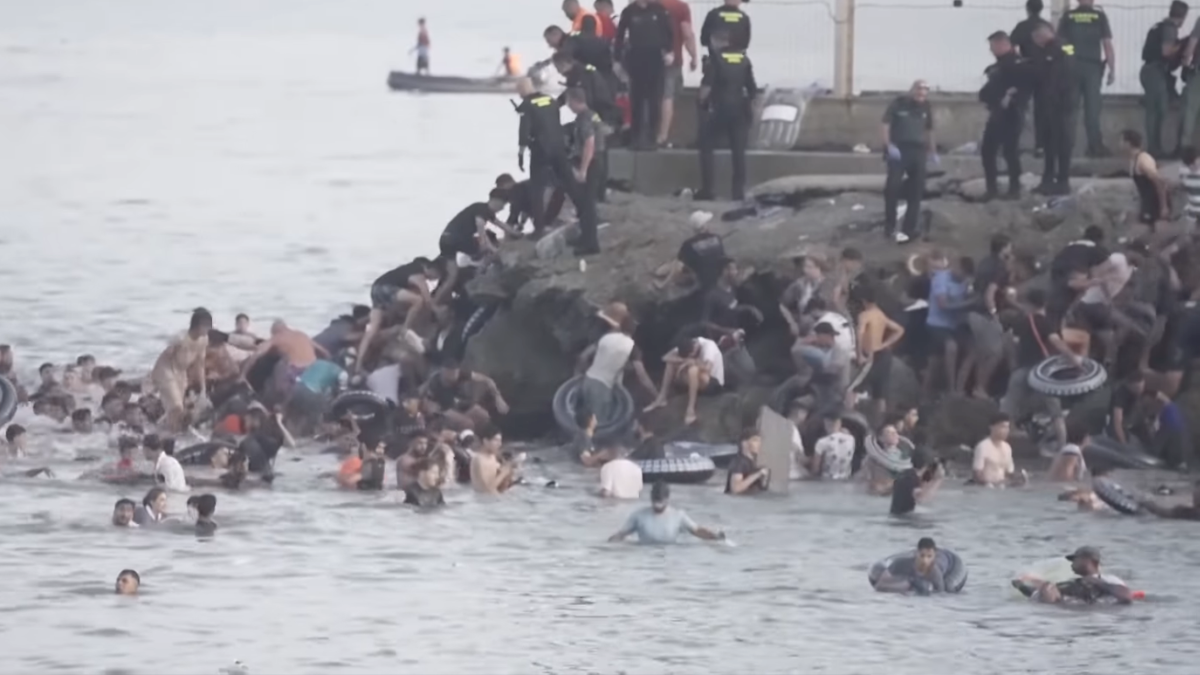
It's become cliché to roll out Mark Twain's supposed line about history rhyming. But the videos of the invasion of Ceuta, the autonomous Spanish city bordering Morocco, remind you why cliches exist — they're based on truth.
NOW - Illegal migrants scream "Allahu akbar" as they continue to storm the Spanish enclaves of Ceuta and Melilla.pic.twitter.com/TLXLQexVhu
— Disclose.tv (@disclosetv) July 30, 2026
These invaders "clashed" with hopelessly outnumbered police while people barricaded their doors with furniture to try and defend themselves. "There are no measures in place. It's every man for himself," one anonymous restaurant owner said. It was a tribe flexing and celebrating the atrophy, weakness, and compliance of its enemy.
While the invasion of Ceuta was not the bloodbath that Constantinople's demise was, there is a parallel and a stark warning. Michael Doukas, the late Byzantine Greek historian, described the fall of Constantinople to the Muslims in 1453 as an apocalypse.
The invading Ottoman Turks slaughtered people — soldiers and civilians — wantonly; they killed 2,000 soldiers in a single instance. They cut sacred icons to pieces and pulled men, women, and children from the churches where they had sought sanctuary and made slaves. Homes were "robbed of children, wife, and belongings."
Before "Islamophobe!" can be deployed like a backpack at an Ariana Grande concert, Doukas is not the only writer to describe these atrocities. Michael Kritovoulos, a contemporary of Doukas and a pro-Turk Greek, said the same thing. In his History of Mehmed the Conqueror, Kritovoulos wrote that after the Turks breached Constantinople's walls:
Then a great slaughter occurred of those who happened to be there: some of them were on the streets … others were in their own homes and fell victims to the violence of the Janissaries and other soldiers, without any rhyme or reason; others were resisting, relying on their own courage; still others were fleeing to the churches and making supplication — men, women, and children, everyone, for there was no quarter given.
After the Turks, "had had enough of murder," Kritovoulos observed, some of the invaders went to loot the "mansions" of the nobles; others looted the churches and monasteries; and others "dispersed to the simple homes of the common people, stealing, robbing, plundering, killing, insulting, taking and enslaving men, women, and children, old and young, priests, monks — in short, every age and class."
Doukas gave perhaps the most chilling description of fallen Constantinople when he wrote, "And the City was desolate, lying dead, naked, soundless, having neither form nor beauty." That is not the description of a city that has only been conquered; it presents a picture of a civilization that has been snuffed out. For a thousand years, the Byzantine Empire had been the dominant power in the East, at its height reaching from Spain to Jerusalem, the Italian Alps to North Africa.
Its destruction was not just about territory or power: It was about civilizational death. Mehmed II and his Muslims wanted to stake the last civilizational remnant of Eastern Christianity and the polity which housed it out of existence. By enslaving the people, looting it of its treasures and art, and attacking its churches, they shredded the city's soul. They bleached Constantinople out of existence.
Why is all this important? Because Ceuta is the latest reminder of what the stakes are. It's not just about borders, or even sovereignty; it's about civilization. "Civilization" gets thrown around a lot, and people have spilled good gallons of ink defining it. The simplest and truest definition is that civilization is the bedrock of who we are as a people.
Being part of a civilization means that the world is divided between "us"— we who see the world this way, we who believe this, and do things this way — and "them" — everyone else. Greeks are not Romans; Romans are not Frenchmen; and Frenchmen are not Americans.
You can lose a lot of things — influence, power, even territory — but if you can keep your civilization, you're still in the game. It's why the Jews are still a people (in the religious sense) and the Carthaginians are not. Lose that, and you lose yourself.
JUST IN: 🇪🇸 Law enforcement seen opening gates allowing thousands of illegal immigrants into Spain. pic.twitter.com/UUvMoRfqnY
— BRICS News (@BRICSinfo) July 30, 2026
Never forget when the Biden admin sent trucks to remove razor wire from Texas’ border so our country can be invaded pic.twitter.com/a9xiTlvLsy
— Libs of TikTok (@libsoftiktok) July 31, 2026
The reason is hate. It sounds overly simplistic, and the devoted leftist believer will gussy it up under pounds of academic jargon. But the makeup cannot change the face. One of the best tells came right after the Oct. 7 terror attacks when Teen Vogue writer Najma Sharif posted, "What did y'all think decolonization meant?"
🚨 Walk with me down the road of an Islamic hijacking in a deep-red state through a conduit known as the DSA.
— NizNellie3 (@NizNellie3) June 26, 2026
This was never about socialism. The rise of political Islam is upon us.
The Islamic/Socialist/Eco-Terrorists have been actively partnering in Ohio since the Oct 7… pic.twitter.com/fnMpv01YuR
We can defeat the people who want to kill our civilization. Or we can complain we haven't gotten a hundred percent of what we want, do nothing, and then, like Jeremiah, weep when the hordes have robbed us of children, spouses, and homes.
Source link