
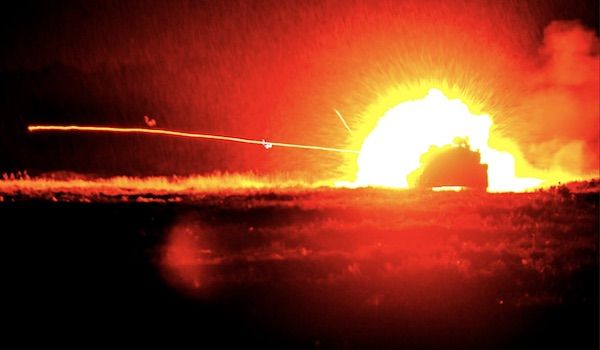
Drones and ground-launched munitions have decimated Russian and Ukrainian tank fleets, and U.S. allies are looking to Israeli technology to ensure their tanks aren’t next.
EuroTrophy GmbH signed a contract in January for approximately $380 million to outfit Leopard 2A8 main battle tanks ordered by Lithuania, the Netherlands, the Czech Republic, and Croatia with the Trophy Active Protection System (APS). EuroTrophy GmbH is the German subsidiary of Israeli defense manufacturer Rafael and a joint venture of General Dynamics European Land Systems and KNDS Deutschland.
This purchase is just the latest example in which Israeli technology is helping increase European defense capabilities and advance U.S. and transatlantic interests. In December 2025, Germany deployed the Arrow 3 ballistic missile defense system, Israel’s largest single defense export to date.
The Trophy configuration is mounted on a vehicle exterior and includes radars, launchers, and countermeasures to detect and intercept incoming projectiles, such as anti-tank missiles and rocket-propelled grenades. In Israel, Trophy has been officially in operation on Merkava tanks and Namer armored vehicles for at least 10 years. Trophy has been deployed on American M1 Abrams tanks since 2019.
Trophy proved itself in the 2014 war, where Hamas fighters repeatedly, and with a variety of anti-tank weapons, fired on Israeli tanks with little success. More recently, following the October 7, 2023, terror attack on Israel, Trophy reportedly intercepted thousands of Kornet missiles and other anti-armor munitions launched by Hamas and Hezbollah. The Israeli military reportedly says that Trophy systems have had an estimated 85 percent interception rate during the most recent war.
In 2024, Rafael announced an upgrade to Trophy that enables increased defense against top attacks from drones, instead of just ground attacks.
That is a vital improvement. Thousands of tanks have been damaged or destroyed in the Russia-Ukraine war. Estimates from the Oryx military tracker show that Ukraine has lost more than 1,000 tanks since the start of the war in February 2022, many to Russian drones. Russia has reportedly lost more than 3,000 tanks since then, with the Ukrainian Ministry of Defense stating that drones are used in more than 80 percent of its total targeting.
The First Leopard 2A8 Rolls Out With TROPHY APS - Setting a New European Standard for Armored Protection
— Rafael Advanced Defense Systems (@RAFAELdefense) November 24, 2025
Last week in Munich, KNDS officially rolled out the first Leopard 2A8 Main Battle Tanks equipped with RAFAEL’s TROPHY Active Protection System (APS) - the first Leopard… pic.twitter.com/xOfFTjHREC
The new multinational contract follows Leopard 2A8 tank procurement orders from KNDS by the Czech Republic for 44 tanks, the Netherlands for 46, and Lithuania and Croatia for 44 each. The tanks will be delivered with Trophy over several years, with Lithuania’s order to be completed by 2034, according to Lithuanian news.
That is not a quick delivery. A primary reason for that timeline is tank production capacity, underscoring the fact that European allies need time to translate increased defense spending into increased production capacity.
Adding a sense of urgency, the threat environment is hardly improving.
After Putin’s unprovoked invasion of Ukraine in February 2022, Iran began sending hundreds of drones to Russia and also helped Russia build a domestic Shahed drone production facility. The proliferation of Iranian drones should be a concern for NATO members, as it has helped make Russia’s recent violations of NATO airspace possible.
As then Army Vice Chief of Staff Gen. James Mingus stated in July 2025, “the vast majority of the things that are going to kill our troopers in the future are going to come from the air.” That is true for Americans and Europeans.
If Washington and its allies and partners are going to respond appropriately, they need to collaborate more closely and quickly when it comes to defense modernization.
Echoing longstanding bipartisan concerns, Secretary Pete Hegseth has bemoaned the fact that Pentagon processes have “moved at the speed of paperwork, not war.” In a speech on November 7, he called to ensure “speed replaces process, money follows need, joint problems drive action, experimentation accelerates delivery and the services move faster and smarter.”
On 1 Nov, USD(R&E) Heidi Shyu established the U.S. – Israel Operations – Technology Working Group to strengthen defense #science and #tech cooperation between @DeptofDefense and @Israel_MOD to address mission challenges. pic.twitter.com/Lx4W8FzH2I
— Department of War CTO (@DoWCTO) November 2, 2021
The OTWG’s purpose is for Washington and Jerusalem to systematically share and identify common intelligence-informed military capability requirements; assess industry recommendations to meet those requirements; and create combined plans to research, develop, procure, and field weapon systems and military capabilities as quickly and economically as possible, according to reports from the Senate and House Armed Services committees.
OTWG has included artificial intelligence/autonomy, directed energy, counter-unmanned aerial systems, biotechnology, integrated networks, and hypersonic capabilities.
This model could be expanded to include other American partners and allies. That would help ensure that U.S. warfighters never confront a fair fight and that America’s partners are stronger and able to carry a larger share of the security burden, consistent with America’s 2026 National Defense Strategy.
That strategy called Israel a “model ally,” citing its will and ability to defend itself and its defense of shared interests. As the Trophy contract demonstrates, one of the reasons for this status is Israel’s advanced military technologies, which continue to help America’s allies carry more of the security burden.
Justin Leopold-Cohen is a senior research analyst at the Center on Military and Political Power at the Foundation for Defense of Democracies, where Bradley Bowman is senior director.