In the bitterly cold seas around the Shetland Islands, the sight of trawlers plying their trade in search of fish stocks would scarcely set alarm bells ringing.
Except that some fishing vessels, which ostensibly make their living from the area's bountiful marine life, have been behaving very oddly in recent years.
Observed by the unflinching gaze of a satellite-based vessel tracking platform, boats from the Russian fishing fleet appeared entirely focused on a different sort of prey.
Great shoals of mackerel and herring must have passed one boat by in April 2023, for instance, as she probed far deeper into the inky depths.
Approaching from the north, near the Faroe Islands, the trawler abruptly changed course just as she reached the exact latitude of Atlantic Crossing 1 – a telecommunications cable which provides a vital undersea link between the US, the UK, Germany and the Netherlands.
Data collated by Global Fishing Watch shows how, after initially veering east, the vessel doubled back on herself ten times along a 15-mile length of the cable.
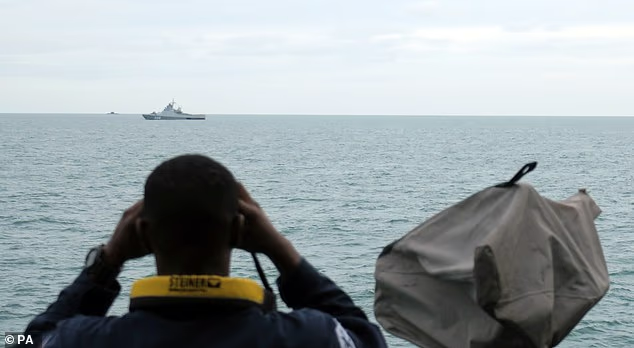
The Navy are no strangers to keeping tabs on Russian spy vessels
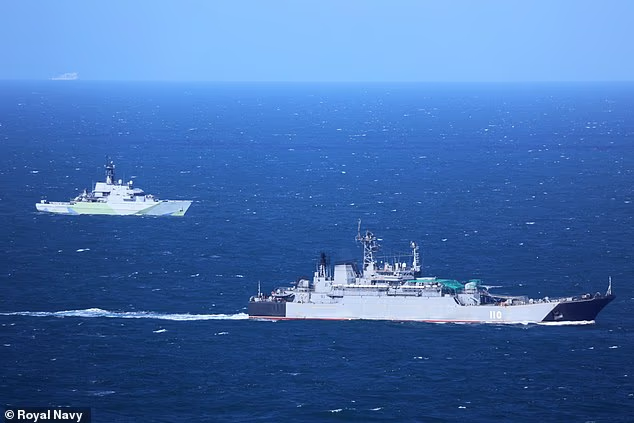
HMS Tyne (left) intercepts RFN Aleksandr Shabalin near the Outer Hebrides last month
In all, she spent eight hours in the area, including a half-hour period when she slowed to fewer than two knots.
Before heading north again the following day, the data appears to show the trawler making a similar manoeuvre above a second, now decommissioned, telecoms cable.
In another example, in February 2025, a Russian fishing vessel crossed the transatlantic Hibernia Express cable on multiple occasions, once travelling at under two knots for 42 minutes in close proximity to the subsea line.
On another occasion, she was recorded travelling slowly along the route of the SHEFA-2 cable, which connects Shetland to the Faroe Islands.
When four-and-a-half years of tracking data was crunched and cross-referenced with nautical charts showing the locations of undersea cables, it revealed an astonishing picture: more than 500 incidents where 17 different Russian trawlers have either hovered above vital communications cables linking Britain with Europe and the US or followed their routes exactly for miles.
The analysis, first revealed by the Daily Telegraph, suggests the deliberate use of Russian commercial trawlers as spy vessels to map the precise locations of fibre-optic cables carrying billions of pounds worth of economic activity every day along the seabed.
While the cables' general routes are widely known, this precision tracking – most likely using sophisticated sonar equipment – would furnish Russia with the accurate intelligence needed to launch a targeted attack in a future conflict with Nato.
Such a move would risk paralysing the UK by disrupting banks, hospitals, the transport network and mobile phones, since these cables carry the vast majority of telecoms data abroad.
More than 60 subsea cables – many lying in the waters around Shetland – carry 99 per cent of Britain's internet data, which is vital to the UK economy.
When the story broke, a Nato source confirmed to The Telegraph: 'We're absolutely aware of what Russian civilian fishing ships are up to and where. Some of these ships have never seen a single fish on their deck.'
And yet, the tracking exercises have not stopped. There have been recent sightings of Russian tankers idling for days over the FLAGS and Frigg pipelines, which bring crucial gas supplies ashore at the St Fergus gas terminal in Aberdeenshire.
The revelations raise the unpalatable prospect that the Kremlin has been carrying out subterfuge on the high seas under the noses of the Royal Navy and in defiance of repeated warnings by the British authorities.
The growing importance of undersea infrastructure prompted a parliamentary report last year to warn of security vulnerabilities in areas including transport and supply chains, financial services and payment systems.
It has also heightened fears over just how exposed Scotland's outlying island communities could be to the Russian menace, in a chilling echo of the dark days of the Second World War. Just as in 1940, it is the Shetlands which have come into sharp focus.
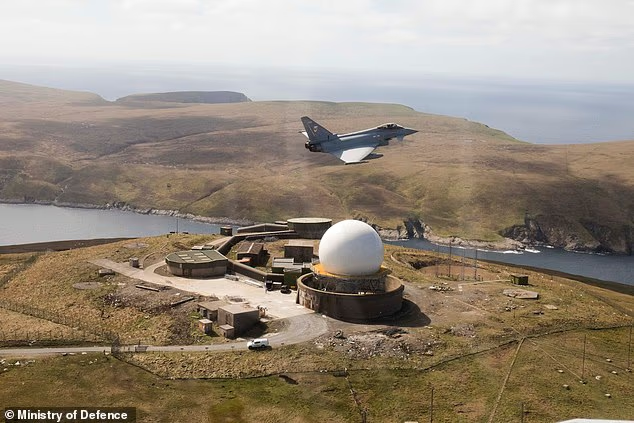
The RAF Saxa Vord Air Defence Radar station was reopened in 2019 after closing in 2006
Then, there were real concerns that the islands could be attacked after Hitler invaded Norway. Defences were built, troops were mobilised, ready to repel.
Now there are renewed calls to bolster their defences amid increased detections of Putin's shadowy 'fishing fleet'.
Shetland holds a unique combination of assets which could make it a Russian target.
As well as links to the SHEFA-2 cable, the islands are home to the giant Sullom Voe oil and gas terminal. There are also fears that the £30million SaxaVord Spaceport, on the archipelago's most northerly outpost of Unst, is on the Kremlin's radar.
There is mounting concern at Russia's increasingly brazen behaviour: last week, three senior Tories, shadow defence spokesman James Cartlidge, shadow energy secretary and shadow Scottish secretary Harriet Cross, voiced their disquiet in a joint letter to the UK Government urging it to act.
In it, they demanded all subsea cables and energy pipelines, along with North Sea energy infrastructure, should be handed priority 'critical national infrastructure status' to deter hostile states.
Ms Cross said: 'Scotland is on the frontline of the growing threats from states such as Russia and China.
'Energy security is national security, and reports of vessels from these hostile nations operating close to vital pipelines off our coast should set alarm bells ringing for Labour ministers.'
She added: 'These pipelines bring the gas that millions of households and businesses depend on. Any disruption would have catastrophic and potentially long-lasting consequences.'
Last week, First Minister John Swinney accused the UK Government of leaving 'Scotland's vast coastline dangerously exposed'.
Pinpointing the waters off Shetland, he said: 'I don't think we've got nearly the presence in those areas that we require today.'
Similar comments he made at the SNP party conference, however, were angrily denounced by Defence Secretary Wes Streeting as 'irresponsible and unfounded'.
But in rare cross-party unity, veteran Liberal Democrat MP Alistair Carmichael, whose constituency covers Shetland, insisted the world had changed sufficiently that it was time the UK Government re-established a 'permanent and dedicated' military presence in nearby waters.
'Through the years of the Cold War, the RAF radar station at SaxaVord in Unst was the front-line of our nation's defences to the north,' he said. 'That was drawn down 20 years ago.'
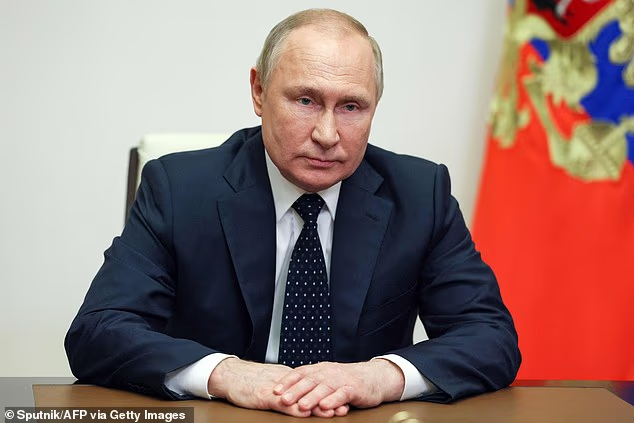
Putin's interest in the region has increased in recent years
He added: 'The High North is rapidly becoming one of the most significant arenas for the UK's political and military interests and the Northern Isles are the gateway to that.'
He told BBC Radio Scotland's Breakfast programme: 'This is something we do need to be taking seriously.
'We're not expecting an imminent problem here but this is a time where the Government is already telling us that we should all be keeping baked beans and a torch in a cupboard.'
This was in reference to Mr Streeting urging the public to stockpile food, bottled water and cash in preparation for widespread shortages and disruption from cyberattacks and emergencies.
Mr Carmichael said full-time command should be restored to the island and 'low' numbers of reservists boosted or it could risk sending the wrong signal.
He pointed to several recent suspicious incidents in the Baltic Sea where underwater cables have been damaged or completely cut.
Since Finland joined Nato in 2023, its telecoms cables in the Baltic Sea have been damaged several times. Russian commercial vessels have been implicated in several of these.
On Thursday, the Russian captain of a freighter was jailed for three-and-a-half years by a Finnish court for deliberately dragging his anchor over a cable owned by a Finnish telecoms company.
Mr Carmichael said the suspicion is Moscow has been keen to 'send a signal to the Finnish government' about its links to Nato.
He added: 'This is how Russia will see these things; Russia looks at the signals we send and if they say we don't think there's any threat here, that we're not vulnerable, then they will read these signals and could at some point in the future act accordingly.'
The Ministry of Defence (MoD) has stressed it is 'clear-eyed about the threat Russia poses' and has strengthened its capability to respond rapidly when needed.
'Clear-eyed only takes you so far in a situation like this,' countered Mr Carmichael, pointing out that last year alone, there were two 'catastrophic outages' when the cables connecting Shetland to the rest of the UK were broken.
On one occasion it took more than two weeks to get full services restored to the community.
In 2022, Russia's Nord Stream oil pipelines were sabotaged, leaving the Kremlin swearing revenge. Weeks later, the cables connecting Shetland to the Faroes and then with the Scottish mainland were cut in quick succession, causing mayhem and crippling services.
Although a police investigation later ruled the damage was most likely caused by a fishing vessel dredging in the area, it has been observed that a Russian research vessel, the Boris Petrov, had also been nearby shortly beforehand.
Whether or not Russia was involved in any of these incidents, they demonstrate how fragile the cables are and the devastating effects of any damage.
Mr Carmichael said: 'The whole of the UK is not adequately protected – that is a fairly broad political consensus. That's why we are looking, with the support of all parties in the House of Commons, to increase defence spending at scale and speed.'
A unit of nine P-8A Poseidon aircraft is currently based at RAF Lossiemouth, Moray, tasked with monitoring Russian vessels in the North Sea and North Atlantic.
However last year the Yantar, a Russian spy ship, directed a laser beam at an RAF maritime patrol aircraft sent to track it.
The UK also has only one ship dedicated to repairing any sabotage to undersea cables. The CS Sovereign, based in Dorset, is due to leave service by 2030.
In a bid to quell concerns, ministers last week set out proposals in a White Paper to make attacks on subsea cables a criminal offence resulting in a lengthy jail term.
Mr Carmichael, for one, is sceptical of such an approach: 'If Russia is willing to send people armed with [the nerve agent] Novichok into Salisbury then they are not going to be deterred by the threat of ending up in a UK court,' he told The Sunday Times.
He added: 'This is not a problem that is going to be solved by well-meaning legislation and regulation. We need better protection and resilience.'
The Royal Navy has ramped up its response. In July, Royal Navy warships and helicopters increased monitoring of Russian activity in UK waters and the North Atlantic by a quarter.
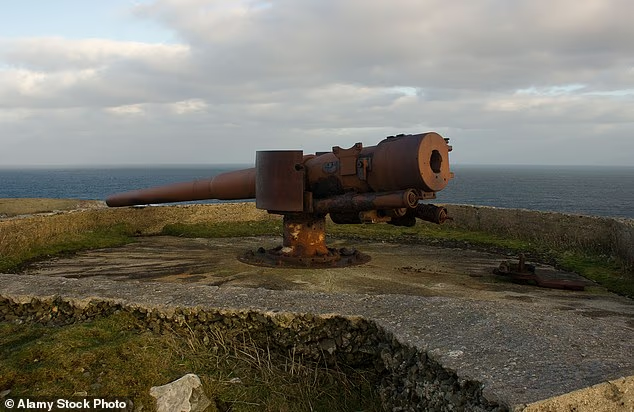
A WW1 artillery gun, a reminder of Shetland's importance in defending the UK's shores
With the UK already in Putin's crosshairs due to its backing of Ukraine against Russia's war, the Kremlin's interest in Shetland may well have been heightened by its entry into the space race.
Only last month, the UK Government announced a £30million investment in SaxaVord Spaceport, as part of a new £7.8billion space strategy.
Controlled by the Danish-born billionaire Anders Holch Povlsen, Scotland's richest man, SaxaVord has permission for up to 30 rocket launches a year.
Announcing the investment, Scottish Secretary Douglas Alexander boasted that Scotland already builds more satellites than any other European country, adding: 'SaxaVord is poised to deliver up to three quarters of the continent's orbital launch slots.'
That will inevitably label it a geopolitically strategic asset. As such, Mr Carmichael said: 'The Russians will want to know all about it. Not all interference will be about defence. A lot of it will be around commercial interests.'
Defence analyst George Allison, editor of the UK Defence Journal, said it was clear Shetland's 'strategic relevance is increasing' given society's near-total reliance on the internet.
But he said the UK's defence model does not rely on permanently defending every point on the map with fixed forces but rather on 'surveillance, early warning, rapid response capability, and alliance reinforcement.
'So the vulnerability is not that Shetland is defenceless in a traditional sense, but that it sits near strategic routes and infrastructure that are increasingly central to Nato planning. The risk is about disruption and pressure.'
It is understood there has been no recent escalation in threat levels around SaxaVord.
A MoD spokesman said: 'Through the UK-led Joint Expeditionary Force, we are leading allied activity across the High North, strengthening Nato's northern flank and increasing our ability to respond rapidly to emerging threats.
'This government is also investing in the capabilities needed to meet those threats, with £1.5billion backing Atlantic Bastion to deliver a next-generation Hybrid Navy and a further £330million to strengthen the protection of critical undersea infrastructure.'
Meanwhile, Shetland remains caught up in a tense game of maritime cat and mouse.
And the ghost trawlers still circle, fishing for information in a vast ocean of our private data.
Source link