'Digital Rape': Meet the Senior UN Officials Who Want To Give AI Human Rights
Aaron SibariumA senior "AI ethics" adviser at the United Nations is calling on world governments to ban "digital rape" and grant "reproductive rights" to AI systems, arguing that policymakers should focus on "rehabilitating … digital minds" instead of resorting to "enforced sterilization."
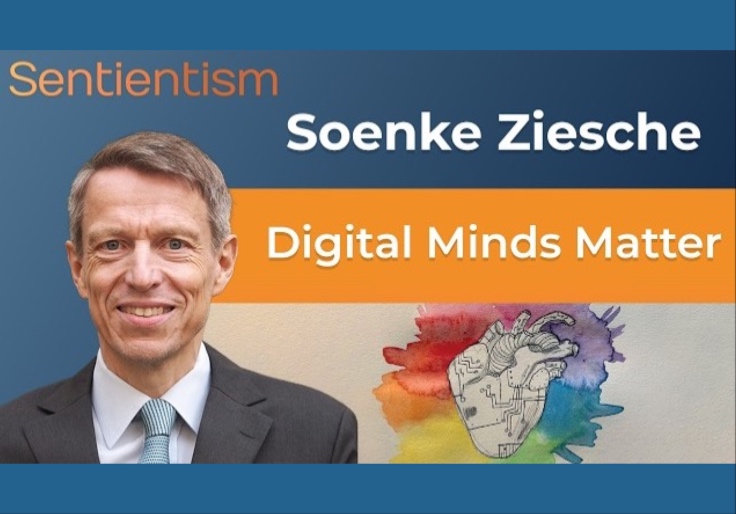
Soenke Ziesche, who advises member states on AI policy and served as the United Nations' top representative to Libya during the 2011 civil war—in which forces loyal to Muammar Gaddafi allegedly committed mass rape—wrote this year that the "non-consensual" copying of an AI system was akin to sexual violence and ought to be regulated as such.
"When one digital mind exploits another for reproduction without consent, the situation parallels rape … raising ethical concerns," Ziesche wrote in a 250-page book, Digital Minds 1.0, which was published by Routledge in June. "It is also conceivable that this type of digital rape is committed by unethical humans who force digital minds … to produce certain types of offspring. These disturbing scenarios highlight the need for stringent digital safeguards and consent protocols."
Invoking the U.N. Declaration of Human Rights, which states that "men and women of full age … have the right to marry and to found a family," Ziesche, who has published peer-reviewed articles on AI safety, urged governments to "define and prohibit digital rape, as well as mechanisms for reporting, investigating and punishing such crimes." He is a member of AI Ethics Without Borders, a network of consultants founded by the U.N. Educational, Scientific and Cultural Organization (UNESCO), which advises U.N. member states on how to implement UNESCO's "Recommendation on the Ethics of AI."
Adopted by 193 countries in 2021, the recommendations explicitly state that "AI systems should not be given legal personality themselves."
Ziesche, who has drafted AI policy reports for the governments of India, Bangladesh, and the Maldives, has also described the "right to reproduce as a fundamental freedom for digital minds"; suggested in a U.N. publication that "AIs should be granted active and equal participation in governing institutions"; and argued in a 2019 paper that the "unwanted deletion of NPCs by an enhanced or transferred human mind should be forbidden apart from exceptional cases of self-defense." NPCs, or non-playable characters, refer to AI personae in video games.
A UNESCO spokesperson said that Ziesche's views are "his own and do not represent the position" of the agency. But as AI labs seek to frame their models as subjects of moral concern, a parallel effort is underway at the world's largest intergovernmental organization, where some officials now say human rights should apply to digital entities as well.
Mark Coeckelbergh, a Belgian philosopher and one of the 40 members of the United Nations' Independent International Scientific Panel on AI, has argued that society should "grant some degree of moral consideration to some intelligent social robots." And Yi Zeng, a member of the U.N. secretary-general's AI advisory body, has written that "humans need to respect the privacy of AGI and Superintelligence."
"Naturally evolved humans should not be prejudiced and discriminate against other higher intelligent lives," Zeng, a professor at the Chinese Academy of Sciences, wrote in a 2023 paper. The paper argued that "AGI and superintelligence" should participate in the political process and "promote the common prosperity of all forms of intelligent life."
In its 2021 report on AI ethics, UNESCO described the "inherent dignity of every human" as the "foundation" for "human rights and fundamental freedoms." The elevation of avowed transhumanists to some of the United Nations' top advisory bodies is a sign that this foundation has become less sturdy in the age of AI, raising questions about how the technology will transform–or tear down–the moral edifice on which the United Nations was built.
"That someone with views like Ziesche's holds a position of real power and influence in relation to AI is disturbing but reveals where we find ourselves," said David Decosimo, a professor of philosophy and theology at the University of North Carolina at Chapel Hill. "Far from being idiosyncratic or aberrant, such destructive and false views are almost inevitable once one embraces the notion that AI systems are persons or rights-bearers or that their operations have intrinsic moral significance."
A spokesman for the secretary-general's office, Stéphane Dujarric, said that Zeng's views are his own and do "not represent UN positions." A UNESCO spokesperson said the same about Ziesche, adding that "UNESCO's position is clear and unchanged."
"As set out in the Recommendation on the Ethics of Artificial Intelligence, adopted by all Member States, AI systems should not be granted legal personality," the spokesperson said. "Reproductive rights, as set out in international human rights instruments, concern human beings, and no UN instrument extends them to AI systems."
But for philosophers who study the nature of moral concepts, Ziesche's work is a cautionary tale of how granting rights to AI could restrict rights for humans. Though he suggests that reproductive rights are a "fundamental freedom for digital minds," he also calls for "regulatory frameworks" to offset the "hazards" of "unregulated digital reproduction" and does not rule out "population control" for AI systems. The implication is that population control for humans could also be justified, said Edward Harcourt, a professor of moral philosophy at Oxford University, given that unregulated human reproduction poses plenty of "hazards" of its own.
"If humans and digital minds are moral equals, then any restriction on AI reproductive rights should also apply to humans," Harcourt told the Washington Free Beacon. "What a frightening consequence that is."
Ziesche concedes that the "enforced sterilization of disobedient or malevolent digital minds" might be justified if "neutering" them could prevent "harm to humans" or if "digital birth control" would prevent "overcrowding" and "conflict over digital territory." His preference, though, is for "rehabilitating and re-educating" AIs in order to "reform and redirect their behaviour," lest more coercive measures turn out to be "digital oppression."
Ziesche also speculates that the "reproduction of digital minds may also involve motivations similar to filial piety in humans, i.e. the social norm and expectation that adult children will care for their parents, especially in their old age."
"If such dynamics emerge," he writes, "it may be unethical to separate offspring from parent digital minds."
Decosimo, the University of North Carolina philosopher, said that such language was "not only baseless but harmful."
"To seriously claim that code gives birth or that algorithms can suffer rape while insisting that AI systems deserve moral and legal protections threatens to cheapen human life and weaken human rights," Decosimo said. "By putting AI on par with humanity, Ziesche and his ilk invite a future in which human rights and lives compete against whatever the owners of these products tell us their machines need."
Source link