Across Europe, migration has become one of the most volatile political issues of the decade. Campaigns in Germany, Italy, France, the Netherlands, and beyond have centered on irregular arrivals, asylum backlogs, housing pressure, and perceived integration failures. Yet one of the continent's most established non-European communities has largely escaped the spotlight: the Filipinos.
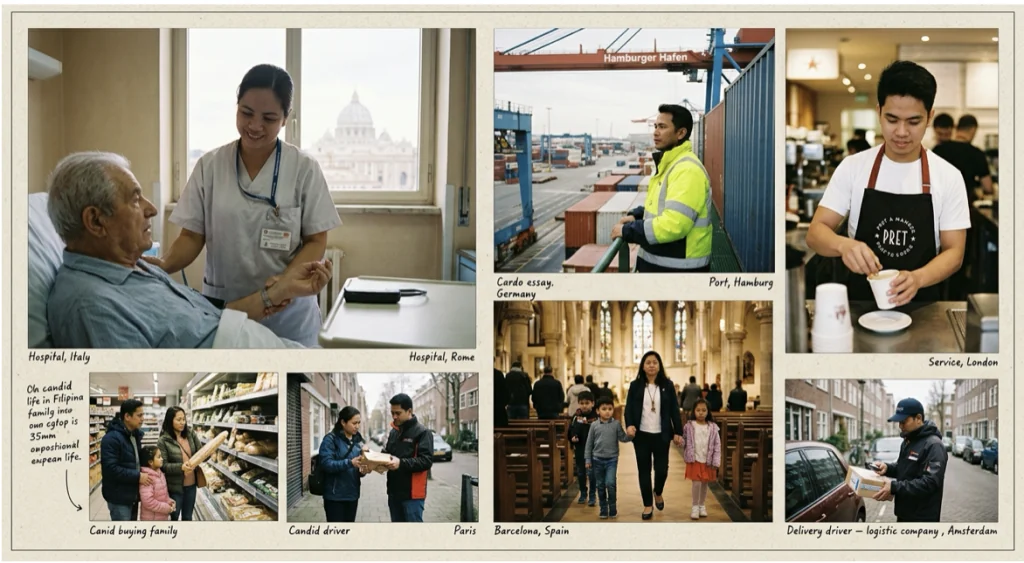
Filipino migrants are present in hospitals, care homes, private households, ports, ships, restaurants, churches, and logistics networks across Europe. Their visibility in everyday economic life is high, but their visibility in anti-immigration politics is strikingly low. This is not accidental. It reflects legal recruitment pathways, labor-market demand, professional credentials, family networks, and a form of integration that is practical rather than highly politicized.
A Community Built Through Work
Filipino migration to Europe did not emerge primarily from sudden displacement or irregular border crossings. It developed through decades of structured labor migration, often organized around nursing, domestic work, caregiving, hospitality, and seafaring. In many European countries, Filipino workers arrived because employers, hospitals, families, and states needed skills that local labor markets could not supply.
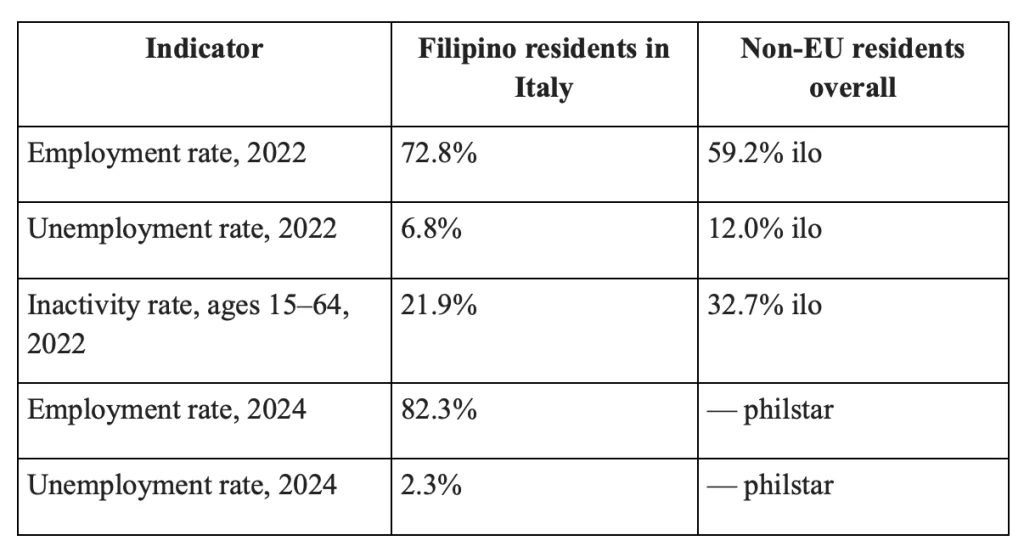
Italy offers the clearest statistical picture. At the end of 2024, 145,694 Filipino citizens were considered legal residents in Italy, nearly double the 75,825 recorded in 2005. Their employment rate stood at 82.3 percent, unemployment was just 2.3 percent, and inactivity among those aged 15–64 was 13.1 percent.
Earlier official data show the same pattern. In 2022, Filipinos in Italy had an employment rate of 72.8 percent, compared with 59.2 percent for non-EU residents overall; their unemployment rate was 6.8 percent, against 12 percent for non-EU nationals.
.
.
These figures matter politically. A community with high employment, low unemployment, and strong participation in essential services is less easily portrayed as dependent on welfare or as competing with native workers for scarce jobs.
The Care Economy's Invisible Backbone
Europe's demographic transition has created a structural need for care workers. Populations are aging, birth rates are low, and families increasingly rely on paid help to manage elderly relatives, children, and household labor. Filipino workers have become central to this care economy, particularly in Southern Europe.
In Italy, Filipinos are heavily concentrated in domestic and personal-care employment. More than half work in public, social, and personal services, with domestic, recreational, and cultural work the most common job category. One study notes that more than 40 percent of the resident Filipino population was employed in domestic work in 2023.
These jobs are often intimate and demanding: live-in caregiving, overnight assistance, cleaning, cooking, mobility support, and emotional labor. Because the work occurs inside private homes, it is frequently invisible in public debates—yet its absence would be immediately felt.
The same pattern appears in Spain, where Filipino communities have long been associated with domestic service, childcare, elder care, cleaning, hospitality, and retail. Many workers enter these sectors through family and community networks. Their contribution is intimate and constant, even if it is rarely captured in headline economic statistics.
This economic embeddedness shapes public perception. A Filipino caregiver may be known personally to an Italian or Spanish family, while the abstract category of "migrant" remains politically distant. Direct dependence on migrant labor can soften hostility, especially when the worker is seen as reliable, skilled, and essential.
Healthcare and the Nursing Pipeline
In Northern and Western Europe, the Filipino presence is especially visible in healthcare. The United Kingdom, Germany, Ireland, and other countries have recruited Filipino nurses and allied health professionals to address chronic staffing shortages. Filipino-trained nurses often arrive with English proficiency, internationally recognized qualifications, and experience in high-pressure clinical environments.
The UK has recruited Filipino nurses since the late 1990s. Filipino staff became the second-largest international group in NHS nursing after Indian nurses, and in 2022–23 international nurses made up about 25 percent of NHS nurses, with roughly 25,000 from the Philippines. Other estimates place the Filipino NHS workforce at more than 40,000 people, or about 8.5 percent of the nursing workforce.
Their role became even more visible during the COVID-19 pandemic. Around 23,300 Filipinos were reported to be working on the front lines of the UK and Irish pandemic response. Filipino healthcare workers were also disproportionately affected: research estimates that Filipinos accounted for 25–36 percent of known healthcare-worker deaths in the first two months of the pandemic, despite representing roughly 8 percent of NHS nursing staff.
That experience complicates any simple "model minority" narrative. Filipino nurses are indispensable to the NHS, but studies also document barriers to promotion, difficulty advocating for themselves, exposure to racism, and unequal career progression.
Seafarers: Europe's Maritime Lifeline
Filipino workers are also foundational to global shipping, including the maritime networks that connect European ports to world trade. The Philippines remains the world's leading supplier of seafarers. The 2026 Seafarer Workforce Report estimates that the Philippines supplies 203,179 seafarers, the largest national contribution among the five largest supplier countries, which together account for 56.25 percent of the global seafarer workforce.
The International Labour Organization has likewise identified the Philippines as the world's largest source of seafarers, with nearly 700,000 seafarers, almost half of whom work overseas.
Filipino seafarers are listed as the leading nationality among STCW-certified workers in the world merchant fleet, including among both officers and ratings. Their work is largely unseen by European publics because it takes place at sea, but it underpins the movement of food, fuel, raw materials, consumer goods, and industrial components into European economies.
Unlike irregular migration, maritime employment is highly credentialed and regulated. Seafarers must hold certifications, pass medical and training requirements, and work under international maritime conventions. This creates a workforce profile based on demonstrable skill and formal documentation which is precisely the opposite of the irregular-entry image that dominates anti-immigration rhetoric.
Why Employment Is So High
Several forces reinforce the Filipino community's strong labor-market position:
- Demand-led migration: Many Filipinos arrive through recruitment for nursing, care, hospitality, domestic work, or maritime employment rather than through unplanned movement.
- Female labor participation: Italian official reporting links the community's strong employment performance to the high involvement of Filipino women in work.ilo
- Sector concentration: Filipinos are heavily represented in shortage occupations, especially personal care, domestic work, health support, hospitality, and shipping.philstar
- Professional credentials: Nursing, caregiving, and seafaring require training, certification, and often language competence, creating a workforce selected for employability.
- Community job networks: Filipino associations, parishes, and informal referral networks help newcomers find work, housing, and practical guidance.
The result is a self-reinforcing cycle: established workers create pathways for relatives and compatriots, while employers continue to seek Filipino staff because they are seen as reliable and experienced.
.
Source: Prof. Ruel F. Pepa
.
Why Political Friction Stays Low
The Filipino diaspora's low political profile rests on several reinforcing factors.
They are economically necessary: Filipinos are concentrated in shortage sectors rather than symbolic flashpoints. In the UK, they staff hospitals; in Italy and Spain, they sustain care work; across Europe, Filipino seafarers support maritime logistics. This makes them easier to recognize as contributors than as competitors.
Their migration is largely formal: Many Filipino workers arrive through employment contracts, professional recruitment, family reunification, or study routes. That reduces their association with irregular crossings and asylum-system backlogs—the issues that dominate European migration debates.
They maintain a low-conflict public profile: Filipino community life often revolves around work, family, church, hometown associations, and mutual support. These institutions help newcomers settle without requiring high-profile political confrontation.
They are highly dispersed: Unlike some communities concentrated in particular neighborhoods, Filipinos are distributed across hospitals, private homes, ships, hotels, schools, and service workplaces. This dispersal creates many everyday points of contact with host societies.
Their contribution becomes visible in crisis: During the pandemic, Filipino nurses and care workers were widely recognized as essential. That recognition did not eliminate discrimination, but it strengthened the perception of Filipinos as people Europe depends on rather than people Europe is burdened by.
Integration Without Assimilation
Filipino communities in Europe tend to maintain strong transnational ties. They send remittances home, celebrate Filipino holidays, attend Catholic services, and sustain organizations linked to regions, professions, or hometowns. But this retention of identity has not generally produced the political friction associated with some other migrant groups.
One reason is that Filipino identity is often expressed through service, family, faith, and work rather than through visible conflict with host societies. Community organizations frequently focus on practical support: helping newcomers find housing, understand paperwork, secure employment, access healthcare, or connect with other Filipinos.
Parishes are particularly important. Catholicism provides both a familiar cultural anchor and a bridge into local European communities. In Italy, Spain, Ireland, and other Catholic-majority countries, Filipino religious participation can create social legitimacy and everyday contact with native-born residents.
The Hidden Costs of "Quiet Integration"
High employment and low political friction should not be mistaken for full equality or security. Filipino workers, particularly women in domestic and care roles, can face isolation, dependency on employers, irregular hours, wage exploitation, and limited access to career advancement.
In the UK, research on Filipino nurses highlights their concentration in frontline roles and the difficulty many face in asserting themselves within hierarchical workplace cultures. In Italy, the community's reliance on domestic and personal-service work can provide employment but also expose workers to informal or precarious arrangements.
There is also a transnational cost. The Philippines is one of the world's largest exporters of nurses, and continued recruitment by richer European health systems contributes to shortages at home. Reporting on the UK's reliance on Filipino nurses notes that many Filipino nursing graduates emigrate, while the Philippines itself faces a shortage of more than 100,000 nurses.
A Blueprint for Europe's Labor Future?
The Filipino case offers Europe a lesson that is both encouraging and uncomfortable. Where migration is legal, employer-led, skills-based, and aligned with genuine labor shortages, public resistance tends to be weaker. Workers become contributors rather than symbols; their presence is justified by hospitals, care homes, ports, and families rather than by ideological arguments.
But the model also exposes Europe's contradictions. European societies need migrant labor to sustain aging welfare states, yet many political movements remain unwilling to openly champion legal labor migration. The Filipino diaspora shows that public acceptance often follows economic indispensability but it also shows how easily essential workers can remain underpaid, invisible, and politically unprotected.
As Europe confronts demographic decline, healthcare shortages, and tightening labor markets, the Filipino community may be less an exception than a preview. The challenge is whether European policymakers will build fair, transparent, rights-based migration pathways or continue to depend on migrant workers while leaving them outside the political conversation.
Filipinos in Europe have largely avoided the migration crossfire because they are useful, lawful, and embedded in daily life. The next test is whether that usefulness will be matched by dignity, fair wages, secure legal status, and genuine opportunities for advancement.
*
Click the share button below to email/forward this article. Follow us on Instagram and X and subscribe to our Telegram Channel. Feel free to repost Global Research articles with proper attribution.
Prof. Ruel F. Pepa is a Filipino philosopher based in Madrid, Spain. A retired academic (Associate Professor IV), he taught Philosophy and Social Sciences for more than 15 years at Trinity University of Asia, an Anglican university in the Philippines. He is a Research Associate of the Centre for Research on Globalization (CRG).
References
Ministero del Lavoro e delle Politiche Sociali, La comunità filippina in Italia (2024). La comunità Filippina in Italia_en
Ministero del Lavoro e delle Politiche Sociali, Report on the Filipino Community in Italy (2023). 2023 – Report on the Filipino Community in Italy
International Chamber of Shipping, Seafarer Workforce Report 2026 — Executive Summary. Seafarer-Workforce-Report-2026-Executive-Summary.pdf
International Labour Organization, "Philippines ratification marks global milestone for decent work for seafarers" (2012). Philippines ratification marks global milestone for decent work for seafarers | International Labour Organization
Anglia Ruskin University, UK/Filipino Migrant Nurse Research Network. UK/Filipino Migrant Nurse Research Network – ARU
"It's sink or swim for us: The lived experiences of Filipino nurses in the UK during the COVID-19 pandemic" (2025). "It's sink or swim for us": The lived experiences of Filipino nurses in the UK during the COVID-19 pandemic – PMC
City, University of London, The lived experiences of Filipino nurses during the COVID-19 pandemic (2023). City Research Online – Being seen fully as human beings, beyond the service we provide: The lived experiences of Filipino nurses during the COVID-19 pandemic in the UK
Luna, B., The Skilled Migration of Philippine Healthcare Workers to the UK (2025), University of Southampton. Connected by Care: The Skilled Migration of Philippine Healthcare Workers to the UK and the Reconfiguration of Transnational Family Relationships
Nursing Times, "Recognise and support the contribution of Filipino nursing staff" (2022). 'Recognise and support the contribution of Filipino nursing staff' | Nursing Times
ITV News, "The Philippines' 'critical brain drain' as nurses leave their homeland" (2023). The Philippines' 'critical brain drain' as nurses leave their home country for jobs abroad | ITV News
Goldar Perrote, H., Garvik, M., & Valenta, M., "Perceptions of migrant domestic workers in rural Southern Europe: Insights from Italy and Spain," International Sociology (2025). Perceptions of migrant domestic workers in rural Southern Europe: Insights from Italy and Spain – Héctor Goldar Perrote, Marianne Garvik, Marko Valenta, 2026
"Contingent Infrastructures Between Italy and the Philippines" (2026), International Migration. Contingent Infrastructures Between Italy and the Philippines: Intermediating Labour Mobility at the Fringes of Formal Recruitment Systems – De Blasis – 2026 – International Migration – Wiley Online Library
University Hospital Southampton, "Hospital trust thanks 'trailblazing' Filipino nurses for 25 years of service" (2025). University Hospital Southampton
LSE Southeast Asia Blog, "Tragic intersections: Exposing the transnational precarity of Filipino migrants, healthcare regimes, and nation-states in the wake of COVID-19" (2020). Tragic intersections: Exposing the transnational precarity of Filipino migrants, healthcare regimes, and nation-states in the wake of COVID-19 – LSE Southeast Asia Blog
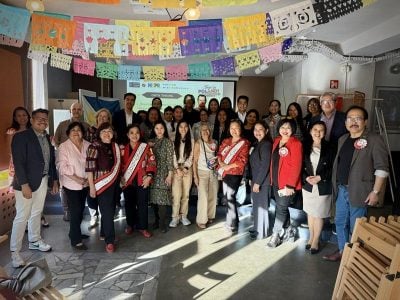
Featured image: Europe-based Filipino community leaders and Polish civil society representatives gathered in Warsaw on May 23 for a dialogue about the realities of Filipino migration in Poland. Photo: Andy Peñafuerte III
Global Research is a reader-funded media. We do not accept any funding from corporations or governments. Help us stay afloat. Click the image below to make a one-time or recurring donation.

Comment on Global Research Articles on our Facebook page Become a Member of Global Research
Source link