
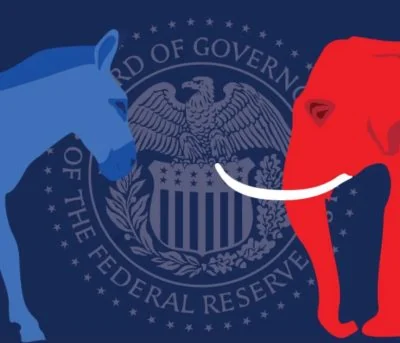
Until the structural incentives that favor financial returns over productive investment are confronted directly, US economic policy will continue to find it easier to inflate existing assets…
***
The failure of both Republican and Democratic administrations to direct the nation's money-creation capacity toward reindustrialization rather than financial asset inflation is not a story of insufficient ambition or poor messaging but of structural capture that neither party has been willing or able to confront. The machinery of US credit creation has been wired for decades to serve the balance sheets of the financial sector, and every attempt to redirect it toward factories and supply chains has run into the same wall of institutional incentives that reward asset speculation over productive investment. This pattern held across such different political coalitions because of specific mechanisms that defeated each party's industrial ambitions and the deeper financial logic that neither has challenged.
The Democratic Party's most ambitious reindustrialization effort, the legislative package comprising the Bipartisan Infrastructure Law, the Inflation Reduction Act, and the CHIPS and Science Act, deployed subsidies and tax credits on an unprecedented scale, yet it operated entirely within the existing financial architecture rather than transforming it. Between 2021 and 2024, announced investments in the North American battery and electric vehicle supply chain surpassed two hundred fifty billion dollars, and the Biden administration could point to genuine commitments from legacy automakers and battery manufacturers establishing facilities across the Midwest and South. The problem was that these subsidies flowed through corporations whose own incentives remained oriented toward shareholder returns and short-term profitability rather than the patient, long-horizon capital formation that genuine industrial reconstruction demands.
Two-thirds of the Inflation Reduction Act's energy-related funds were expected to go to corporations, and the executives who had spent the previous three decades offshoring manufacturing were cast not as adversaries but as the privileged partners through whom reindustrialization would be achieved. This approach assumed that subsidizing the private sector would naturally produce industrial capacity, but it ignored the degree to which the financialized corporation has been restructured precisely to avoid the fixed commitments and lower margins of manufacturing. The results were visible in the electric vehicle sector, where the Ford F-150 Lightning's entry price rose from roughly forty thousand dollars at launch to nearly fifty-five thousand by early 2024, as battery costs failed to decline and consumer demand fell short of the projections that had justified the investment. The subsidies had created activity, but they had not created a durable industrial base, because the investment decisions remained governed by the same calculus that had produced deindustrialization in the first place.
The Trump administration's approach, by contrast, relied on tariffs and immigration restriction as levers to force production back onshore, and it encountered an even more immediate set of contradictions. The tariffs imposed in 2025 did not produce a manufacturing boom but rather coincided with the disappearance of nearly one hundred thousand manufacturing jobs, while construction spending in the manufacturing sector declined steadily. The reason was perverse in its simplicity. Tariffs raised the cost of imported components and raw materials without providing any offsetting mechanism for domestic producers to obtain credit for expansion, so manufacturers faced higher input costs and greater uncertainty rather than a clearer path to profitability. The Computer and Communications Industry Association warned that the administration's tariff policies would increase the cost of building semiconductor fabrication facilities and the broader artificial intelligence supply chain by four hundred fifty billion dollars between 2026 and 2030.
Meanwhile, the administration's immigration restrictions directly undermined the workforce available for the plants it claimed to be promoting. A Stanford professor who had formerly served as chief scientist at TSMC found that only seventeen percent of his former doctoral students now worked at companies that actually fabricate microchips, with the remainder choosing design firms, consultancies, or other industries offering better pay and working conditions. The semiconductor workforce gap was estimated at one hundred fifty-seven thousand people, and without targeted intervention the shortage would delay fabrication plant startups, yet the administration's political coalition treated the immigration that could fill those positions as a threat rather than a solution. Tariffs without credit direction and workforce policy without immigration produced cost inflation and delay, not reindustrialization.
Beneath these contrasting failures lies a common structural condition that Michael Hudson's work describes with precision. Two distinct actors create the financial resources in question, and the article's argument turns on keeping them separate. The Federal Reserve creates reserves, which are the liabilities it holds against the assets it purchases, and private banks create credit, which is the lending that actually finances investment. In the contemporary US system, the banks do not create credit for industrial capital formation; they lend against assets that already exist, for the purpose of inflating the prices of real estate, stocks, and bonds. This is not a policy choice that can be reversed by electing different officials, because it is built into the incentive structure of privately owned banks whose profits derive from asset-price appreciation and interest extraction rather than from financing new production.
When the Federal Reserve conducted quantitative easing after 2008, it purchased government bonds and mortgage-backed securities from banks, flooding the financial system with reserves, and those reserves flowed overwhelmingly into the same asset markets that the banks already served. The intended wealth effect was supposed to trickle down into spending and investment, but the actual result was a recovery concentrated in equity prices and housing values while manufacturing employment remained depressed and the real economy received little benefit. Hudson's analysis explains that interest charges and fees siphon off corporate income and consumer purchasing power, making industrial production uncompetitive and unprofitable, and that the only politically feasible way to redirect credit toward productive purposes is to place money creation and bank credit creation under government control. Neither party has been willing to contemplate this socialization of credit, because doing so would directly threaten the financial sector that funds political campaigns and supplies the personnel who staff regulatory agencies.
The persistence of quantitative easing and bailouts as the default response to economic distress, rather than directed credit for industry, reflects a deeper political economy in which the financial sector's interests are structurally privileged over those of manufacturers and workers. When the banking system seized up in 2008, the government and Federal Reserve intervened massively because the collapse of major institutions threatened the entire economy, and the tools deployed were designed to stabilize the financial plumbing rather than to rebuild the industrial base. Reindustrialization, by contrast, requires sustained fiscal policy and credit guidancethat is subject to political negotiation, can be reversed by the next administration, and demands a level of state capacity that the United States largely dismantled over four decades of neoliberal governance.
So the result is a policy equilibrium in which it is operationally and politically simpler to rescue the financial system when it fails than to undertake the slow, costly work of building supply chains and training a manufacturing workforce. Trump's tariffs and the Democrats' subsidies represented two different attempts to escape this equilibrium, but neither addressed the underlying mechanism by which credit is created and allocated. Until the structural incentives that favor financial returns over productive investment are confronted directly, US economic policy will continue to find it easier to inflate existing assets than to build what does not yet exist.
*
Click the share button below to email/forward this article. Follow us on Instagram and X and subscribe to our Telegram Channel. Feel free to repost Global Research articles with proper attribution.
Miguel Santos García is a Puerto Rican writer and political analyst who mainly writes about the geopolitics of neocolonial conflicts and Hybrid Wars within the 4th Industrial Revolution, the ongoing New Cold War and the transition towards multipolarity. Visit his blog here.
He is a Research Associate of the Centre for Research on Globalization (CRG).
Featured image is from the author
Global Research is a reader-funded media. We do not accept any funding from corporations or governments. Help us stay afloat. Click the image below to make a one-time or recurring donation.

Comment on Global Research Articles on our Facebook page Become a Member of Global Research
Source link