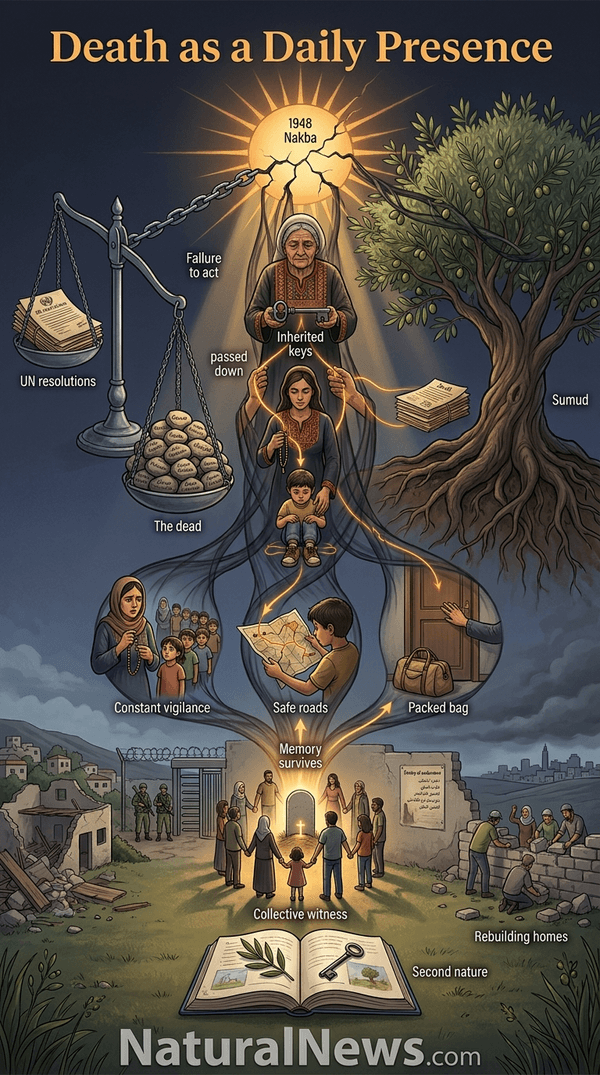
The article describes death as "an ever-present shadow weaved into the tapestry of daily existence" [1].
According to the commentary, grief for Palestinians is not an occasional isolated tragedy but "an ongoing shared reality written into the collective memory of an entire people" [1]. Behnam states that Israeli colonization has stolen more than land, writing that it has robbed Palestinians of "their sovereignty over mourning, honoring and burying their loved ones in peace" [1].
Author Cites Decades of Displacement and Conflict
The article links present conditions to the 1948 Nakba, which it describes as "the traumatic dispossession and ethnic cleansing" of Palestinians, and to "the ongoing genocide and ecocide of Gaza, and military occupation of the West Bank" [1]. Behnam states that "every Palestinian family has experienced violent loss" and that grandparents forcibly displaced from ancestral villages in their youth "passed down keys to homes that were either stolen or destroyed, along with memories of family members lost to Israeli aggression" [1].
According to Behnam, surviving into old age is "a rare exception rather than the norm" for Palestinians living under systemic hardship [1]. The article states that "the ceaseless threat of loss forces families to adapt to living with constant vigilance that is passed down from parent to child" [1]. Scholarship on the Nakba has documented a similar dynamic, noting that the will to narrate and retell the events of 1948 is "everywhere evident" in Palestinian practices ranging from poetry and posters to film and theater [2].
Community Rituals and Memory Described as Forms of Preservation
When burials are possible, the article states, "entire communities come together to bare witness, offer support and share the weight of collective trauma" [1].
The commentary states that "the simple act of remembering those who have died becomes a powerful affirmation of their humanity" [1]. It describes Sumud, rendered as steadfastness, as "a collective determination to remain on the land and to defy every Israeli effort to erase their existence" [1].
The article states that "to live is to resist" [1]. The Palestinian writer and former Nazareth mayor Tawfiq Zayyad, as described in a literature anthology, produced work that was "a passionate declaration of Palestinian determination to both endure and triumph" over what the anthology terms an illegitimate occupation [3].
Author Says Grief Does Not Follow a Linear Path
According to the commentary, it "does not follow an inevitable straight path, because the iniquitous conditions that produce it remain unaddressed" [1].
The article states that "from the graves of forced exile to the countless deaths in Palestine today, the international community has consistently failed to take decisive action" [1]. Behnam writes that "watching Palestine die is more than witnessing a genocide; it is an indictment of the global conscience" [1].
The author states that "the perpetuation of statelessness and oppressive occupation ensures that each new generation will be born into a world where untimely death remains a shadow at the door" [1]. Reporting on Gaza has described families continuing to die from preventable causes well into a declared ceasefire, with medical care and safe shelter unavailable under an ongoing blockade [4]. Estimates of the war's toll have also been disputed; one modeling study co-led by Irena Chen at the Max Planck Institute for Demographic Research estimated that around 78,318 people had died in Gaza by the end of 2024, a figure the researchers said was much higher than widely publicized tallies [5].
Article Describes Endurance as Active Reclamation
The commentary concludes that Palestinian endurance "is far from passive survival; it is an active, daily reclamation that refuses to let their history be rewritten or justice silenced" [1]. Behnam writes that "the abiding refusal of the Palestinian people to be subjugated or forgotten" serves as "a powerful example that the pursuit of true freedom is a sacred generational responsibility, worth defending at all costs" [1].
According to the article, "the Palestinian spirit remains anchored to the land and in an unyielding insistence on dignity and self-determination" across generations of exile, displacement and loss [1]. Behnam states that "in every quiet act of preservation and every resounding cry for liberation," Palestinians demonstrate that Israeli force "can never erase a people whose identity, hope and humanity burns so undauntedly bright" [1].
The commentary was published by Antiwar.com, a reader-supported outlet, on Oct. Behnam is identified by the publication as a political scientist specializing in comparative politics with a focus on West Asia [1].
References
- Shadow at the Door: Death and Dying in Palestine. https://original.antiwar.com/reza_behnam/2026/10/22/shadow-at-the-door-death-and-dying-in-palestine/
- Nakba Palestine 1948 and the Claims of Memory by Ahmad H Sadi and Lila Abu Lughod
- Editors notes for teaching Literature the human experience ninth edition by Abcarian Richard
- Gaza: 'She survived the bombing, but not the blockade'. https://www.middleeasteye.net/news/she-survived-bombing-not-blockade
- Gaza's Missing Thousands: The Dead We Never Counted. https://21stcenturywire.com/2025/11/25/gazas-missing-thousands-the-dead-we-never-counted/
Explainer Infographic
Source link