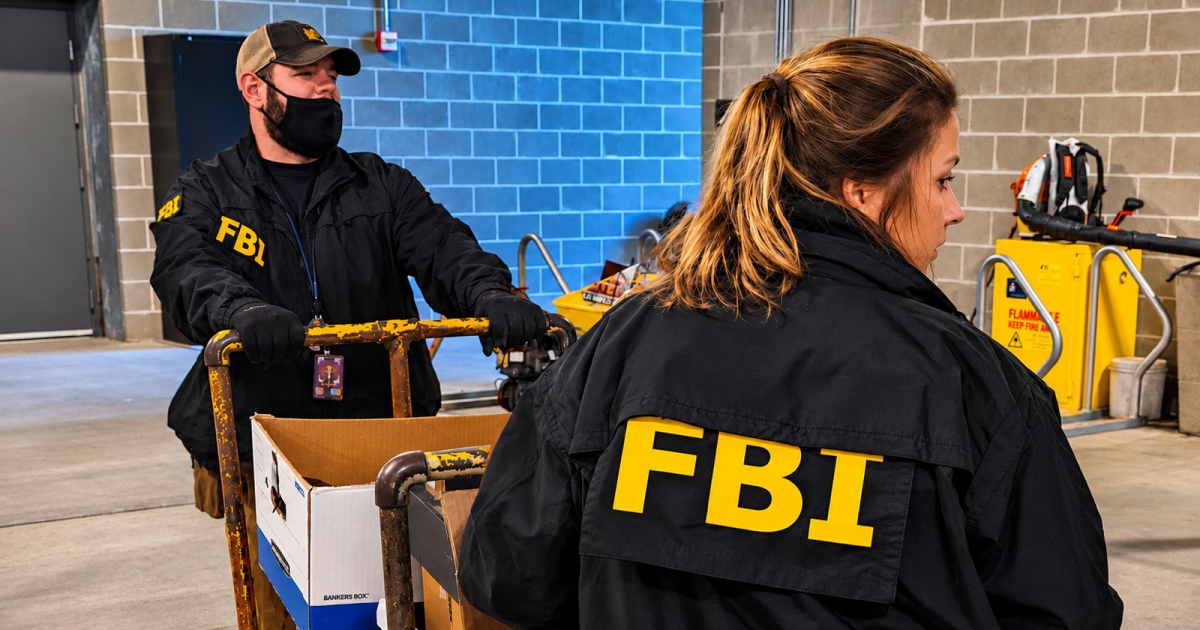
A former FBI agent is now facing federal charges after prosecutors say he drove the wrong way down a major Brooklyn road, blew through a red light, struck a pedestrian, and fled without reporting what happened.
And according to the indictment, the alleged misconduct did not end on Ocean Parkway.
The U.S. Attorney's Office for the Eastern District of New York announced that an indictment was unsealed Thursday charging 30-year-old Brooklyn resident Andrew Reyes, described by prosecutors as a former FBI special agent. The indictment includes a federal civil-rights count and a false-statements count.
The charges are allegations, not a conviction. Reyes is presumed innocent unless and until the government proves its case beyond a reasonable doubt.
Prosecutors say the incident happened on February 3 while Reyes was driving a government vehicle on Ocean Parkway, a heavily traveled Brooklyn thoroughfare.
The indictment alleges that Reyes activated the vehicle's emergency lights, drove against traffic, went through a red light, and struck a pedestrian hard enough to leave the victim seriously injured.
What prosecutors allege happened next is even more disturbing.
They say Reyes got out of the vehicle, moved the unconscious victim out of the roadway, placed the victim's bag beside him on a bench, and then left the scene without reporting the collision or rendering aid.
The Justice Department's Office of Inspector General joined the U.S. Attorney's Office in announcing the case.
(1/3) “As alleged, the defendant was driving his government vehicle the wrong way on a major Brooklyn thoroughfare, blew through a red light, struck a pedestrian, and then fled the scene without rendering aid to the severely injured victim...”
— US Attorney EDNY (@EDNYnews) November 5, 2026
The case also turns on the authority prosecutors say Reyes was exercising at the time.
One count accuses him of willfully depriving the victim of constitutional rights while acting under color of law. In plain English, the government is alleging that Reyes misused power connected to his official position and caused bodily injury in the process.
The federal civil-rights statute at issue makes it a crime for someone acting under color of law to willfully deprive a person of rights protected by the Constitution or federal law. The potential penalties increase when bodily injury results.
That is a much more serious theory than an ordinary traffic case. It places the alleged conduct inside the federal government's own duty to police abuses of official authority.
(2/3) “...or reporting the incident,” stated U.S. Attorney Nocella. “The defendant’s alleged conduct demonstrated a shocking disregard for human life and his sworn oath to uphold the law.”
— US Attorney EDNY (@EDNYnews) November 5, 2026
Then there is the alleged lie.
Prosecutors say investigators later asked Reyes whether he had ever struck a person with a vehicle and failed to report it. The indictment alleges that he falsely answered no.
The federal false-statements law generally prohibits knowingly and willfully making a materially false statement in a matter within federal jurisdiction. That charge does not depend on proving a broad conspiracy; the government must prove the specific statement, its falsity, the defendant's knowledge and intent, and its material importance to the federal matter.
Those elements will have to be tested in court, where the defense will have the opportunity to challenge the government's evidence and account of events.
The Associated Press reported that Reyes was arrested Thursday morning and was expected to be arraigned later in the day. Federal Public Defender Nora Hirozawa said he would plead not guilty.
The AP also reported that the pedestrian has not been publicly identified and that the victim's current condition was not known. Court papers describe Reyes as a former FBI special agent, while the Bureau had not immediately clarified his full employment history or current status.
That distinction matters. The public deserves precision about what is alleged, what has been charged, and what remains unproven.
(3/3) “The charges announced today send the clear message that no one is above the law and those who abuse their position of trust and deprive citizens of their constitutional rights will be prosecuted.” (announced with @JusticeOIG)
— US Attorney EDNY (@EDNYnews) November 5, 2026
U.S. Attorney Joseph Nocella framed the case as a test of whether the same law applies to those entrusted with enforcing it.
That is exactly the right standard.
A badge is not a shield from accountability. A government vehicle is not a license to endanger the public.
Official authority means very little if the people who wield it are not held to at least the same standard as everyone else.
Now the government must prove every allegation in court.
If it can, this case will stand as a blunt reminder that public trust is not preserved by protecting institutions from embarrassment. It is preserved by confronting alleged wrongdoing honestly—even when the accused once worked inside one of the nation's most powerful law-enforcement agencies.
Source link