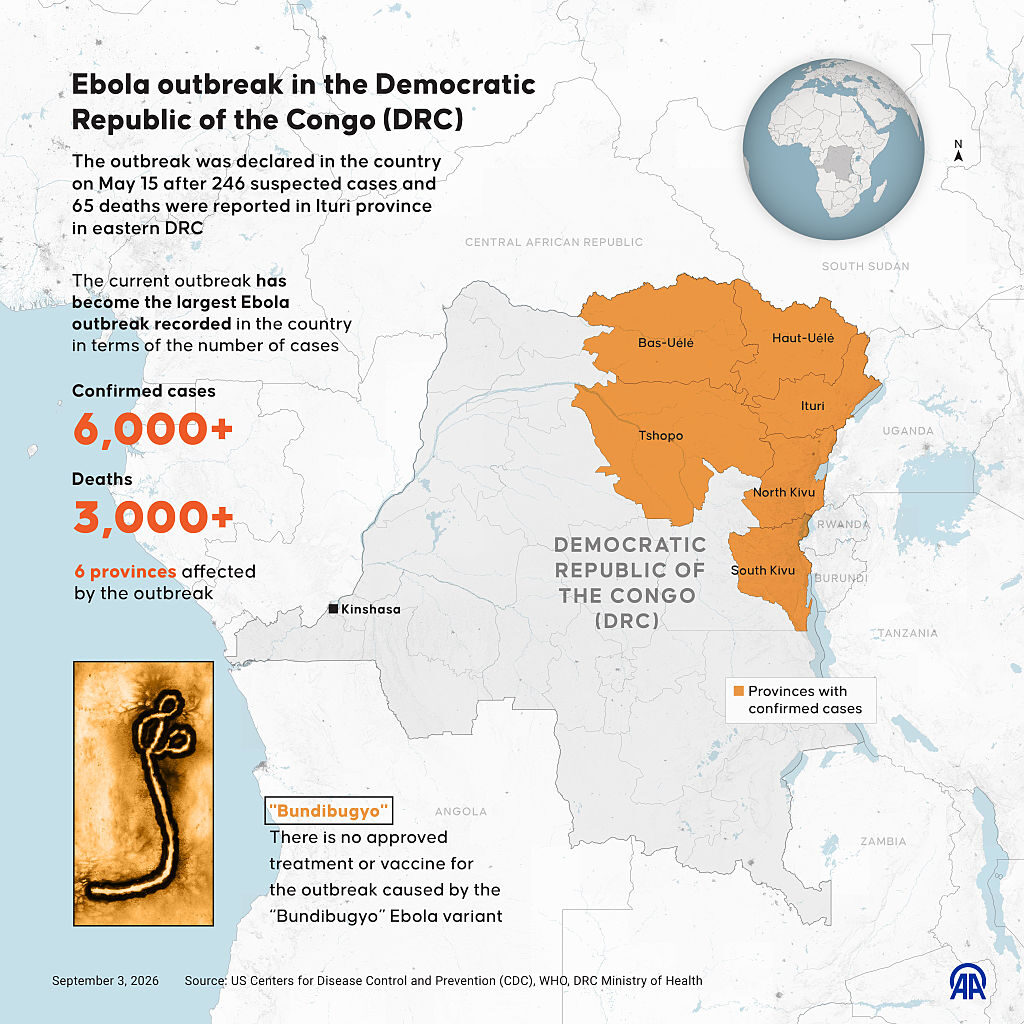
Public health officials in the Democratic Republic of the Congo (DRC) revealed this week the latest updated numbers on Ebola cases in the country have resulted in a death toll of over 50 percent.
Ebola is a hemorrhagic fever whose mortality rate is generally around 50 percent, but official statistics on the ongoing outbreak in the DRC had so far remained slightly below that threshold. Officials noted that the increase in the death rate was likely the result of improved data collecting and updated statistics, not necessarily an increase in the lethality of the virus.
The World Health Organization (W.H.O.) declared a public health emergency in eastern DRC in May after a surge in the number of cases of a strain of Ebola known as Bundibugyo, which is less common than the Zaire and Sudan strains behind previous outbreaks.
EVERYBODY PANIC! The head of the World Health Organization says the Ebola outbreak in Congo is spreading rapidly and poses a “very high” risk at the national level https://t.co/gluJ9YczVI
— Breitbart News (@BreitbartNews) May 23, 2026
No specific treatments, cures, or vaccines currently exist to target Bundibugyo. In recognizing the outbreak, W.H.O. Director-General Tedros Adhanom Ghebreysus admitted that the outbreak could have begun as early as in January, but response was hindered by the remoteness of the outbreak hotspots, and ongoing conflict featuring warring militias, and active, violent hostility among the local populace against humanitarian aid workers.
The latest statistics from the Africa Centers for Disease Control (Africa CDC) released on Monday have confirmed over 10,000 Ebola cases tied to the current outbreak in DRC. Of these, 5,376 of them have been fatal, the vast majority of them in DRC except for two cases in Kenya and two and Uganda. In addition to those three countries, Nigeria and France have confirmed Ebola Bundibugyo cases this year and, on Tuesday, the government of Israel announced it had isolated a patient with a fever potentially exposed to the disease.
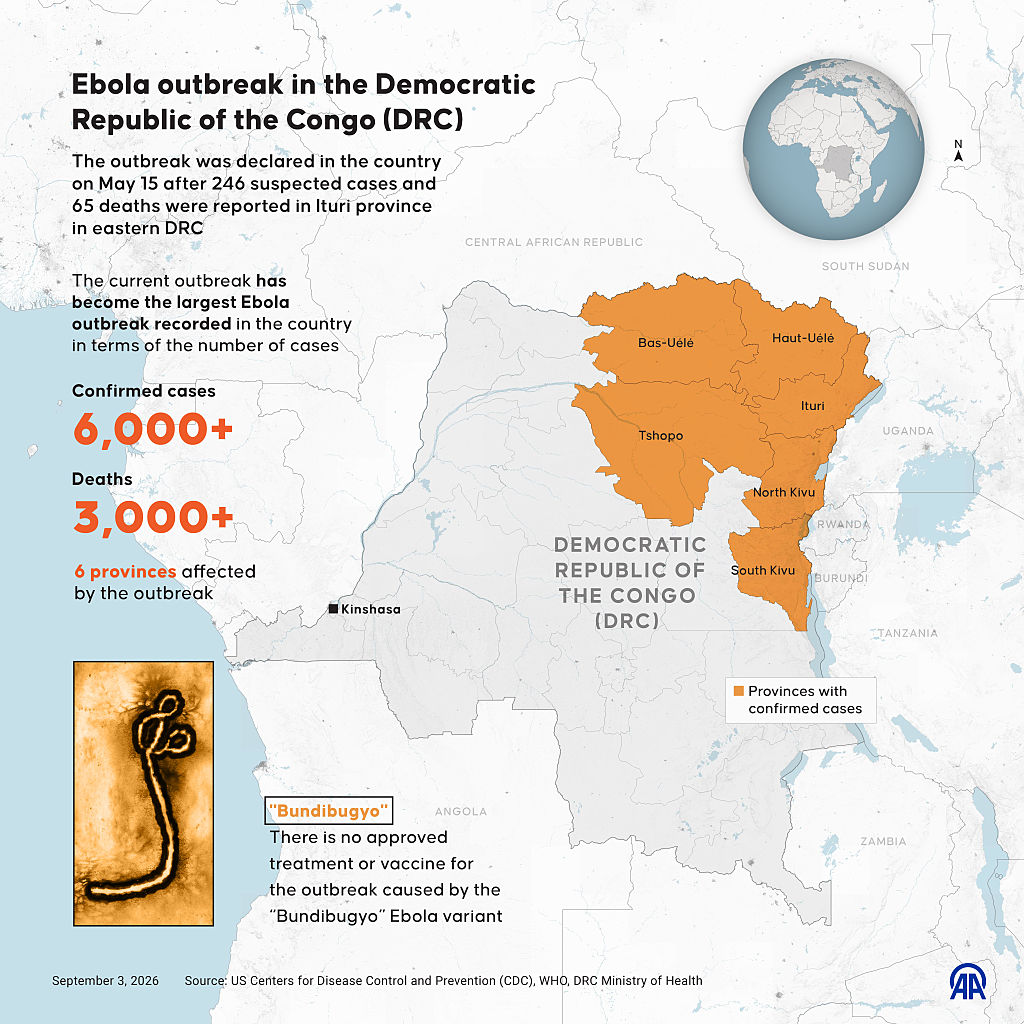
The outbreak of Ebola was declared in the country on May 15 after 246 suspected cases and 65 deaths were reported in Ituri province in eastern DRC. (Photo by Yasin Demirci/Anadolu via Getty Images)
The DRC Ministry of Public Health, Hygiene and Social Welfare confirmed on Monday that it had documented 10,414 cases of Ebola and, among them, 5,372 people dead, resulting in a 51.6-percent mortality rate. Officials attributed the change in the death rate to a "retrospective data adjustment," meaning improved updated data on already known cases, rather than a sudden increase in the severity of known Ebola infections or an acceleration of the spread of the disease.
These statistics are likely severely undercounting the true number of cases and fatalities in the DRC as reports from the most affected of the nation's provinces, Ituri and North Kivu, suggest minimal compliance by locals with health checks and quarantine measures. The Congolese outlet Radio Okapi reported on Monday, citing local health workers in Beni, North Kivu, that the Ebola treatment centers there had "exceeded capacity" and seen a significant increase in the number of child patients, which caused alarm as the health workers suggested the disease could be spreading freely in schools.
Ebola is not airborne and spreads only through contact with the bodily fluids of an affected person, but hygiene and general disease prevention strategies are not as regularly implemented in DRC as in the West, leaving the possibility for more rapid disease spread open.
Two community health workers trying to spread awareness of Ebola in the eastern Congo were attacked by a machete-wielding mob, further demonstrating the difficulty of controlling the deadly disease among hostile and suspicious rural residents. https://t.co/QdmJ0sc2hQ
— Breitbart News (@BreitbartNews) October 28, 2026
"We have far exceeded the capacity of our care infrastructure in Beni," doctor Jérémie Muhindo, who is overseeing Ebola response in Beni, told Radio Okapi. Muhindo raised the alarm that children may be increasingly exposed to Ebola in schools, urging families to practice hand washing and other proven disease prevention practices.
Radio Okapi lamented last week that, in the major cities of North Kivu, few appeared to be following disease prevention protocols.
"In the region of Beni, Butembo and Lubero, in North Kivu, certain preventive measures against Ebola are still poorly respected," the outlet observed. "Motorcycle taxi drivers continue to transport several passengers, while hand washing devices are absent at the entrance to certain businesses, schools and churches. Health sources also report a lack of protective equipment in several private health facilities."
Compounding the problem is the pervasiveness of violence against health workers in the DRC. Last week, an incident in the east of the country resulted in the deaths of a doctor and nurse after a machete-wielding mob attacked their health center, fueled by local rumors that the health workers themselves were the ones spreading Ebola. Similar mob attacks have resulted in the mass destruction of health facilities and the "escape" of Ebola patients stolen out of quarantine by families concerned that the health workers would kill them.
Follow Frances Martel on Facebook and Twitter.
Source link